

PROTECT YOURSELF with Orgo-Life® QUANTUM TECHNOLOGY
Orgo-Life the new way to the future Advertising by AdpathwayBefore arriving at the quanta to which this first lesson is devoted, allow me to begin with a simple observation. We humans inhabit the surface of the planet Earth, and this is a rather peculiar place: it has aspects that are not at all common in the universe. They are not unique—most likely there are plenty of planets similar to Earth—but most of the vast cosmos is very different from our narrow home. The peculiarities of the surface of our planet lead us to prejudices that make it difficult for us to understand that vaster world. Here are some of them.
Article continues after advertisement
The surface of the Earth is very small. So small indeed that it takes light a mere tenth of a second to travel around it: a mea-sure smaller than we are capable of perceiving with our senses. This is why we communicate in a way that seems instantaneous to us: we speak by telephone between Paris and Shanghai as if we were standing next to each other. We could not do this with a friend who lived in a different solar system. It takes years for a signal to travel back from even the nearest of stars. The smallness of the Earth gives us the impression that there is a shared common Time; that it always makes sense to ask what is happening somewhere else right now; that we could just make a call to find out. But it is not so in the larger, vast world. The idea of a shared, common time works well here, between ourselves, neighbors on the same planet. But it does not work in the rest of the universe.
A child born in a village naturally thinks that the whole world is like that village.
On Earth there are objects. A stone, a pen, a house—these are objects, things. Solid entities, well-defined, stable over time. This leads us to believe that nature is made up of such things. But we only need think of Jupiter or Saturn, or of our Sun, to become aware that not everywhere is like this. Jupiter and Saturn are worlds vaster than Earth. All sorts of phenomena occur there—but they are fluid. There, phenomena cannot be understood in terms of objects. There are no “things” on Saturn.
The surface of the Earth is surrounded by air. Air is a strange substance; we treat it as if it was not there. We say “this glass is empty,” when in fact it is full—of air. The evanescence of air leads us to imagine that there is something like empty space. But there is nothing in the universe that is completely empty.
One quarter of the surface of the Earth is very rigid. Earthquakes and bradyseisms are very rare; the continents move extremely slowly. This circumstance offers us a peculiar opportunity to locate ourselves: we give names to the regions of the Earth and we use them to say where things are—“I am in Princeton,” or “I am on Ponte Pietra in Verona.” If there was only sea, with water that never stands still, locating anything would be much more complicated—as mariners know full well. The existence of places fixed with respect to one another by the rigidity of the continents causes us to think about space in a way that simply does not work elsewhere. It allows us to say “I’m staying in the same place,” when what we actually mean is “I’m not moving in relation to the solid surface of the Earth.” On Jupiter the meaning of “staying in the same place” is unclear.
On Earth gravity is more or less the same everywhere. This is why the time between when we separate from someone and when we meet them again is the same for everyone. This is not the case in the wider universe. Time passes at different speeds for different travelers: when they meet again, they have generally not aged by the same number of years. The fact that here on Earth the same amount of time lapses for two people between a separation and reunion gives us a peculiar intuition about temporality—an intuition that does not work elsewhere.
A child born in a village naturally thinks that the whole world is like that village. He expects to encounter outside it the same mores, the same way of dressing, the same language. When he finds that the world is otherwise, he is amazed. This amazement is the beauty of learning. And this is science.
It is not always easy, however, to free ourselves from the ideas and outlook of our native village. Even learning that in Rome cats are called gatti, and in New Delhi billee, does not prevent us from having a hard time thinking that the proper, true name of the feline is not “cat.”
Reality is more complex and more varied than we think.
We instinctively mistake local peculiarities for universal truths. We do not easily realize that the things which seem obvious to us are just aspects of “the garden that makes us so ferocious,” as Dante calls the Earth when he views it, at the end of Paradiso, far below and tiny, from the heights of the heavens of fixed stars.
The peculiarity of the surface of the Earth, the village in which we happen to be born, generates prejudices in us that are not easy to recognize. If we do not want to be like the child that only knows its own village, we must learn to separate ourselves from these prejudices.
In the wider universe, there are no objects, empty space, ways of definitively locating events—and it is meaningless to say thatsomething “stays in the same place.” It means nothing to speak of a “now” in distant places; no common time exists . . . Reality is more complex and more varied than we think.
Allow me, before dealing with twentieth-century science, to dwell upon one more elementary fact.
Consider, if you will, dear reader, an object that is near to you. The chair on which you are sitting, for instance—or the sofa on which you are lying. Look at it carefully, and ask yourself whether it is still, or moving. If it is not still, ask yourself at what speed it is moving.
Our first intuitive response is that, if nobody moves it, then the chair is obviously still. Always given, of course, that you are not reading these lines on a train, or an airplane, in which case the seat on which you are sitting will be moving at the speed of the train or the plane, and could even be going at hundreds of meters per second.
Perhaps, though, it has already occurred to you that the Earth itself is moving, turning on its axis and orbiting around the Sun. We are all moving with it, at a considerable speed. Therefore, the chair is moving with the Earth, even if you are not on a train or an airplane.
But this is not all. Our galaxy is also turning, and the entire solar system with it. The chair moves, with the galaxy, at a tremendous speed. And the galaxy itself? Is it not moving at a certain speed in relation to something else? In relation to what?
Is it possible to stop this sequence of references with respect to which it is possible to say at what speed the chair is moving? Is there, in other words, an ultimate reference point, one that is really still, and that will finally allow us to determine what is the objective speed of the chair?
The answer to this question is well known to any good physics student. The answer is no. There is no ultimate reference point, nothing really still, and no meaning to an objective (in the sense of non-relative) notion of velocity. This aspect of nature was intuited by Galileo some four centuries ago, and clarified in depth by the subsequent history of mechanics. There is no ultimate, absolute reference point which would allow us to say that something is still and something is moving, except in relation to something else. It only makes sense to ask whether or not an object is stationary relative to something else. The question as to whether an object is moving or stationary in itself is meaningless.
We usually set a reference point implicitly, without saying so. The Earth, being solid, large, and accessible, offers a very conve-nient reference. When we say “still,” we commonly mean still with respect to the Earth’s surface. But not always. If on a train the man in the seat in front of us tells his son who is running around to “keep still,” he is not suggesting that the poor child should throw himself out of the window in order to be still with respect to the Earth. He means that the child should not move with respect to the train. When studying the movements of the planets, we take the Sun as a convenient reference point: as noticed by Copernicus, it is better than the Earth for this purpose. An absolute reference point, in our current understanding of the world, simply does not exist.
But I believe we do not reflect enough upon just how very radical a discovery it is—the fact that speed is a relative property.
But given that we are used to seeing the Earth as a point of reference, it seems natural to us to think that there still must be a final, true one, even if the Earth moves in relation to the Sun, and the galaxies move in relation to each other.
It comes instinctively to us to think that, ultimately, the fact that an object is moving or not is essentially meaningful, inde-pendently of where other objects are, or what they are doing. But we are wrong. It is like thinking that even though the word for cat is different in different languages, there must nevertheless be a true name for cat that can ultimately be referenced.
Forgive me, dear reader, if I seem to be laboring a point that is already clear to you. One that you studied at school, as part of elementary physics. But I believe we do not reflect enough upon just how very radical a discovery it is—the fact that speed is a relative property. It is not easy to digest an idea which, if we think about it properly, is astonishing.
A few years ago, while on a lecture tour, I made friends with a brilliant young man who was working in the Princeton philosophy department. Talking with him, I realized that he was fully aware of physics—but also that he did not really believe it. One day, while discussing this, he said to me: “But come on, Carlo. There must, in the end, be an absolute sense in which a thing is either moving or not.” While accepting the idea that it is not possible to measure whether an object is moving, he nevertheless insisted on thinking that whether something is moving or not moving must be a real fact, even if it cannot be measured. In other words, a young philosopher in the Department of Philosophy in one of the most prestigious universities in the world had failed to digest what Galileo had understood four centuries ago!
What led him to believe that there is something fundamentally real about absolute motion, even though it is not observable? The answer that he gave to this question is one of the reasons that I wrote this book: “Because,” he said to me, “it is the very nature of the whole concept of motion that a thing is either moving or still.” The world, to his way of thinking, must conform to our concepts.
Where does the error lie? There is no doubt that in the nature of his concept of movement everything is either moving or stationary. A philosopher capable of precise conceptual analysis sees clearly what a certain concept of movement implies.
The mistake lies elsewhere: in not understanding that this particular concept of movement is inadequate for describing the actual world. My friend, in other words, considered his intuition, based on the concept of motion, to be more reliable than the knowledge accumulated by humanity over the past four centuries.
His mistake was to not take into account the fact that his intuition, on which his concept of movement is based, is the result of experience that is limited, and that as such is adapted to describing a limited region of reality: the region that is familiar to us, slow-moving ants on the solid surface of our small planet.
What my friend failed to consider is that concepts are the products of experience, and that when that experience is limited, as ours inevitably is, concepts can prove inadequate to giving a proper account of the real world. What he failed to see is that in order to understand the world better it is necessary to allow our concepts to evolve, even if this seems at first to be counterintuitive.
I feel that there is a whole branch of contemporary philosophy that is trapped inside this mistake. The mistake is to believe that the concepts we have are necessarily adequate for understanding reality, even beyond the context in which these concepts were shaped.
The mistake is to remain attached to a conceptual framework, without realizing that it might no longer be working in the light of what we can see when we look a little further.
__________________________________
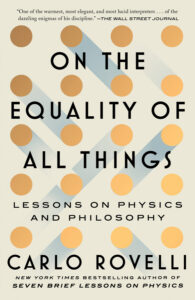
From On the Equality of All Things. Used with the permission of the publisher, Scribner. Copyright © 2026 by Carlo Rovelli




















 English (US) ·
  French (CA) ·
  French (FR) ·