

 2 months ago
30
2 months ago
30
PROTECT YOURSELF with Orgo-Life® QUANTUM TECHNOLOGY
Orgo-Life the new way to the future Advertising by AdpathwayIn Southeast Asia today, consumer choices are becoming increasingly linked to questions of identity, heritage, and even political expression. This connection, however, is not new. Its roots extend to the 1920s and 1930s, when colonial cities such as Surabaya, Penang, and Singapore saw the rapid growth of department stores, fairs, shopping arcades, advertisements, and branded goods. Colonial officials and European firms often presented these spaces as evidence of Western progress, yet they were never fully controlled by colonial designs: Southeast Asian consumers, traders, journalists, and organisers used the same spaces to negotiate identity, assert status, defend local enterprise, and criticise foreign economic dominance.
Historical narratives of anti-colonialism have often focused on parties, nationalist organisations, and formal political struggles. My doctoral research examines a more everyday arena: the participation of Southeast Asians in consumer culture. Some ordinary practices acquired political meaning: supporting local goods and participating in boycotts could become explicit forms of economic protest, while fashion, advertising, and the use of traditional motifs allowed consumers and businesses to negotiate colonial ideas of taste, status, and modernity.
Colonial consumer culture did not produce a single political outcome. It was designed to attach modernity to Western goods, spaces, and habits, but Southeast Asian consumers, traders, journalists, and organisers often redirected these meanings. Some did so through boycotts and local goods campaigns; others through fashion, advertising, craft promotion, or moral criticism. These practices did not always amount to formal anti-colonial resistance, but nonetheless reveal how everyday consumption became a field in which colonial authority, class aspiration, cultural identity, and political mobilisation met.
Colonial consumer culture and the projection of Western modernity
Colonial authorities and European firms recognised the value of consumer spaces in shaping aspiration. Department stores, fairs, advertisements, and shopping arcades presented Western products as signs of mobility, refinement, and progress. Shopping spaces and fairs created environments that promoted Western consumer habits and values while supporting the colonial “civilising mission” and embedding Western lifestyles in the daily lives of locals.
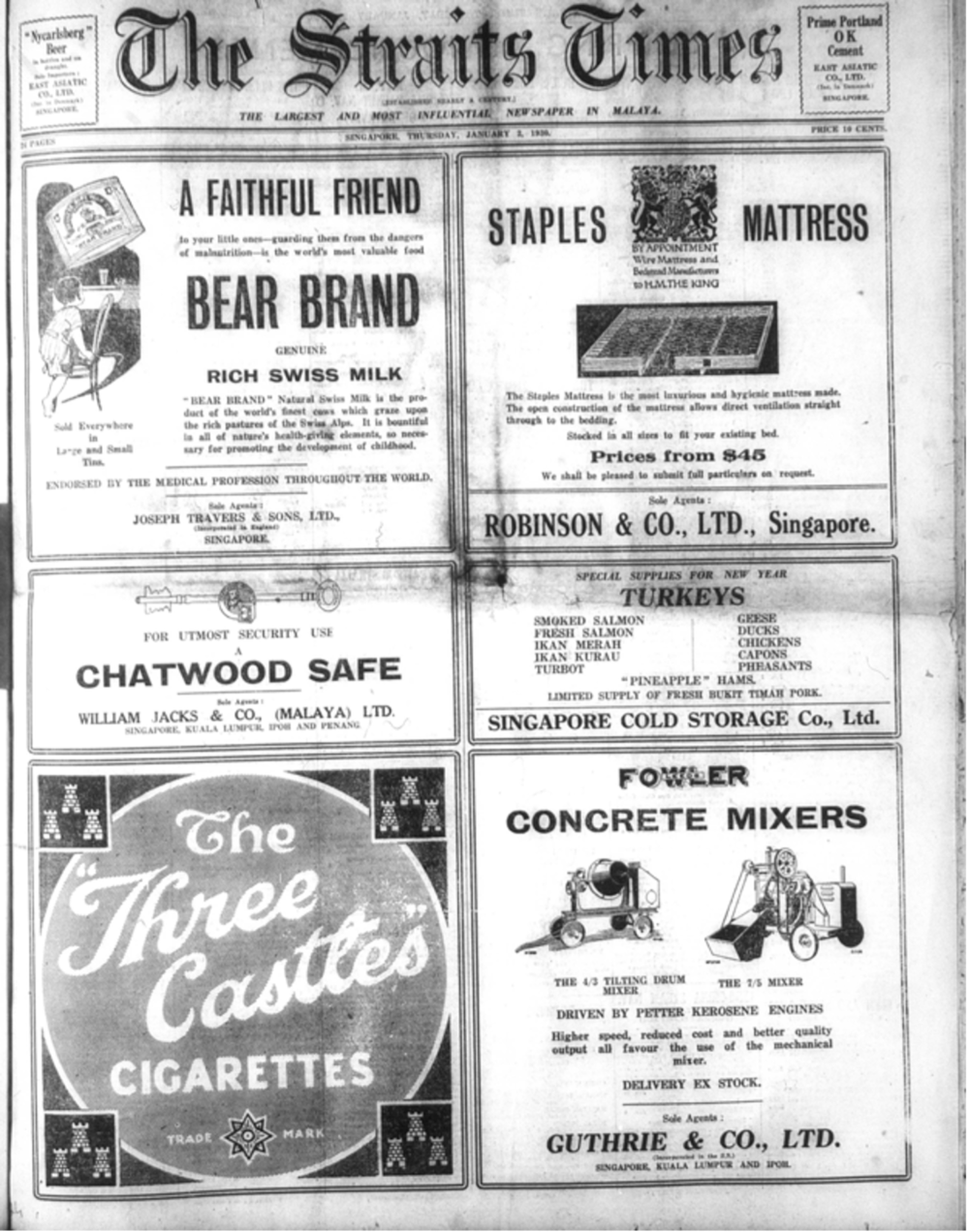
Figure 1. Advertising on the front page of The Straits Times, 2 January 1930 (Source: National Library of Singapore)

Figure 2. Listerine Toothpaste Advertisement, D’Orient, 23 October 1937 (Source: The National Library of the Republic of Indonesia)
Advertisements in major colonial newspapers further enhanced this dynamic. By the 1920s and 1930s, the pages of The Straits Times, Singapore’s leading English-language newspaper, and various Malay-language dailies teemed with promotions touting European cosmetics, toiletries, and household items as key to achieving a “modern” life (See Figure 1). This trend went beyond hygiene or convenience; it promised social elevation and refined living. Take for instance the 1937 Listerine Toothpaste ad in D’Orient (See Figure 2), which featured a European woman’s radiant smile and stressed the brand’s “quickly and safely” transformative power. Using scientific language also implied that Western medicine outperformed local methods, reinforcing the notion that true modernity was Western in origin.

Figure 3. Aerial view of John Little’s Department Store, at Raffles Place, formerly known as Raffles Square, Singapore, 1930s (Photo: National Archives of Singapore)
This emphasis on Western consumerism dovetailed with architectural projects designed to showcase “progress” (See Figure 3). These ads linked Western products to notions of success and social prestige, subtly encouraging locals to align themselves with colonial ideals. Such messaging framed Western products not just as desirable but as essential for achieving a modern identity, shaping aspirations and consumer choices within the colonial system.
Colonial spaces, too, were designed to reinforce this hierarchy visually. Department stores and arcades presented retail through European architectural forms, display windows, interior arrangements, and regimes of service. These features helped distinguish the modern commercial city from surrounding urban spaces and attached prestige to Western modes of consumption. They also reinforced the distinction between the “modern” West and “traditional” Southeast Asia.

Figure 4. The Surabaya Annual Market in 1926 (Photo: Reclame & Advertentie Bureau Java, 1926)

Figure 5. Automobiles at The Surabaya Annual Market in 1926 (Photo: Reclame & Advertentie Bureau Java)
This message was reinforced by fairs like the Soerabaiasche Jaarmarkt, an annual event organised by Dutch authorities to familiarise locals with “advancements in European civilisation”, as it was described in De Indische Courant, an influential Dutch-language colonial newspaper. The Courant framed the Jaarmarkt as an institution that legitimised the colonial project, promoting European industrial and technological superiority.
The event prioritised Western automobiles, luxury goods, and industry, shaping consumer aspirations (See Figure 5). While local craftsmanship featured in the kampoeng pertoekangan (craftsmen’s village), it was framed as traditional and secondary to European advancements. Entertainment, exhibitions, and structured competitions further linked Western consumption to social prestige. The establishment of the Vereeniging tot Bevordering van het Jaarmarktwezen (Association for the Promotion of Annual Markets) in 1927 underscored the fair’s strategic role in managing colonial commerce.

Figure 6. The Malaya-Borneo Exhibition carnival in Singapore, held from 31 March to 17 April 1922, featured commercial displays, cultural performances, and colonial pageantry (Photo: National Archives of Singapore)
Parallel attempts to champion local handicrafts occurred in British Malaya, though usually under more direct colonial oversight. Groups like the Malayan Arts and Crafts Society (MACS), often led by the wives of colonial officials, sought to preserve Malay craftsmanship while adapting it to European tastes, a process Hwei-Fen Cheah describes as commercialisation rather than pure cultural preservation. This approach often reduced Malay industries to curated displays of “native” artistry rather than recognising their full economic and cultural significance.
The 1922 Malaya-Borneo Exhibition in Singapore exemplified this approach, presenting economic recovery through the language of British governance and imperial commerce (See Figure 6). While promoted as a platform for showcasing regional potential, the fair placed European commercial firms at the centre of its vision of recovery and progress. Companies like Fraser and Neave, Robinson and Co., and Sime Darby received accolades, underscoring the prioritisation of imperial business interests.
Indigenous craftsmanship, though present, was framed through a colonial lens. The Arts and Crafts Section featured 20,000 artefacts, attracting buyers interested in batik, rattan crafts, and other traditional works. Dyak craftsmen constructed a longhouse, and performances of mak yong, wayang kulit, and other regional art forms highlighted Malaya’s cultural diversity. Yet, as with other colonial exhibitions, these displays catered to European expectations rather than treating indigenous producers as equal participants in the modern economy.
The fair, much like MACS-led initiatives, commodified indigenous artistry while ensuring that economic and commercial control remained in colonial hands. While it provided artisans a space to sell their work, it positioned traditional crafts as decorative rather than economically vital, reinforcing the perception that local industries were secondary to British enterprise.
By promoting Western goods and lifestyles as aspirational, these fairs encouraged Southeast Asians to see modernity as synonymous with European culture and attainable only under the guidance of colonial authorities. The consumption of Western goods was framed as a ticket to status and belonging, extending beyond economic transactions. Authorities strategically framed consumerism as a path to an “improved” identity, reinforcing the belief that colonial rule was the gateway to modernity. To further consolidate their economic control, colonial authorities imposed trade restrictions and offered European merchants preferential access to credit and resources, limiting opportunities for indigenous businesses.
Local resistance through boycott
Yet while consumer spaces were designed as sites of control, Southeast Asians transformed them into more contested grounds than the colonial regime had anticipated. My doctoral research into newspapers, advertisements, fair catalogues, and popular print culture shows that Southeast Asians did not passively absorbing the promoted values. They engaged with, reinterpreted, and at times resisted the narratives of modernity and progress promoted by colonial powers.
In 1930, Soeara Indonesia Moeda Soerabaia—a prominent youth publication based in Surabaya—published a compelling article urging Indonesian consumers to actively support local businesses over those financed by foreign capital. The author, writing under the initials T. T., appealed to the “power of the masses” as a counterbalance to the overwhelming influence of foreign trade. Calling for economic solidarity among Indonesians, T. T. explained how consumer choice could foster Indonesian self-sufficiency and national identity:
“We should not simply regard competition as a fair contest; there must also be cooperation to defend against the might of foreign commerce… As the majority, we have the strength to determine the future of Indonesian trade if we all support Indonesian businesses. Yet at the same time, we must beware of ‘so-called Indonesian’ enterprises funded by foreign capital.”
Boycotts of foreign goods emerged as a powerful form of economic resistance across Southeast Asia. In the mid-1920s, two Dutch-language newspapers in the Indies, De Indische Courant and De Locomotief, reported on boycotts targeting British and Japanese products in Surabaya. These actions often reflected a broader dissatisfaction with colonial policies and foreign monopolies. A 1928 article in De Locomotief titled “Boycott van Japansche goederen” (“Boycott of Japanese Goods”) describes how Chinese middlemen in Surabaya refused to sell Japanese groceries and textiles, disrupting contracts and the market. The Dutch colonial government responded with a heavy-handed crackdown, underscoring the high stakes of consumer-based resistance.
Related

Instagramming colonialism in Surabaya
On what’s lost when the Dutch East Indies is recalled as a time of picturesque sophistication
This resistance was not limited to Surabaya. In 1928, Straits Echo Weekly Edition, Penang’s largest English-language newspaper, ran a story headlined “Japanese boycott in Singapore”, reporting substantial losses for Japanese steamers due to a boycott movement in the city. These boycotts were not always anti-colonial in a narrow sense: some targeted Japanese goods, others criticised foreign capital more broadly. Yet they show how consumer markets became arenas in which Asian communities debated sovereignty, economic vulnerability, and collective discipline.
While British authorities sought to encourage the consumption of imported goods also in Penang, they faced a “buy local” campaign in 1928, which successfully promoted local products, galvanising support across Malay, Chinese, and Indian communities, and fostering a sense of unity among them. This unity, reinforced through shared economic practices, helped familiarise consumers with the idea that purchasing could carry collective and political consequences.
These cases also underscore the role of vernacular newspapers in shaping public opinion about foreign products, colonial modernity, and moral discipline. Soeara Indonesia Moeda Soerabaia was not alone. Sinar Hindia (30 November 1918) cautioned readers against uncritically adopting Western vices, referencing “mim pitu”, or the “seven M’s” a moral vocabulary used in Javanese reformist discourse and taken up by groups such as Boedi Oetomo and Sarekat Islam, who framed self-discipline as a way to reclaim autonomy and define modernity on local terms. Neratja (13 December 1920; 28 May 1921) argued that imitating the Dutch too closely risked eroding local cultural identity. Hindia Dipa (5 September 1921) similarly warned that indulging in Western habits threatened both societal and individual integrity.
Reimagining modernity on their own terms
Selectively embracing and adapting Western products allowed local populations to assert their identities while navigating the colonial landscape. This trend is evident in fashion and other areas of consumer culture, where the mixing of Western and local elements allowed Southeast Asians to negotiate a space between colonial modernity and local tradition. While colonial authorities promoted Western attire as markers of progress, many Southeast Asians responded by creating hybrid styles that blended Western and traditional elements.
For instance, the “Modern Girl” trend in Malaya fused European-inspired clothing with local jewellery and accessories. This blending of styles allowed women to navigate colonial expectations while maintaining connections to their cultural heritage. By reimagining modernity on their own terms, they complicated the colonial narrative that equated progress with abandoning tradition. These styles are best understood as signs of negotiation: women adopted elements of global fashion while retaining regional forms of dress, producing modern selves that did not fully conform to colonial expectations.

Figure 7. Two women in sarong kebayas, Penang, 1930s. One wears a headscarf, the other a wavy bob, reflecting the fusion of Western and regional fashion (Photo: National Library of Singapore)

Figure 8. Portrait of a woman in a floral cheongsam, 1930s. Popularised by Shanghai film stars, the cheongsam became a Modern Girl staple (Photo: National Library of Singapore)
Photographs from the 1930s capture this sartorial hybridity. In one image from Penang, two women wear sarong kebaya—one with a headscarf, the other with a wavy bob—reflecting the era’s embrace of both Western and regional fashion (See Figure 7). Another portrait showcases a woman in a floral cheongsam, her permed bob mirroring the styles popularised by Shanghai’s film stars (See Figure 8). Known as the Shanghai dress, the cheongsam was favoured by local Modern Girls seeking to express cosmopolitan modernity.

Figure 9. Bier Itam Tjap Ayam Advertisement (Source: Lucia Sumarijanto, “In Search of a Style, The Issue of Cultural Identity and Graphic Design in Indonesia,” Master’s dissertation, Pratt Institute School of Art and Design, 2003, 66–68)
Local businesses often adjusted the design and promotion of goods to align with cultural values, thereby producing items that merged modern aspirations with local identity. A clear example is the Bier Itam Tjap Ayam advertisement, which appears to address a lower-income or working consumer audience (See Figure 9). Instead of invoking European prestige or relying on established brand recognition, the ad depicts an Asian figure facing the rigours of Monday (Senen), suggesting that the beer provides a brief respite from daily labour. This contrasts with imported beer campaigns, which commonly employed Western imagery to signal social status. Such advertising demonstrates how local producers and marketers tailored messages to resonate with regional tastes, reflecting a colonial marketplace stratified by class, culture, and race.
A similar process appeared in the marketing strategies of Chinese-Indonesian businesses. A 1923 advertisement by Tjhiang Siong & Co. in Surabaya promoted European-made products while using local language and addressing readers of Sin Po, an influential Malay-language Chinese newspaper. The advertisement shows that local businesses did not simply reject imported goods. They also translated them into vernacular commercial settings, using language, readership, and placement to situate global products within local markets.
Resistance through consumption extended beyond individual actions to collective initiatives that reinforced community solidarity and cultural pride. Events, campaigns, and fairs promoting indigenous products provided spaces to express and celebrate cultural identity. Local artisans and small businesses found innovative ways to incorporate traditional motifs into contemporary designs, preserving cultural significance while appealing to modern tastes. These efforts were often supported by nationalist leaders who recognised the power of consumer culture to mobilise communities and foster a sense of unity among diverse ethnic groups.
Locally organised fairs like Surabaya’s Pasar Malam Nasional (National Night Market) redirected the format of the colonial fair towards nationalist and social aims. Organised by the Indonesian Study Club (which later evolved into Persatuan Bangsa Indonesia, or PBI), this annual fair advanced the Swadeshi-inspired goal of fostering local economic self-reliance. Amid the severe economic depression of 1932, the Pasar Malam Nasional remained a major attraction, drawing 96,619 visitors over 16 nights and earning 17,000 guilders from ticket sales. Beyond commerce, it served as a cultural hub, featuring Wayang, Ketoprak, and Gamelan performances, while 20 stalls offered locally produced crafts and batik. The Dieng cigarette company, a major local employer, donated 1,333 guilders from its earnings to assist unemployed Chinese communities in Surabaya.
The Study Club’s sponsorship revealed the link between labour rights, cultural revitalisation, and consumer activism. While colonial-era unions for government workers already existed, private-sector unions were tenuous. The Study Club’s involvement offered these unions organisational support, connecting “buy local” campaigns to the broader movement for social welfare and economic fairness. Although cost barriers may have limited access for the poorest groups, the Pasar Malam Nasional remains a vital example of how a concept from India (Swadeshi) could be reworked in Indonesia to align with local ambitions for cultural dignity and self-determination.
Legacies of colonial resistance in modern consumer cultures
In contemporary Southeast Asia, consumer choices are again frequently linked to heritage, ethical responsibility, and political expression, trends that gained momentum in the early 2000s alongside rising global awareness of environmental issues, fair trade, decolonisation, and cultural revival. Indonesia’s Batik Fridays, initiated around 2009 in part due to UNESCO’s recognition of batik as Intangible Cultural Heritage, exemplifies the renewed public use of dress as a marker of national culture. Malaysia’s promotion of songket weaving also links craft preservation to broader national identity. Government campaigns to promote locally made goods similarly draw on the language of national self-reliance. These examples should not be treated as simple continuities from the colonial period, but they show that consumption remains a visible arena for debating culture, economy, and belonging.
Across Southeast Asia, companies sell everything from ethically sourced local coffee to “zero-waste” fashion to consumers who increasingly view everyday purchases as ethical actions, recalling earlier movements that treated consumer choices as political statements. Branding strategies build on the legacy of anti-colonial consumption by using local languages, cultural references, and traditional motifs to appeal to consumers’ sense of heritage.
Unlike colonial ads that promoted Western goods, contemporary Southeast Asian brands emphasise cultural significance, regional identity, and support for the local economy. While modern motivations address contemporary challenges such as climate change and economic inequality, the underlying principle remains: consumption serves as a vehicle for activism, reflecting the colonial-era legacy of linking commerce, culture, and collective identity.
Related
Instagramming colonialism in Surabaya
On what’s lost when the Dutch East Indies is recalled as a time of picturesque sophistication
The class dimension matters here. Politically conscious consumption in the colonial period was often articulated by urban, literate, and relatively mobile groups: newspaper editors, students, clerks, teachers, small traders, women consumers, and nationalist organisers. These groups had access to print culture, fairs, branded goods, and the language of self-improvement. Yet consumer politics cannot be reduced to elite behaviour. Boycotts depended on wider participation; night markets drew large mixed crowds; cheap commodities, cigarettes, textiles, food, and popular entertainments connected political ideas to everyday habits.
The archive, however, is uneven. It preserves the voices of journalists, advertisers, officials, and organisers more clearly than those of poorer consumers. For that reason, it is safer to see anti-colonial consumerism as a mediated political practice: often framed by the urban middle classes, but capable of reaching broader publics through markets, newspapers, performances, and campaigns for local goods.
The politics of everyday consumption
The history of consumer culture in colonial Southeast Asia does not show that buying was always liberating, or that markets naturally produced political agency. It shows something more specific: colonial commerce tried to make Western goods, spaces, and habits appear synonymous with modern life. Southeast Asians entered those spaces under unequal conditions, but they did not leave their meanings untouched. Through boycotts, local goods campaigns, vernacular advertising, sartorial experimentation, and nationalist fairs, they turned consumption into one arena for debating dignity, autonomy, class, and belonging.
That history matters because consumer politics remains uneven today. Ethical shopping, local branding, and boycotts can give political form to everyday choices, but they are shaped by income, access, and visibility. One must be able to choose between brands before one can boycott them. Recent boycotts of global brands associated by Southeast Asian consumers with the Gaza war show that consumer choice remains a visible language of political protest, although access to such protest is still shaped by class, location, and purchasing power.
The colonial archive therefore offers no simple celebration of consumer power. Its contemporary resonances suggest a sharper lesson: markets are places where people learn, perform, contest, and sometimes refuse the terms on which modern life is offered to them.















 English (US) ·
  French (CA) ·
  French (FR) ·