

PROTECT YOURSELF with Orgo-Life® QUANTUM TECHNOLOGY
Orgo-Life the new way to the future Advertising by Adpathway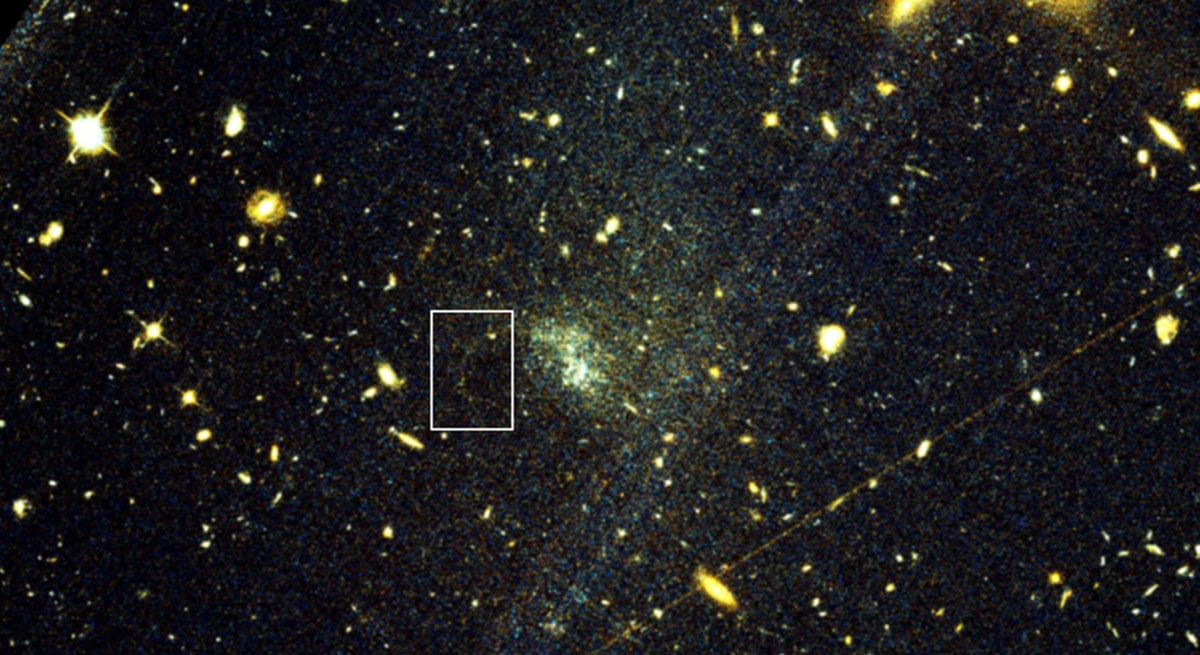 Hubble Space Telescope image showing the globular cluster stellar stream. Credit: Hubble Space Telescope and Holm et al. (2026)
The first globular cluster stellar stream found beyond the Milky Way shows that these faint structures can be used to study dark matter in other galaxies.
A faint ribbon of stars stretching across a galaxy can preserve a record of how that system has evolved. Known as globular cluster stellar streams, these long, coherent structures can also help astronomers investigate dark matter, the invisible material that accounts for most of the mass in the Universe.
Until recently, their extreme faintness made such streams difficult to detect. Improvements in large astronomical datasets and analysis methods have now turned them into increasingly useful tools for tracing dark matter and studying how galaxies change over time.
PhD student Julie Kiel Holm of the Niels Bohr Institute, Associate Professor Sarah Pearson of DTU Space, and an international group of researchers have now detected one in a place astronomers had never seen before. Their findings were published in Nature.
“We have discovered a globular cluster stellar stream in another galaxy. This is the first time such a stream has been observed outside our own galaxy, the Milky Way, which makes the discovery particularly exciting,” says Julie Kiel Holm.
A stellar stream appears beyond the Milky Way
Finding a globular cluster stellar stream outside the Milky Way is especially difficult because these structures produce so little light. In this case, the researchers identified the stream inside an ultra-diffuse galaxy, itself an unusually faint type of galaxy.
That combination makes the detection particularly unusual and extends the search for these structures beyond our own galaxy.
 PhD student Julie Kiel Holm (left) and Associate Professor Sarah Pearson (right). Credit: University of Copenhagen
“This opens entirely new possibilities. Not only can we now search for globular cluster stellar streams in other galaxies, but in the long term, we may also be able to measure the dark matter content of more ultra-diffuse galaxies,” says co-author Sarah Pearson, who contributed to the discovery during her employment at the Niels Bohr Institute.
Stellar streams can map distant dark matter
The result goes beyond simply detecting the stream. For the first time, the researchers show that globular cluster stellar streams can be used to measure dark matter in galaxies outside the Milky Way, where determining how that unseen mass is distributed has traditionally been difficult.
“We show that a well-established tool from studies of the Milky Way can be used to understand other galaxies, where measuring the distribution of dark matter has traditionally been very challenging,” says Julie Kiel Holm.
UGC9050-Dw1 appears rich in dark matter
The researchers focused on the ultra-diffuse galaxy UGC9050-Dw1 and used the stream to estimate both how its mass is distributed and how much mass the galaxy contains. Their analysis indicates that UGC9050-Dw1 contains substantial amounts of dark matter, consistent with expectations for ultra-diffuse galaxies.
“Our results are consistent with previous studies and what they have shown about dark matter in this ultra-diffuse galaxy. We are measuring it with a completely new tool, demonstrating that this method also works beyond our own galaxy,” says Julie Kiel Holm.
Future telescopes could expand the search
Although the analysis centers on a single galaxy, the method could eventually allow astronomers to compare dark matter across many different kinds of galaxies. Until now, insights from globular cluster stellar streams have been confined to the Milky Way.
“The insights into dark matter that we have previously been able to gain from globular cluster stellar streams have been limited to a single galaxy – our own. Being able to observe these streams in entirely different kinds of galaxies opens the door to using them to build a much broader understanding of how dark matter behaves,” says Julie Kiel Holm.
With facilities including the Euclid Space Telescope and the Nancy Grace Roman Space Telescope, the researchers expect astronomers to detect many more globular cluster stellar streams in the years ahead.
Reference: “Evidence for the first globular cluster stellar stream beyond the Milky Way” by Julie Kiel Holm, Sarah Pearson, Jacob Nibauer, David J. Sand, Adrian M. Price-Whelan, Tjitske Starkenburg, David Hendel and Catherine Fielder, 12 August 2026, Nature.
DOI: 10.1038/s41586-026-10878-w
The study is funded by the Villum Foundation and the European Research Council.
Never miss a breakthrough: Join the SciTechDaily newsletter.
Follow us on Google and Google News.












 English (US) ·
  French (CA) ·
  French (FR) ·