

 2 hours ago
9
PROTECT YOURSELF with Orgo-Life® QUANTUM TECHNOLOGY
Orgo-Life the new way to the future Advertising by AdpathwayFinnish Startup Networks for Education and Software can help founders find useful peers, test a learning-product idea, understand a new market or prepare for investor conversations.
You can open Table of Contents show
The right choice depends on the next decision your company needs to make. An education research partnership, a software industry association and a startup conference offer different kinds of access—and joining one does not automatically provide the benefits of the others.
Which Finnish Network Should You Approach First?
For an early EdTech product, investigate Helsinki Education Hub. For an established Finnish education business pursuing exports, examine Education Finland. Software Finland and its SaaS Finland community are more relevant to recurring-revenue operations. Maria 01, the Finnish Startup Community, Aaltoes and Tribe Tampere provide different routes into founder relationships, while Slush is an event-based option for concentrated meetings.
A useful starting combination is one specialist network and one community you can participate in regularly. That creates room for both focused advice and relationships that develop beyond a single introduction. It also keeps networking from consuming the time needed to build and sell the product.
How We Selected These 8 Networks
We reviewed the official organizer, university and public-agency pages on November 15, 2026. Each entry has an identifiable Finnish connection, a defined community or program, and a plausible use for education or software founders. The list includes membership organizations, campus communities, a selective education program and an event ecosystem. It is organized by practical fit, not ranked by size or claimed success.
This is a research-led comparison, not a review based on attending events or holding memberships. We distinguish published services from our assessment of how a founder might use them. Admission, fees, event availability and program continuity require current confirmation. In particular, Helsinki Education Hub’s published operating period runs through the end of 2026; this article does not assume a 2027 intake.
Screenshots were captured from the organizations’ official public pages on November 15, 2026. They show the pages visible during browser navigation, not membership experience or independent validation of the organizations’ claims.
Finnish Startup Networks for Education and Software: Quick Comparison
| Helsinki Education Hub | Research-informed EdTech development | Selective incubation: confirm future intakes and continuation. |
| Education Finland | Education exports and international partnerships | Eligibility-based membership; established export experience matters |
| Software Finland / SaaS Finland | Software business and SaaS operating peers | Association and activity-specific access; check language and fees |
| Maria 01 | A Helsinki base among startups and ecosystem partners | Membership, workspace and programs have different terms |
| Finnish Startup Community | Recurring peer groups and ecosystem advocacy | Membership fees depend on company stage and size |
| Aaltoes | Student-led projects and builder relationships | Events and project involvement; not automatic accelerator admission |
| Tribe Tampere | Entering Tampere’s startup community | Free Fellowship application and onboarding; the workspace is separate |
| Slush | Focused founder and investor conversations | Event access; separate registration or selection for some activities |
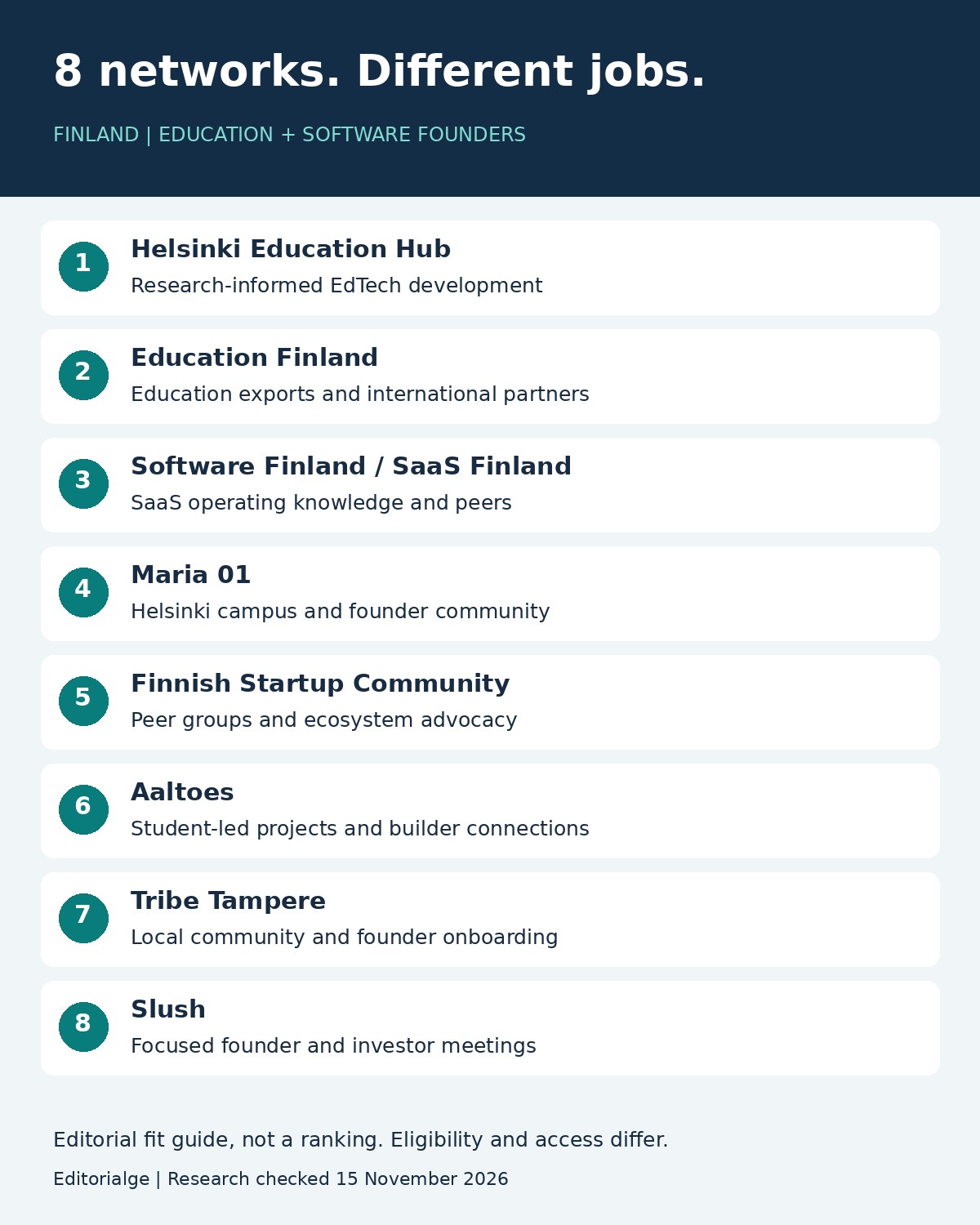 Choose by the problem you need to solve; these editorial fit descriptions are not rankings.
8 networks to consider for your next founder milestone
1. Helsinki Education Hub
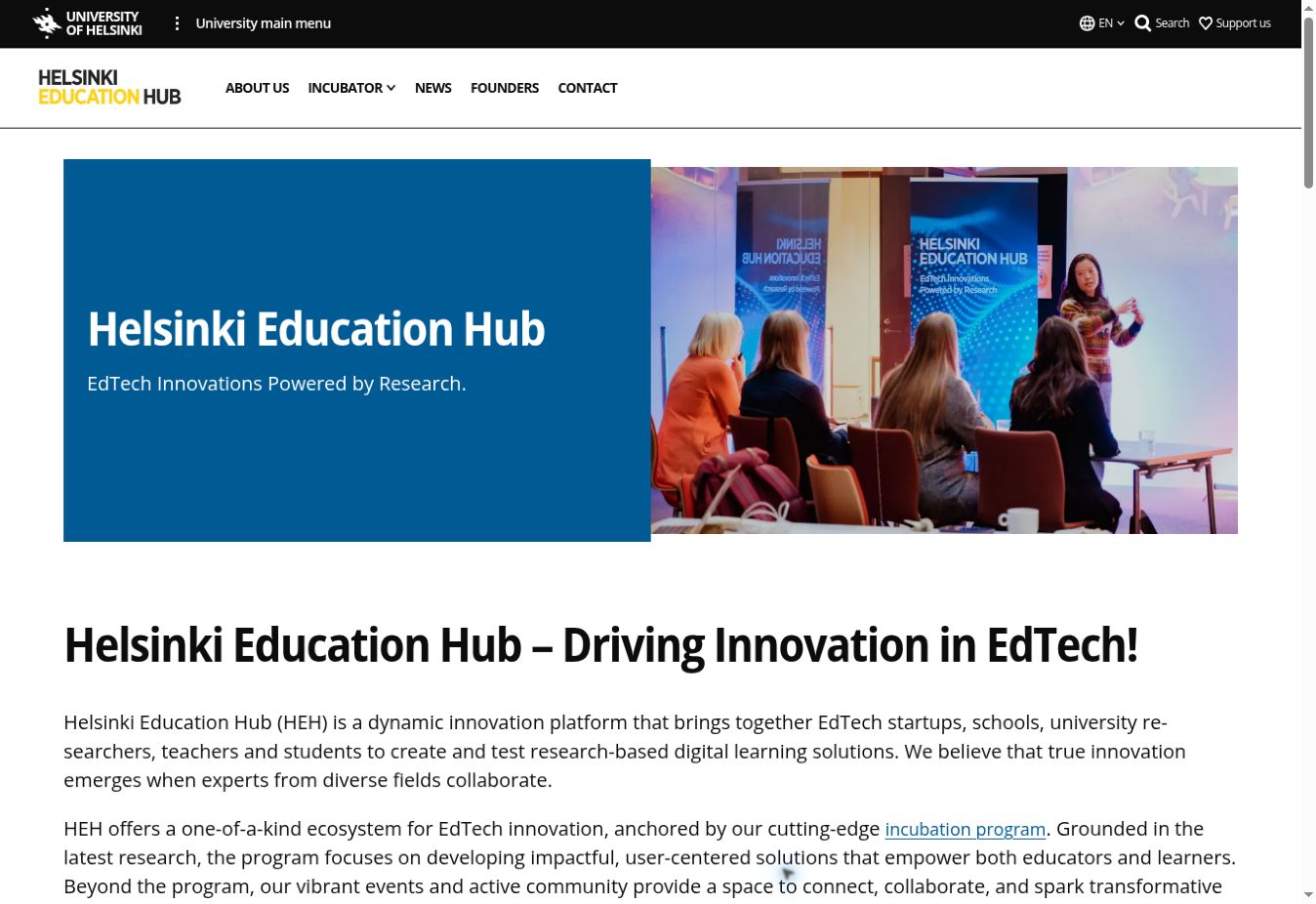 Helsinki Education Hub’s university-hosted homepage introduces its research-based EdTech focus and connections among startups, schools and researchers.
Helsinki Education Hub is the most directly relevant starting point here for a founder still working out whether a digital learning product solves an educational problem. The University of Helsinki describes a platform connecting startups with researchers, schools, educators and students. Its incubator combines product development with business preparation rather than treating educational value as a claim to add to a pitch deck later.
The published program lasts three months and is offered twice a year. It targets early-stage EdTech startups and university-based teams, with work on customer discovery, an initial product, pedagogical development and testing. The practical attraction is access to people who can challenge both the product’s usability and the reasoning behind its learning claims.
For example, a reading-app team could arrive with a specific question about teacher workflow and the evidence needed to assess its intended learning benefit. That is a proposed use, not a result we observed. The university’s incubator description explains the development pathway.
Timing is the material limit. The published autumn 2026 deadline has passed, and the hub’s stated operating period ends in 2026. Ask about confirmed continuation before planning around a future cohort. Participation is not a promise of a school contract or proof that a product improves learning.
2. Education Finland
 Education Finland’s homepage presents its education-export role and routes to explore member organizations and international collaboration.
Education Finland serves a later commercial stage. This government-supported cluster, coordinated by the Finnish National Agency for Education, connects Finnish education providers with international partners. Its remit includes learning software, educational content, training and broader education services. A founder with a market-ready offer may find its export orientation more useful than another general startup introduction.
The program describes international events, expert networks, business delegations and market intelligence. These can support a company exploring where its solution fits, who might deliver it locally and whether another Finnish provider offers a complementary service. An education software business selling internationally may need those relationships as much as it needs investment.
Membership has substantial entry conditions. Published requirements include a significant Finnish ownership connection, a principal place of business and taxation in Finland, at least two employees, relevant education-export experience and international references. The experience condition includes a route based on owners’ comparable work elsewhere. Finnish- and English-language websites and an annual membership fee are also part of the criteria.
Read the agency’s full membership requirements before applying. This is a conditional option for export-ready founders, not an open-access pre-incubator for a solo founder with an untested idea. Membership should not be presented as a government guarantee of product quality or sales.
3. Software Finland and SaaS Finland
 SaaS Finland’s Finnish-language landing page identifies it as part of Software Finland and provides navigation to events, learning videos and resources.
Software Finland is worth investigating when the difficult questions concern the software business itself: pricing, sales, international growth and the practical work of running a company. Its SaaS Finland community explicitly brings founders, entrepreneurs, investors and other growth contributors together around those subjects.
For an education software founder, this supplies a useful second perspective. Education specialists may understand teaching and procurement, while SaaS peers can help examine packaging, subscriptions and the economics of serving customers. Neither perspective replaces the other. A product can be educationally relevant and still have a pricing model that fails to cover onboarding and support.
The published SaaS offering includes recurring community gatherings and learning resources such as the SaaS Academy. The association also provides a membership route. Treat those as distinct access questions: a publicly visible resource does not establish that every course, event or member benefit is included for every participant.
Bring a concrete operating problem to the first conversation—for example, how to compare a school-wide license with a per-user subscription without confusing the customer. Check the activity’s language, membership conditions and applicable fees. A Finnish-language program page should not be read as a promise that every session will be delivered in English. This is an operating-peer network, not a specialist classroom-testing service.
4. Maria 01
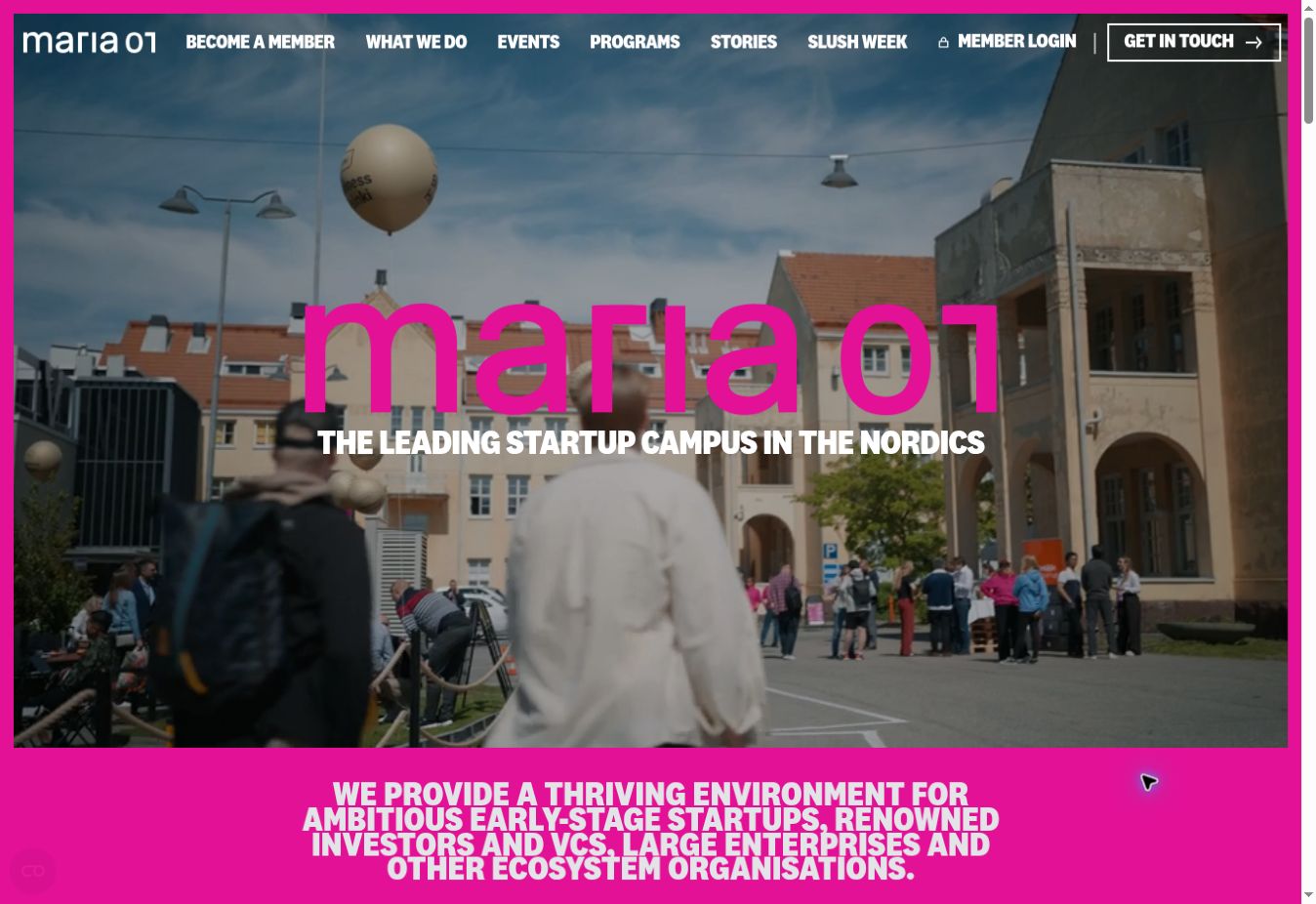 Maria 01’s homepage presents the Helsinki startup campus and separate navigation for membership, events and programs; these routes have different participation terms.
Maria 01 combines a physical Helsinki startup campus with a broader community of early-stage companies, investors, corporate partners and ecosystem organizations. Its value is partly the possibility of repeated contact: meeting the same people often enough to move from introductions to useful conversations about a product, hire or customer problem.
That makes it relevant to founders who want a working base and a community around it. A software team new to Helsinki could start with an event or a campus visit, then decide whether regular participation would justify a membership or workspace commitment. The campus’s public offering includes community activities, workspace and startup programs; these are not interchangeable products.
Maria 01 also describes a Launchpad route offering selected early-stage companies free workspace for up to three months. That limited program should not be confused with free permanent campus membership. Its application page begins with a conversation about the startup and explicitly says Maria 01 cannot support startup visa applications.
Before committing, identify which problem proximity will solve. If most work is remote and the team cannot attend regularly, an event-based or specialist association route may fit better. Ask which activities are available under the proposed arrangement and how workspace and program charges are separated. A campus address by itself does not create customer access or investor interest.
5. Finnish Startup Community
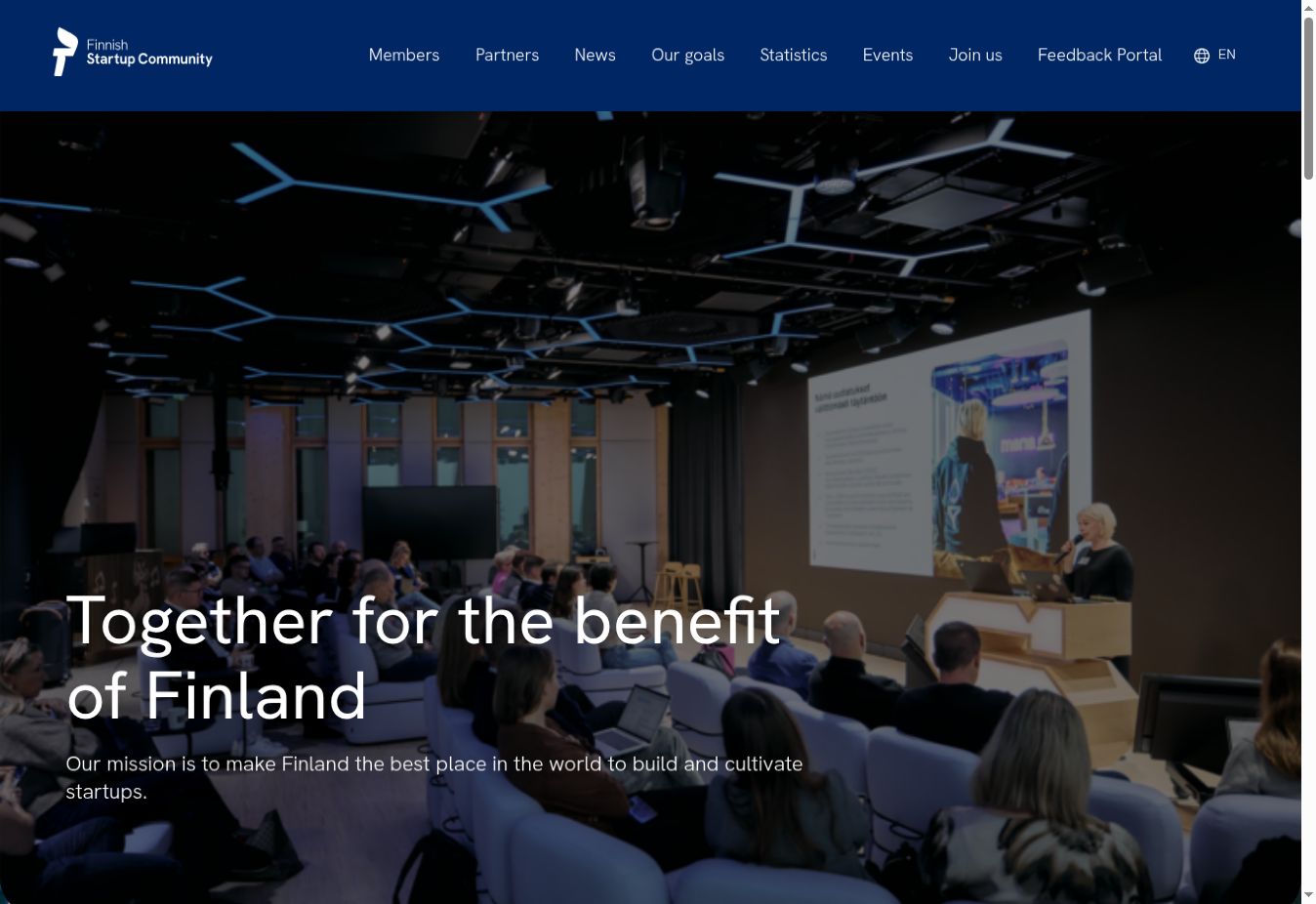 The Finnish Startup Community’s homepage offers routes to members, events and joining the community, alongside its mission to support Finland’s startup ecosystem.
The Finnish Startup Community offers a cross-sector membership route for internationally minded startups, growth companies and investors. Its published activities include weekly community events, smaller peer groups, knowledge sharing, research and policy advocacy. This is a useful distinction from an organization built around a single annual event.
For founders, the appeal is continuity. A recurring group can be a place to compare decisions with people who understand similar hiring, growth or management pressures. For a larger startup team, role-specific peer relationships may be more useful than sending only the founder to broad networking evenings.
Membership fees depend on the company’s stage and size. Obtain the applicable fee and the relevant participation opportunities before comparing it with a coworking plan or conference ticket. Advocacy and ecosystem research are part of the organization’s purpose; membership is not simply a purchase of private introductions.
Education founders should also note that Edtech Finland’s current public website redirects to a dedicated page within the Finnish Startup Community. We have therefore not counted it as an additional independent network in this list. Ask how that education-focused community relates to the main membership. A sector label alone does not establish a separate incubator, a school pilot service or another set of included benefits.
6. Aaltoes
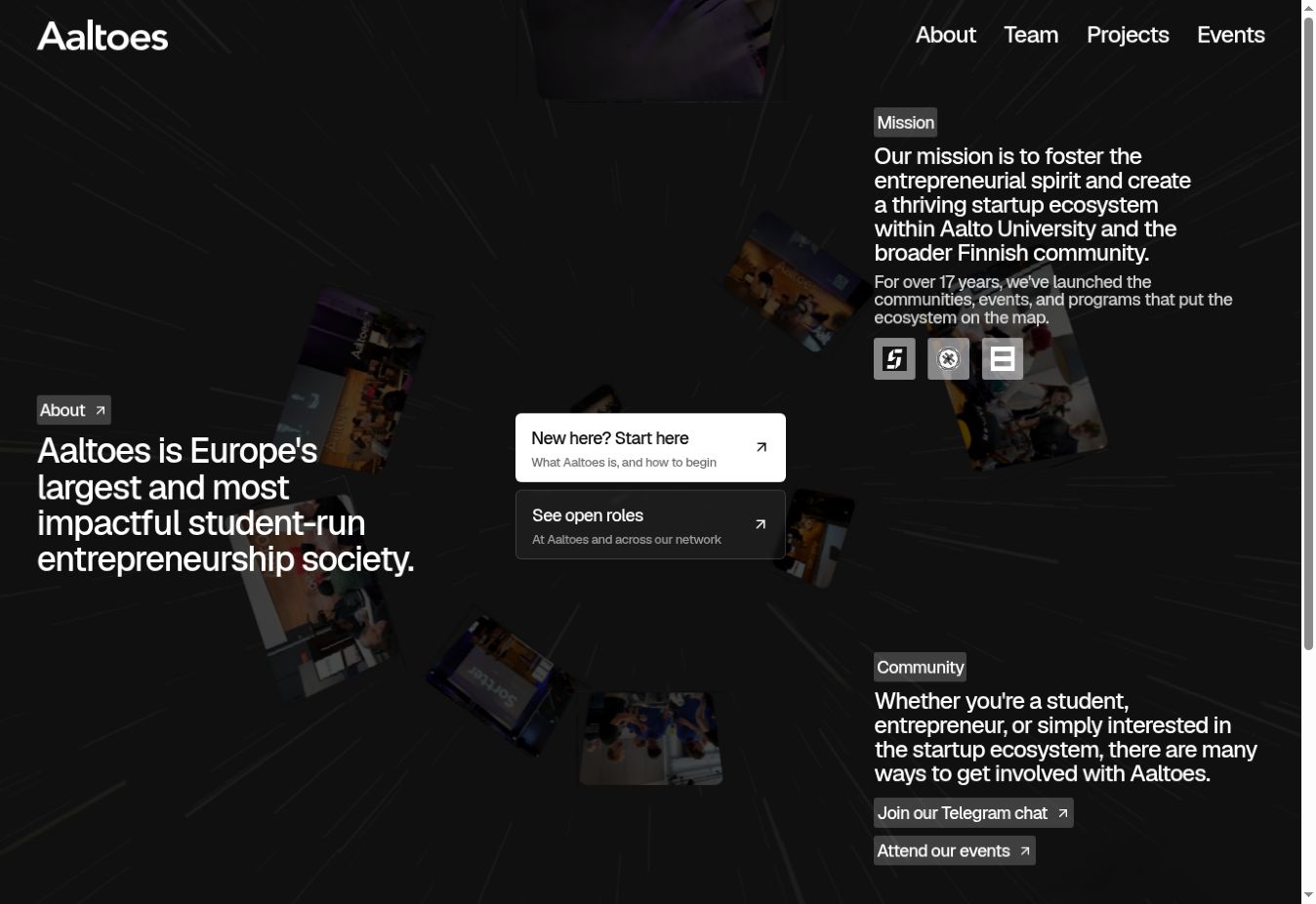 Aaltoes’ homepage gives newcomers a starting point and routes to projects, events and community participation in its student-run entrepreneurship society.
Aalto Entrepreneurship Society, usually called Aaltoes, is a student-run community based in Espoo’s Otaniemi ecosystem. Its public invitation extends beyond students to entrepreneurs and people interested in startups. Events, projects and community participation offer several ways to get involved without beginning with a conventional office membership.
For a founder at the idea or prototype stage, this can be a practical environment for finding people who enjoy building. An education founder might need a technical collaborator; a developer might need a teammate who understands learning design or customer research. Working together on a bounded project can reveal more about that fit than exchanging job titles at a large event.
The important boundary is organizational. Aaltoes, nearby startup spaces and programs with their own identities should not be treated as one application or one guaranteed service. Participation in a community event does not automatically mean admission to an accelerator, access to university research or a formal cofounder-matching commitment.
Start with the current event calendar or an open project role. Explain what you are building and what contribution you can make. A student-led environment may suit an exploratory team better than a mature company seeking a structured export service. Check the particular event or project requirements instead of assuming every activity has identical access rules.
7. Tribe Tampere
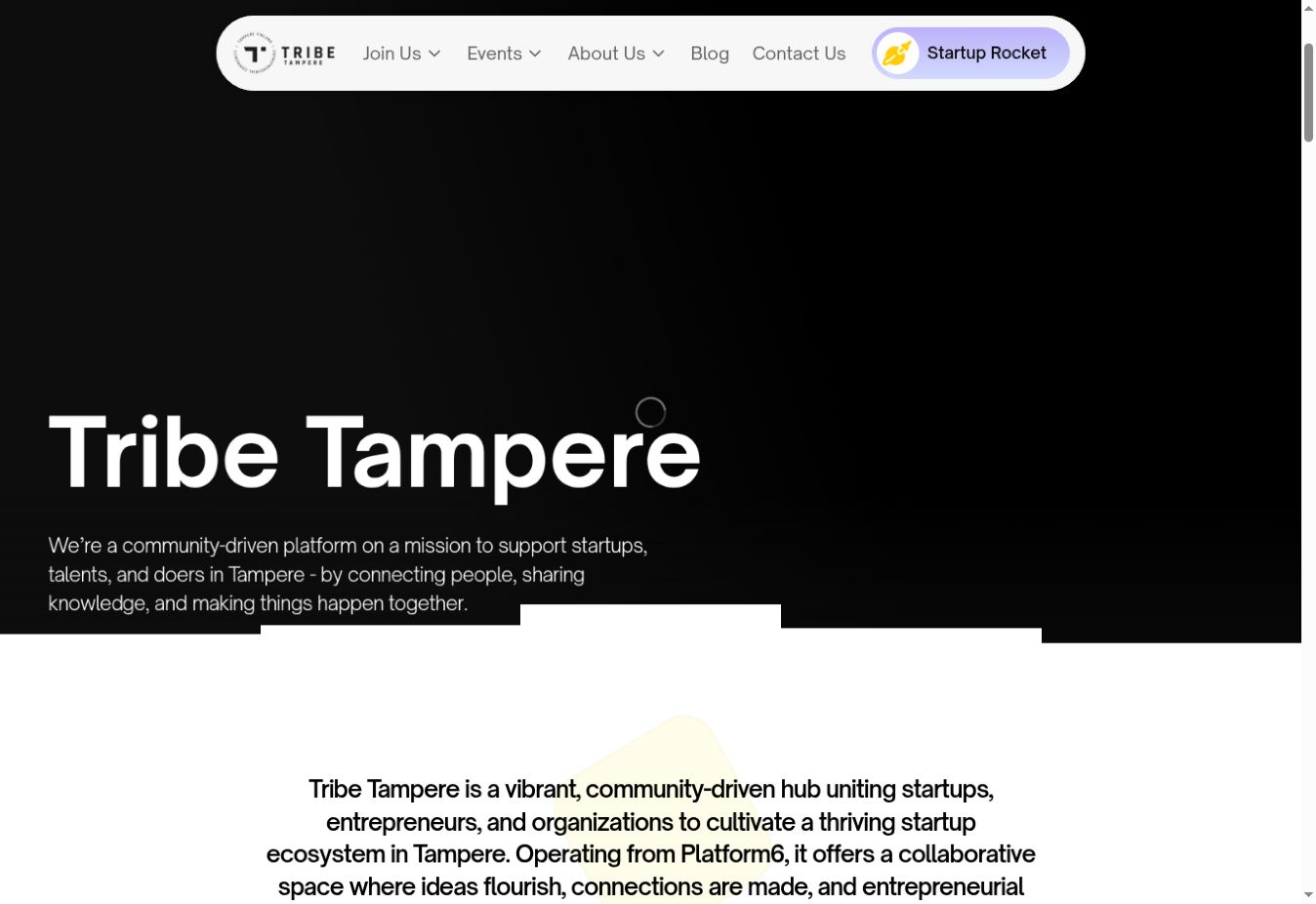 Tribe Tampere’s homepage introduces its local startup community and the Startup Rocket route. The embedded video did not finish loading in this capture; the page text remained readable.
Tribe Tampere offers a clear entry route for founders outside the Helsinki–Espoo concentration. It describes itself as a community operator at Platform6 and a gateway into Tampere’s startup ecosystem. Its Fellowship is presented as a free community membership for aspiring founders, startups and people who want to contribute to the local community.
The published joining process is straightforward: apply, book an onboarding time and meet the community lead. Activities include events, workshops, peer support and opportunities to connect with collaborators. A first-time founder can use that onboarding conversation to identify a relevant next step rather than navigate every local organization separately.
Tribe and Platform6 are related but not identical. Tribe operates the community; Platform6 is the startup house and broader workspace setting. Free Fellowship should not be described as a free private office, a paid desk entitlement or automatic acceptance into an incubator. Their public pages also contain differing floor references, so confirm the meeting location when booking.
This option is particularly useful when regular local participation is realistic. For an education or software team in Tampere, one well-chosen recurring community may produce more useful continuity than occasional travel to a larger event. Ask which upcoming activity matches your present problem and what you can contribute in return.
8. Slush
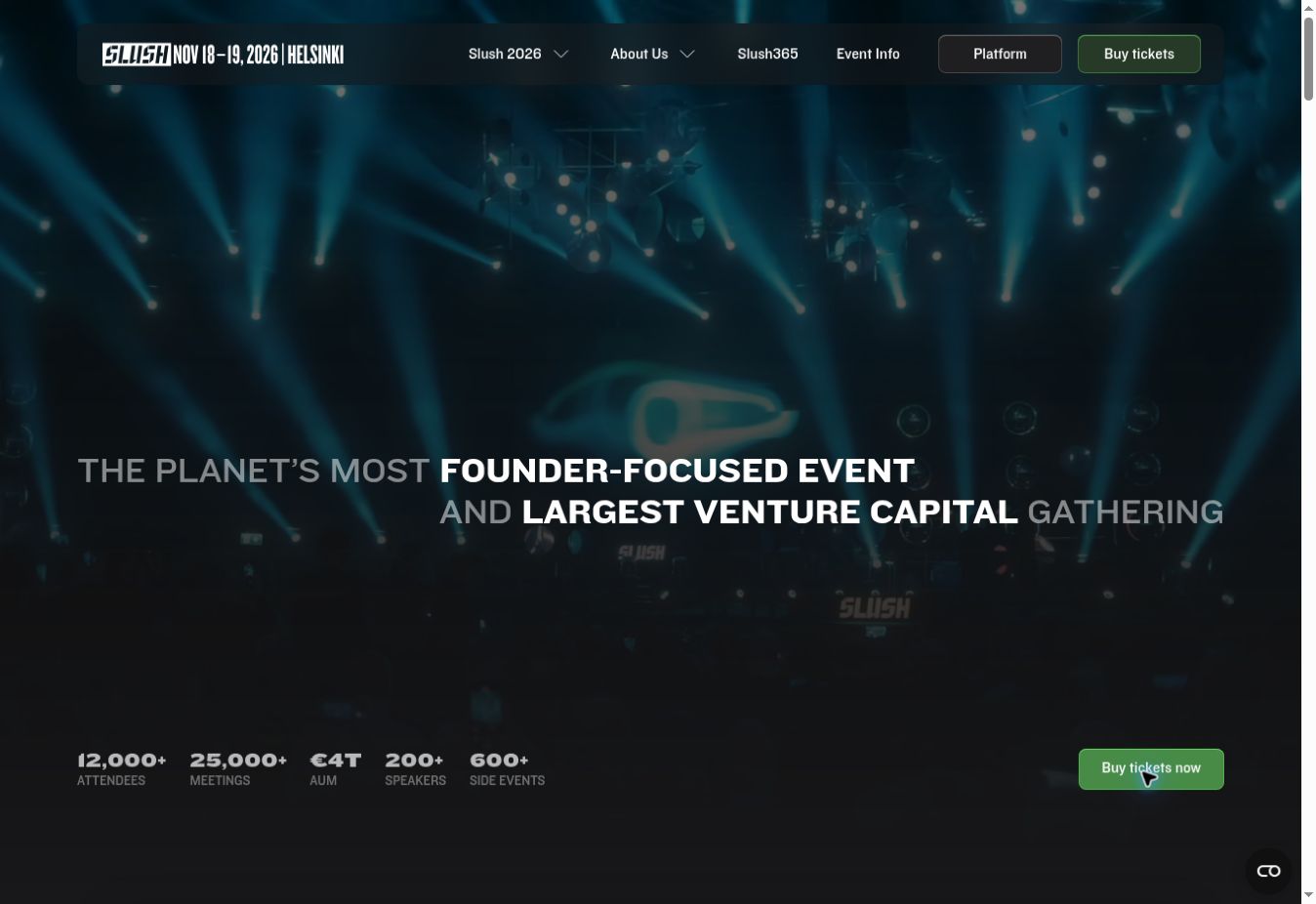 Slush’s homepage displays the November 18–19, 2026, Helsinki event and its platform and ticket navigation. A visible purchase button does not confirm availability; the ticket section showed sold-out categories at capture.
Slush is an event-centered network, with a different rhythm from the ongoing communities above. Its Helsinki startup offering includes founder gatherings, investor office hours, mentoring and selected opportunities to present or exhibit. It is most useful when a team has a clear reason to meet particular people and enough preparation to make those conversations productive.
A software startup preparing to raise funding may use the event to discuss its business with relevant investors. An education founder could also seek partners or experienced operators. However, a room full of investors is not the same as a room full of school buyers, and attendance does not validate an education product’s effectiveness.
The published 2026 program places the main event on November 18–19, with some founder activities on November 17. At our November 15 check, several opportunities had already closed applications, including startup booths and the startup stage. The homepage’s ticket section also marked its displayed ticket categories as sold out during our browser check. A “Buy tickets” navigation button is not proof of availability. Do not assume a ticket provides access to every side event, pitch slot or meeting.
Budget the full visit, including travel, accommodation and time for follow-up, rather than only admission. Before booking, define the people you need to meet and why they would take the conversation. A founder still identifying the basic customer problem may get more value from a smaller recurring community first.
Compare access before comparing popularity
These networks cannot be compared fairly through a single membership-price column. Tribe’s free Fellowship, a campus arrangement, an association subscription, a selective program and a Slush visit buy or provide different things. Some charges also depend on the company or the particular activity. We have not substituted old event prices or guessed fees where the reviewed page did not establish a comparable current amount.
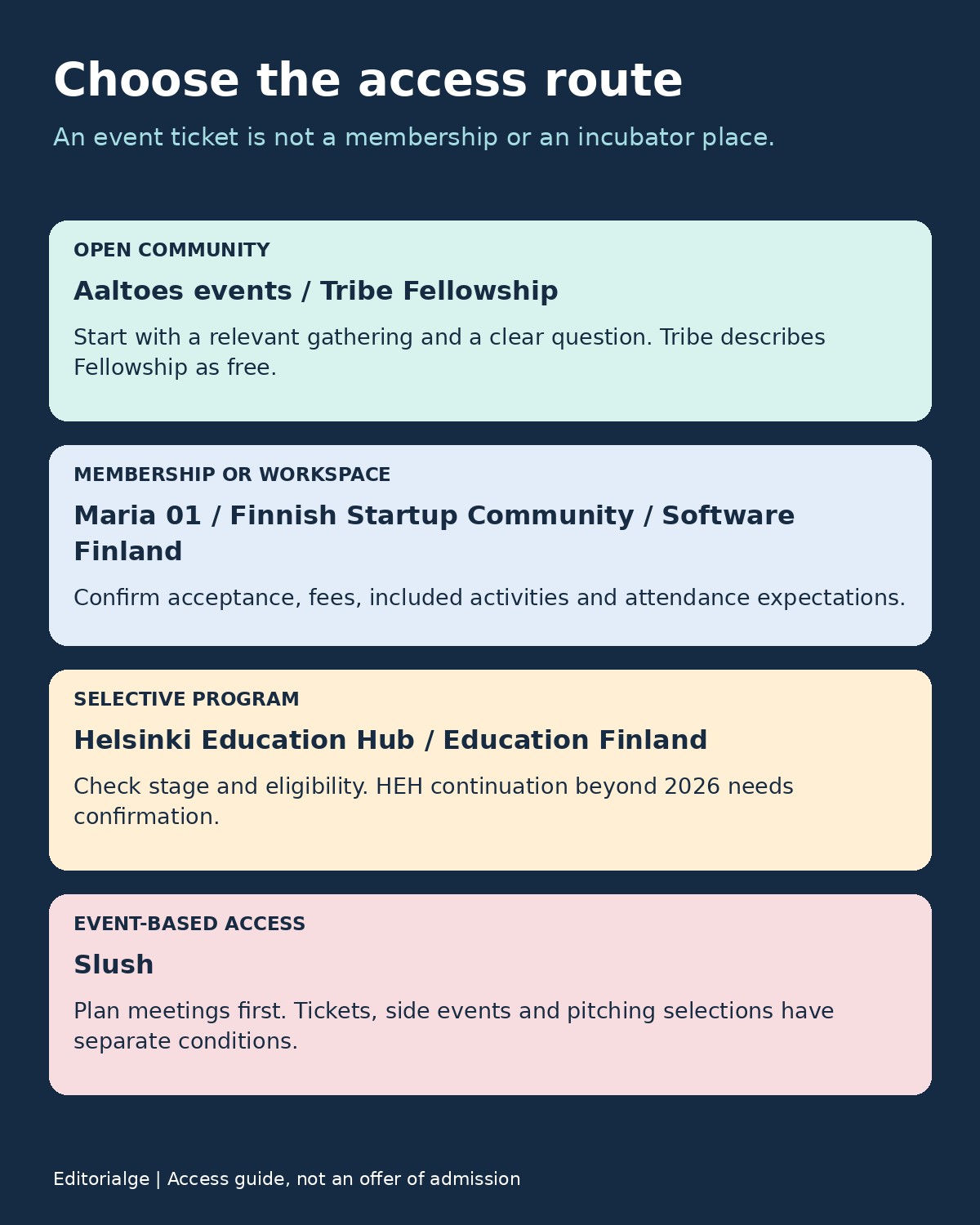 Access routes differ. Confirm current admission, fees and program availability before committing.
Before joining, request five concrete answers: who can participate, what is included, how often the relevant activity happens, which language it uses, and what the commitment costs in money and time. Where a program is selective, ask when applications are actually open. For an international founder, distinguish being welcome at an event from meeting a company-membership requirement.
Location also matters. Helsinki and Espoo provide several of the options here, while Tribe offers a Tampere route. A national remit does not mean every meeting is remote or available in every city. Choose a pattern of participation that fits where the team works. Networking is more useful when follow-up is practical.
For EdTech founders, separate three different kinds of evidence
A teacher saying a prototype is convenient, a learner completing an activity and a buyer agreeing to pay answer different questions. Use a network to find the right conversation for each. A pedagogical adviser can help sharpen a learning hypothesis; an operator can challenge the delivery model; a prospective buyer can explain budget and purchasing constraints.
For a proposed pilot, prepare a short description of the intended users, setting, problem, activity and success measure. Agree responsibilities and appropriate data handling with the participating institution before testing. Do not turn a friendly introduction into an implied permission to use a school, collect learner information or claim research endorsement.
Software founders selling outside education can use the same discipline. Separate a positive demo reaction from a buying commitment, and separate a suggested feature from evidence that a market needs it. A useful community helps you ask better questions; it cannot answer those questions on behalf of customers.
A practical 30-day networking plan
The following is a suggested workflow, not an account of results from these organizations. Begin with one decision you need to clarify within a month. “Find a network” is too broad. “Understand how school buyers evaluate a pilot” or “pressure-test our subscription packaging” gives potential contacts something concrete to respond to.
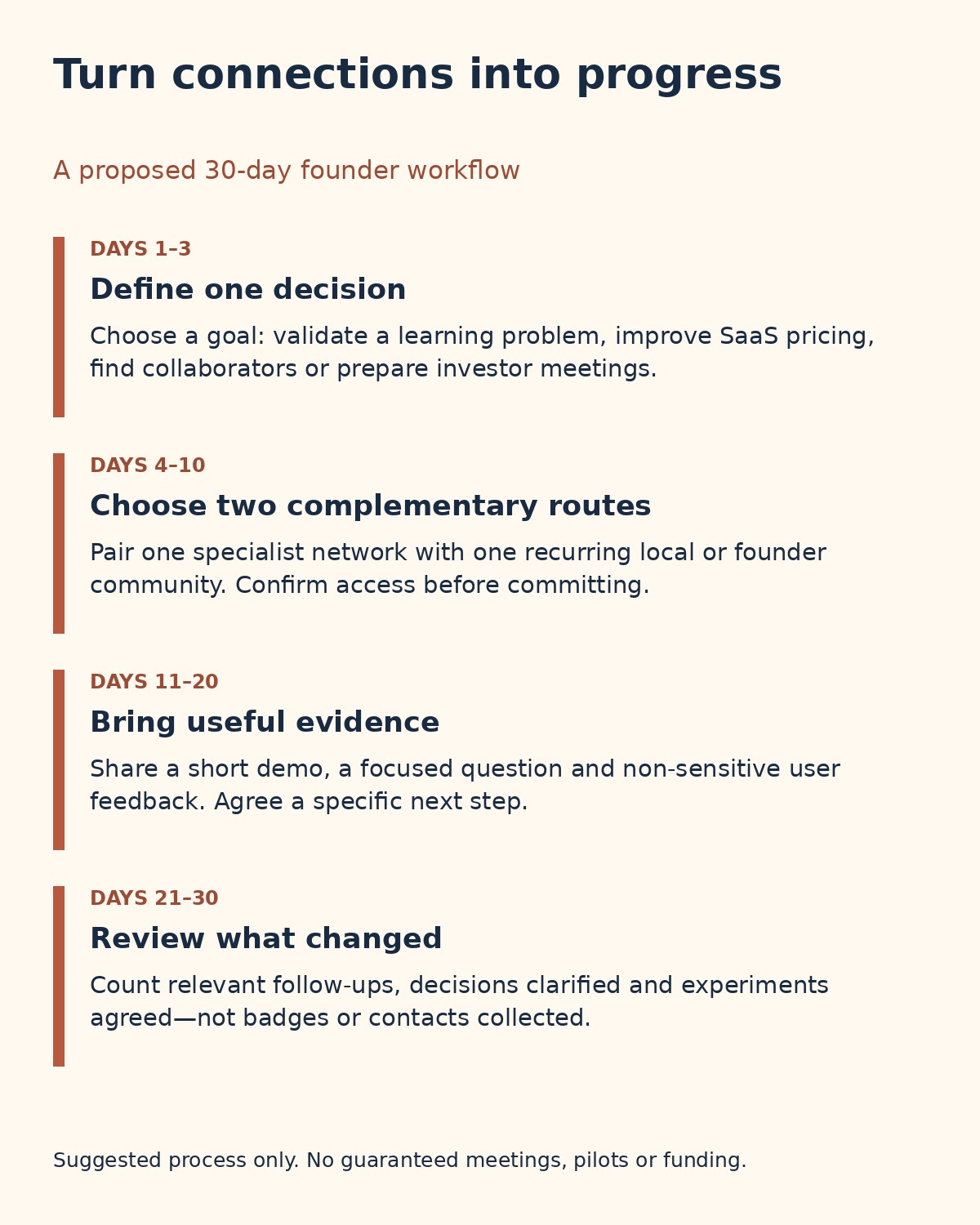 A proposed 30-day workflow for turning introductions into specific next steps; outcomes are not guaranteed.
During the first week, choose two complementary routes and check access. In the second and third weeks, attend a relevant activity or arrange an introductory conversation through the published process. Bring a short demonstration, a specific question and non-sensitive feedback you can discuss. Finish each conversation with a mutually agreed next step, rather than a vague request to stay in touch.
At the end of the month, record what changed: a question answered, an experiment designed, a relevant introduction accepted or a follow-up meeting agreed. Contact counts alone do not show progress. If no useful next step emerged, adjust the question or the network before increasing the number of events.
For help preparing the underlying materials, our guide to resources for early-stage founders provides a broader starting point. Founders comparing international ecosystems can also explore our Singapore startup community guide; its entry routes have their own local eligibility conditions.
Questions founders often ask
Do I need to be a student to participate?
Not across the entire list. Aaltoes invites wider startup participation, while several other entries serve companies or founders without a student requirement. Specific projects and programs may impose their own criteria, so check the activity rather than assuming a university connection defines all access.
Can a founder outside Finland join?
It depends on the route. Event participation, local community involvement and formal company membership have different requirements. Education Finland has explicit Finnish-company conditions. Ask about remote participation and local presence before committing; network access does not establish immigration eligibility.
Does membership include funding?
Do not assume so. Investor introductions, pitch opportunities and advice are different from a funding commitment. Any grant, investment or competition has its own terms and decision process. None of the comparisons here promises financing.
Choose a network around the next decision
The strongest shortlist of Finnish Startup Networks for Education and Software starts with a specific need. An early learning product may need research-informed development; an export-ready provider may need international partners; a SaaS team may need operating peers. Choose one focused route and one community you can use consistently, confirm access, and arrive with a question that someone can help you answer.























 English (US) ·
 French (CA) ·
 French (FR) ·