

 3 months ago
71
3 months ago
71
PROTECT YOURSELF with Orgo-Life® QUANTUM TECHNOLOGY
Orgo-Life the new way to the future Advertising by AdpathwayFinding inconsistencies in records, the Gauhati High Court has upheld a Foreigners’ Tribunal order declaring a man to be a foreigner despite producing a school certificate, PAN card, Elector’s Photo Identity Card (EPIC), and submitting an oral testimony to prove his Indian citizenship.
A bench of Justices Kalyan Rai Surana and Shamima Jahan observed that a person’s oral testimony alone is not enough to establish that he is the same individual whose name appears in voter lists from the 1990s or in more recent records.
“Thus, though the petitioner had exhibited 15 (fifteen) documents as exhibits, the same does not appear to help the petitioner to establish that he has been able to discharge his burden as required under Section 9 of the Foreigners Act, 1946 to prove that he is not a foreigner but an Indian Citizen,” the court said in its June 30 order.
The petitioner, a daily-wage labourer living in a rented house, alleged that the investigating officer submitted an unfair report after enquiry, which led to the tribunal declaring him a foreigner and prompting him to file the petition challenging the order dated February 28, 2019.
To establish his Indian citizenship, the petitioner traced his family lineage through various official records, and stated that the names have been recorded in the National Register of Citizens (NRC) of 1951 in Charai Khasara village. He claimed that 56-57 years ago, due to river erosion, his family had to shift from Charai Khasara to Dhobakura village, and their names continued to appear in electoral rolls.
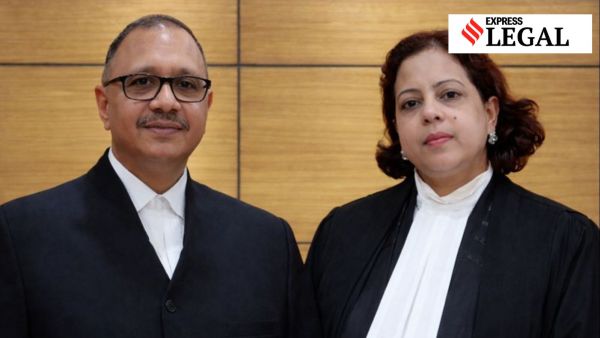 Justices Kalyan Rai Surana and Shamima Jahan held that the petitioner failed to prove that the tribunal showed any legal error in appreciating the evidence.
The petitioner further stated that in 1973, his grandfather purchased land in Ghugudoba, and after the family split, his parents moved to Ghugudoba, and despite a minor variation in spelling, their names were reflected in subsequent voter lists.
Born on May 1, 1988, the petitioner contended that he was born and brought up in Ghugudoba and later Hashdoba. He produced his school certificate, PAN card and EPIC to prove his identity. He further argued that his family’s names had appeared throughout in electoral rolls, and that different spellings of his father, mother and grandfather’s names across these documents referred to the same individual and should not affect his claim to Indian citizenship.
Story continues below this ad
Tribunal notes inconsistencies
The tribunal took into account the entries made in the voters’ list of 1979, which contained nine names. It was found that two of those names were not proved to be members of the petitioner’s family. Moreover, the tribunal found discrepancies in the age of the members. A person recorded as 25 years in the 1979 voter list was shown as 29 years in the 1989 voter list.
It also observed that the names appeared across three distinct villages, Dhobakura, Ghugudoba and Hashdoba, indicative of three different family units. Based on this, it was held that the family of Dhobakura is different from the family at Ghugudoba in 1985 and the family at Hashdoba from 1997 onwards.
Accordingly, it was held that the exhibited documents did not prove the existence of the petitioner with his ancestors, whose presence in India is established since January 1, 1966, and the tribunal held that the petitioner had failed to discharge his burden under Section 9 of the Foreigners Act, 1946, to prove that he is not a foreigner but an Indian citizen.
The Paper Trail: Documents Produced By The Petitioner
15
documents exhibited by the petitioner (DW-1) in evidence, spanning records from 1951 to 2015
List of Exhibits (Ext.A–Ext.N)
1
Copy of NRC of 1951 of petitioner's father
Ext.A-1
2
Computerized copy of NRC of 1951 in the name of petitioner's father, along with grandparents, step grandmother and other family members
Ext.A-2
3
Certified copy of voter list of 1966 in the name of petitioner's grandparents and step grandmother
Ext.B
4
Certified copy of voter list of 1970 in the name of petitioner's father, grandparents and other family members
Ext.C
5
Original land purchase deed dated 12.09.1973 in the name of petitioner's grandfather
Ext.D
6
Certified copy of voter list of 1979 in the name of petitioner's parents, grandparents and other family members
Ext.E
7
Certified copy of voter list of 1985 in the name of petitioner's parents and other family members
Ext.F
8
Petitioner's PAN Card
Ext.G
9
Certified copy of voter list of 1989 in the name of petitioner's parents, uncle and other family members
Ext.H
10
Certified copy of voter list of 1997 in the name of petitioner's parents and elder brother
Ext.I
11
School Certificate dated 20.10.2017, issued by the Headmaster of Hashdoba Anchalik High School
Ext.J
12
Certified copy of voter list of 2005 in the name of petitioner's parents and other family members
Ext.K
13
Certified copy of voter list of 2013 in the name of the petitioner, his parents and other family members
Ext.L
14
EPIC of the petitioner
Ext.M
15
Certified copy of voter list of 2015 in the name of the petitioner, his parents and other family members
Ext.N
Scroll for full list ↓
HTML Code Copied to Clipboard
Can’t reject NRC record: Counsel
The petitioner’s counsel argued that he has been wrongly declared a foreigner merely because of minor discrepancies in the names of his father and grandfather across different documents. Relying on the Supreme Court’s precedent, it was submitted that such variations are common and cannot serve as a valid ground for denying citizenship.
Story continues below this ad
It was further argued that the petitioner’s father, who appeared as a witness, identified the petitioner as his son, and the tribunal wrongly ignored this crucial testimony. The counsel contended that despite all the documents produced by the petitioner, his testimony was illegally disbelieved.
The counsel, citing an earlier judgment on a similar matter, argued that the NRC record, being computer-generated, is admissible and reliable evidence, and cannot be rejected merely on technical grounds.
No relief
The Gauhati High Court held that the petitioner has failed to prove that the Foreigners Tribunal showed any legal error in appreciating the evidence on record. It also found no proof that the tribunal had relied on irrelevant material or that the decision was based on ignorance of law or in disregard of the provisions of law.
After examining the matter, the court found no ground to interfere with the tribunal’s order, as no perversity or illegality was demonstrated by the petitioner. Accordingly, the petition stands dismissed. It held that the consequences of the tribunal’s opinion dated February 28, 2019, shall follow in accordance with law.





















 English (US) ·
  French (CA) ·
  French (FR) ·