

PROTECT YOURSELF with Orgo-Life® QUANTUM TECHNOLOGY
Orgo-Life the new way to the future Advertising by AdpathwayWhy do people sing? Why is it so necessary that we would go to any length to do it, even in the face of repression? Linda Ronstadt suggests people do it for the same reasons the birds do: “They sing for a mate, to claim their territory, or simply to give voice to the delight of being alive in the midst of a beautiful day. They sing so that subsequent generations won’t forget what the current generation endured, or dreamed, or delighted in.”
Article continues after advertisement
The fact is we mark all sorts of occasions with song: we sing at school, on birthdays, and at religious services; we sing to mourn, to express sadness, to protest, to impress, to connect with one another. Some love to sing while others really don’t; some people think they can’t and so avoid it at all costs, while some people think they might be able to but are afraid to try. Some of us can’t stop singing, regardless of whether we’re any good, and god bless.
No matter where we fall into these different (by no means exhaustive) categories, we all sing, or need to navigate occasions when it’s required. Our singing voices are our least socialized voices, and therefore the most vulnerable; even the most trained singer has their secret everyday voice, the one that comes out while they’re doing the dishes, or stripping the beds. (What a lovely, earnest sound, the sound of a voice singing for no one but itself.) Singing can build solidarity, linking individuals into community, a form of protest and hope.
Singing is a crucial part of my life, not as necessary as eating or breathing, but certainly as showering or drinking coffee.
Most of us have felt that amazing joy at joining our voice to someone else’s, even just someone on the radio, and it turns out there’s a reason it feels so good—because it quite literally is good for our bodies. Scientists have discovered that singing, especially in a group, has all kinds of benefits, from stabilizing mental health to reducing stress hormones, bolstering our immune systems, increasing lung capacity, helping postpartum depression, and stimulating the memories of people suffering from dementia. Singing is reparative. We should all be singing!
But we humans “are the animal with a problematic relation to corporeality,” as my philosopher friend Emily Laurent-Monaghan recently remarked to me, and as such we have a unique capacity to agonize over the productions of the body, torturing ourselves attempting to perfect them. When she retired in 2016, the New Zealand soprano Kiri Te Kanawa couldn’t point to a single ideal performance. “I never actually came off stage saying, ‘I’ve really nailed it,’” she told the BBC. “Never. I always thought there was a mistake in it.” It seems like a healthy approach to singing, or art making in general, to be able to walk away from those mistakes without wishing for a do-over; to let them go. A gesture of care for the imperfect voice, the imperfect body. Our imperfect selves! Always striving for the best, always keenly aware that we’ve fallen short of what we set out to do.
Singing is a crucial part of my life, not as necessary as eating or breathing, but certainly as showering or drinking coffee. It is a physical and emotional need, a form of hygiene and cleansing as well as a creative outlet. I sing while I clean the house, while I put my contacts in. In the afternoons when no one is home I tuck in to the piano and completely lose track of time until the doorbell rings and the afternoon post arrives and I’m brought back to reality, slightly dazed but sated. For me singing is like scratching an itch: physically satisfying. Similar to how I feel as a writer, when I manage to find the right words for what I’m trying to say, and the passage goes click into place.
But unlike writing, which is at least partly for other people, I’m not singing to be heard. In fact I’d rather not be. The shame, of admitting my desire, of making it so audible, so public! Singing is so much worse than writing that way; the voice that cracks is more of a visceral failure than a passage that doesn’t quite land.
I was born singing: I sang before I spoke. I would come home from nursery and perform for my mother, with accompanying motions of the hands and feet, the songs they’d taught us that day. If I really liked a song I heard on the radio, I’d trot over to the piano to play it by ear. I wasn’t some prodigy, playing Bach fugues before I could read, but music came naturally, more than anything else. There is no time, for me, before music; my earliest memories of toddlerhood are musical ones. Music still contains the purest thrill: its intensity and intentionality, its rhythm and disruptions, its ability to surprise, to shock. I am more attuned to music than to language, and sometimes worry that I am a fraud as a writer, because I am not essentially a writer; I am a musician who got into writing.
Making a career in the theatre eventually started to feel too exposing.
By the time I was sixteen, I was commuting forty minutes away to a performing arts high school called the Cultural Arts Center, where I spent half the day, coming back to my own school in the afternoons to take English and French. I stopped math and science after tenth grade because I wasn’t planning to attend a proper university: I wanted to major in musical theatre, and the theatre programs didn’t care what classes you took, as long as you were good.
My voice may or may not have been a nakedness, but musical theatre certainly came close. I am slightly shocked at the kind of performances we did back then; I was scantily clad onstage more often than not. How many times did I play a prostitute or an exotic dancer? (What is it with musical theatre and sex workers?) When we did Sweet Charity senior year we wore sparkly leotards and high-heeled character shoes and sang about popping our corks as lewdly as we could to an audience full of our mothers and fathers. Hey, Big Spender! We were enacting our sexual coming of age for everyone to see. We were seventeen years old and we didn’t know how beautiful we were.
But as the years went on, and I joined a theatre world beyond that of suburban high schools, adults started commenting on my appearance. I really ought to have my nose done, I heard, and I should probably lose ten pounds to really be competitive. I can’t remember who precisely told me these things, it was so prevalent I can’t assign blame. Of course I hated parts of my body, my nose, yes, I hated it, the slight curve of my belly made me self-conscious, but I knew they were wrong about my weight, I knew it was insane to tell an already slim seventeen-year-old to lose ten pounds. I had the presence of mind to realize that I was fine as I was. And I needed my strength to support my voice, this sometimes extremely large thing that could wobble out of control if I didn’t stand strong in its soundwave.
Making a career in the theatre eventually started to feel too exposing. The vulnerability, the humiliation, of standing in front of people, having them barely look at you, or look at you from the disinterested perspective of someone assessing a display of supermarket meat. If I stayed in the business, I would have to appear again and again in front of casting directors, subject to their opinions not only of my voice but of my body. The weight loss and nose job were apparently non-negotiable: my lyric soprano meant I had to play the ingenue, and ingenues were skinny with tiny noses. Thin but no waif, with a shtetl nose and an intense gaze, I was not unattractive yet something other than conventionally, Midwesternly pretty. My look did not joy I felt when singing was gradually replaced by the fear of being found inadequate. I didn’t want to spend my life feeling that way, knowing I would see the limited range of parts available to me dwindle even further as I aged.
I am disappointed in myself, looking back. I should have stayed to fight. There are plenty of singers and actors on and off Broadway who’ve refused to sculpt their bodies into what the casting directors demanded, some of them women my age who were faced with the same body-shaming I was. Why didn’t I hold firm to my principles, and soldier on? It felt and it still feels good to sing, but what didn’t feel good was my body in constant competition with other bodies. The profession I had chosen had groomed me to always compare myself to the other women in the room. If they were thinner or prettier, they were a threat; they’d be cast before me. It took me years to stop understanding my value comparatively, to stop classing myself and all the women around me into types.
In the years since I left the theatre, I have often thought that I chose writing instead of music because among trained singers, everyone sounds good, and one good voice is not often much different from another; rare are performers who are so unique that they are irreplaceable. Increasingly so: it seems that most of the women you hear on Broadway today have, with few exceptions, interchangeable voices. Some time during college I discovered the joy of the blank page, where I could say whatever I wanted, however I wanted to say it, and where there was such freedom that in the end there was no competition, writing took me as I was and didn’t ask for there to be any less of me. I could be judged not only on sound or on form, but on content. Whereas in music, I could only ever be as good as everyone else. I went quiet.
__________________________________
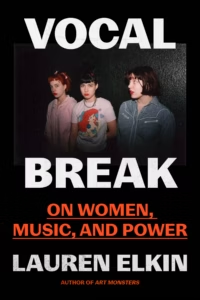
From Vocal Break by Lauren Elkin. Used with the permission of the publisher, Farrar, Straus and Giroux. Copyright © 2026 by Lauren Elkin





















 English (US) ·
 French (CA) ·
 French (FR) ·