

 2 days ago
2
PROTECT YOURSELF with Orgo-Life® QUANTUM TECHNOLOGY
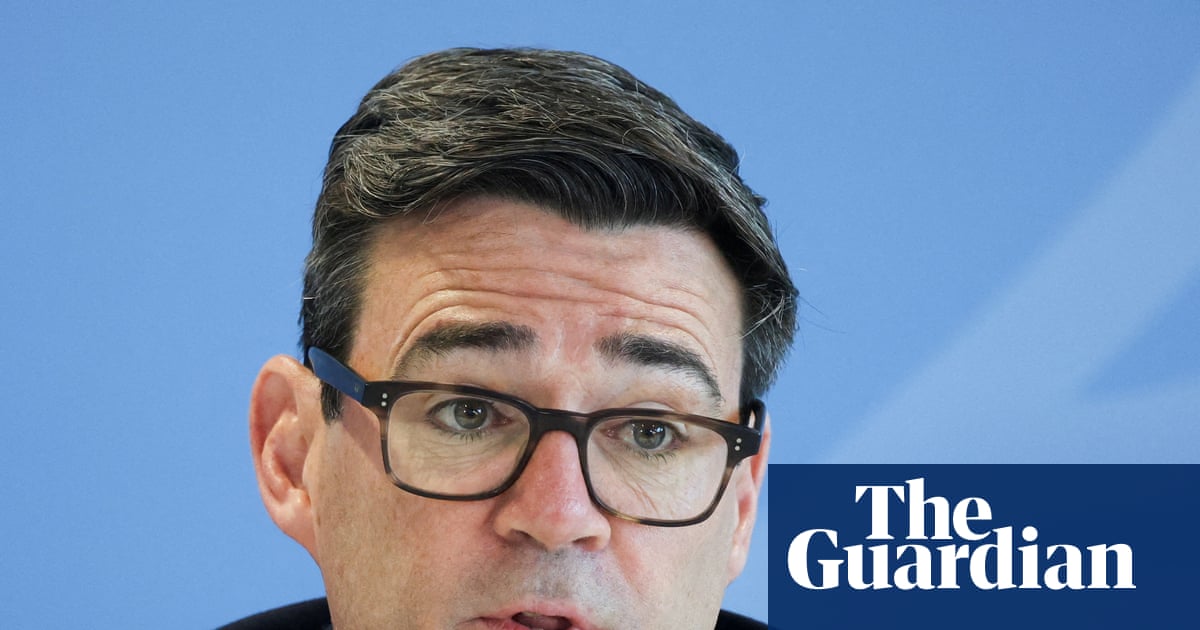
Orgo-Life the new way to the future Advertising by AdpathwayOn the road to Downing Street, Andy Burnham promised a new dawn for Britain’s towns and high streets.
For too long places outside the big cities had been “forgotten or written off”, he argued after the Makerfield byelection. To help towns like those in his constituency, he said his government would make sure that the places Westminster had neglected would now get fairness.
Four times more people live in Britain’s towns than in cities. Since the turn of the millennium, big cities and more prosperous towns have grown significantly faster than weaker local economies. In Manchester, the population rose by almost a third, amid a renaissance in Cottonopolis that its former mayor capitalised on before entering No 10.
In sharp contrast, towns have been growing more slowly than cities on average, and are ageing faster as well. Some are in population decline, including Barrow-in-Furness in Cumbria (6%), Peterlee in County Durham (11%) and Rishton in Lancashire (13%).
To turn things around, experts say the prime minister will need to nurture the ingredients of local economic success. Here we chart five of the critical components.
Job opportunities and the drivers of deprivation
Roughly every five years official estimates of local deprivation in England, Scotland, Wales and Northern Ireland are made using a range of statistics for an index of multiple deprivation.
Each metric is critical for a town’s success: income, employment, education, health, crime, housing and the living environment.
Jaywick Sands, near Clacton-on-Sea in Essex, has led the rankings in England since 2010. The least deprived neighbourhood is in the town of Harpenden, near St Albans in Hertfordshire.
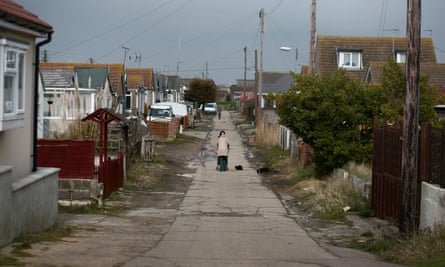
Most parts of the country have pockets of deprivation. But there are also clear patterns: towns, particularly in the north of England, the Midlands and in coastal areas, typically have the highest share of the most deprived neighbourhoods.
When it comes to the vitality of a town, income and employment levels are critical for supporting high streets. Boston in Lincolnshire has the lowest level of resident earnings in Great Britain, with people earnings about half as much as those in St Albans. Employment levels are lowest in Gravesham in Kent, followed by Blaenau Gwent in south Wales and Hyndburn in Lancashire.
Local financial clout and the power to use it
After more than a decade of austerity, local authorities across the UK lack the financial firepower to meet rising demand for critical public services and to support economic activity.
The low point was reached in about 2019, when local spending power in England had been cut by about a quarter from 2010 levels. Analysis by the Institute for Government shows the most deprived local authorities ended up with significantly deeper cuts than affluent ones.
Funding levels have started to recover but will take until at least 2028-29 to return to 2010 levels after inflation is taken into account.
Transport connections and public services
Transport and other physical infrastructure – including housing, superfast broadband, water and power – are central to the prosperity of a place. High standards of healthcare and education provision are also vital. Without these ingredients, households will struggle to reach their local high street or travel to work. Businesses will also lack access to a skilled, healthy workforce.
During the 2010s more than one in four bus services were cut in England. Rural communities and towns suffered most. Subsidies have been cut, and – as with trains – fares have risen. Burnham has made public control over buses and cheaper fares a priority. Official figures show Warrington, the prime minister’s home town, had the biggest fall in miles travelled by bus since 2010 of any English local authority.
Regions outside London and the south-east have also had significantly lower levels of investment.
High street vacancy rates
Retail accounts for 5% of the UK economy and less than a 10th of employment. But its visible position on the high street gives it outsize influence on public perception about local economic performance.
Over the past two decades the internet has transformed the high street. Online spending has rocketed from less than 3% of total retail sales in Great Britain in 2006 to more than 25%. As a consequence, many mainstream shops have either closed or been replaced by vape shops, bookmakers and barbers. Official data shows high street retail employment has fallen most in the East Midlands.
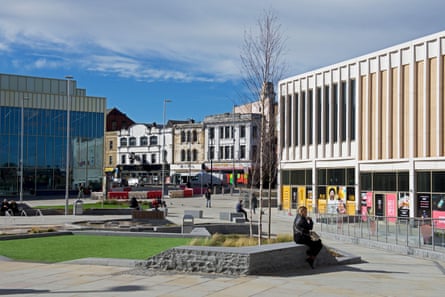
Retailers have suffered from weaker levels of consumer demand amid the cost of living crisis – compounding the challenge in places where households are feeling the pinch most. Closures have been most pronounced in the north of England, the Midlands and deprived coastal towns.
Analysis by the Centre for Cities shows places where retailers pay higher rents (which it said could reflect resilient consumer demand) typically have the lowest vacancy rates. At one end of the scale is London, with high rents and 7% of shops with shutters drawn. At the other is Newport, where despite low costs, 19% of all units lie empty.
The arts, culture and community cohesion
Social capital – the strength of communities, relationships and trust – is a key ingredient of economic success, not just a nice to have. However, Britain has suffered a hollowing out of the associations, clubs, organisations and infrastructure that were once the beating hearts of communities.
Local council spending on culture, sport and other related areas such as tourism and libraries has nosedived since 2010. Towns and rural areas have faced bigger cuts than big cities. Figures show councils spent a net £92.84 per person on culture in 2010-11 after adjusting for inflation. That has halved – last year a net £46.43 a head went on culture and sport.
Looking at total rather than net spending reveals the areas that have cut the most. Hart district council spent £82.36 a head in 2010-11 – that has since been cut to £8.75. Havant’s spending went from £40.04 a head in 2010-11 to £5.66 in 2025-26.
While the vast majority of councils have cut arts spending, others have increased it. Mole Valley spent £109.02 last year on culture and related services, up from £58.16 in 2010-11.













 English (US) ·
 French (CA) ·
 French (FR) ·