

 2 months ago
20
2 months ago
20
PROTECT YOURSELF with Orgo-Life® QUANTUM TECHNOLOGY
Orgo-Life the new way to the future Advertising by AdpathwayWhile thousands of Israeli soldiers are engaged on the frontlines in South Lebanon and Gaza, the Israeli Parliament has approved the laws that would resultantly stop the enlistment of Haredi (ultra-Orthodox Jewish) men in the military. The decision has once again divided Israeli society over why a particular religious group should be exempt from military service. Some see it as a move by Prime Minister Benjamin Netanyahu to woo the religious political parties ahead of the upcoming elections, while others call it a problem for which the Jewish state has no solution.
The issue of the Haredi draft, since the formation of the State of Israel, has remained fiercely debated. After almost eight decades, it has become a structural crisis challenging the foundational ethos of the state. To understand the profound implications of this legislation, we must examine the historical, religious, and sociological divisions that define contemporary Israel.
Genesis and evolution of ‘Status Quo’
When the State of Israel was formed in 1948, its first Prime Minister, David Ben-Gurion, faced the massive task of unifying the diverse Jewish diaspora, making Aliyah (immigrating) from different parts of the world. Each group had its expectations for the “promised land”, which they had achieved after remaining in exile for almost 2,000 years.
In his book, The Jewish State: A Century Later, political scientist Alan Dowty notes that the founding fathers of Israel, including Ben-Gurion, made a number of unwritten understandings known as the “Status Quo” agreement that sought to balance the secular, socialist foundations of the new state with the long-held traditions of the religious minority. So, a small group of roughly 400 elite ultra-Orthodox yeshiva (a traditional Jewish educational institution focused on the study of sacred texts such as the Torah and the Talmud) students were exempted from military service under the framework of Torato Umanuto (“his Torah study is his occupation”). It was probably assumed that the number of Jews practising the faith in that manner would either decrease over time or that they would accept the challenges faced by the state and agree to join the military.
But both assumptions proved incorrect. Gradually, the secular Labour Party (Ben-Gurion’s party) grew weaker, and the parties that didn’t hesitate to align with religious groups filled the political vacuum it created. In 1977, Menachem Begin’s conservative Likud party formed a coalition with Haredi political factions, ending decades of Labour’s dominance. Begin ensured that there were no limits on the number of exempted Haredim (plural of Haredi). Therefore, what began initially as an exceptional provision for 400 religious scholars became a structural exemption for an entire, rapidly growing demographic group.
Religious-secular divide
Sociologist Sammy Smooha calls Israel a “deeply divided society”. He notes that the Haredi-secular divide is not merely a disagreement over policy but a clash between two irreconcilable, self-contained worldviews operating within the same geographic borders.
The military service in Israel is understood to be far more than a strategic necessity. The concept of the Tzva Ha’am (“People’s Army”) has kept the Israeli Defense Forces (IDF) a melting pot where Israelis of different socio-economic, ethnic, and geographic backgrounds forged a shared national identity.
Story continues below this ad
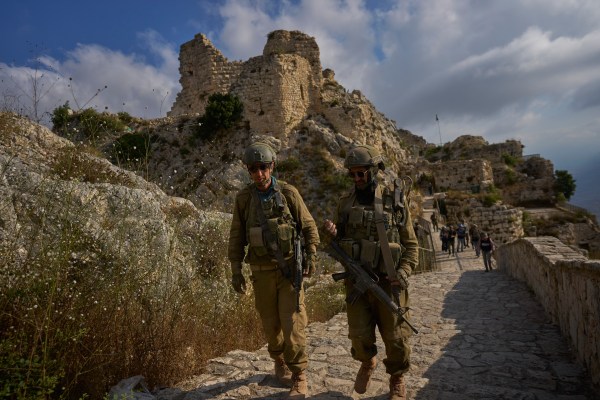 Israeli soldiers at Beaufort Castle in southern Lebanon on July 9, 2026. Military service in Israel is understood to be far more than a strategic necessity. Photo: AP/Ohad Zwigenberg
Secular Israelis see universal military service as a foundational element of distributive justice — what is locally called Shivyon Ba’netel (“equality of the burden”). From this perspective, the exemption of an entire community is an unsustainable civic injustice. The secular Israelis feel forced to risk their lives while the Haredim are legally shielded from doing so.
Haredi worldview
Haredim don’t view military exemption as a privilege or a loophole but as an absolute existential necessity. For them, spiritual defence is entirely equal to — if not more important than — physical military defence. Haredi leaders frequently state that the continuous, intensive study of the Torah provides a metaphysical protective shield over the land of Israel.
Haredim view entering the IDF as an existential threat to their religious identity. The military environment — with its secular norms, mixed-gender units, and alternative authority structures — is considered an institution that would inevitably erode the strict insularity required to maintain ultra-Orthodox life.
In a bid to garner popular support, centre-left and secular right-wing parties in Israel have mobilised voters by promising to end the exemptions. The Supreme Court of Israel has repeatedly struck down previous legislative arrangements, ruling that sweeping exemptions violate the country’s “Basic Law: Human Dignity and Liberty” by discriminating between identical cohorts of citizens.
Story continues below this ad
The Haredi parties, including Shas and United Torah Judaism, view exemption as an absolute red line. They leverage their position as kingmakers in right-wing coalitions to demand explicit, ironclad legislation that bypasses Supreme Court rulings. On the other hand, the secular and centrist parties view the legislation as political extortion. They argue it permanently codifies a dual-class citizenship model.
Meanwhile, the security establishment consistently raises alarm over manpower shortages, noting that the operational realities of modern asymmetric conflicts require a broader mobilisation base that can no longer afford to leave an entire section of the society free from national duty.
‘Kosher’ military units not enough
Despite various government initiatives, financial incentives, and the creation of specialised, strictly kosher military units (such as the Netzah Yehuda battalion), actual enlistment numbers have consistently lagged far behind the growing eligible workforce. According to data compiled by Israeli Democracy Institute, the number of Haredim joining the IDF has only increased from zero to 11% out of the eligible cohort since 1948. There have been several amendments in the legislation to make the job more lucrative for the ultra-Orthodox men but everything has failed to convince them to come out of Torah classes and join their forces.
The formal codification of the Haredi exemption carries risks for the future of the Israeli state across three core vectors: fiscal sustainability, social cohesion, and military readiness. Economists at the Bank of Israel and academic institutions have warned that the current trajectory poses a severe fiscal challenge.
Story continues below this ad
Because the Torato Umanuto framework legally binds state funding and draft deferments to remaining within the yeshiva system, it discourages young Haredi men from entering the workforce. A growing population sector that does not serve in the military and has lower rates of workforce participation places an increasingly heavy tax and security burden on a shrinking percentage of the secular and national-religious population.
From a sociological perspective, when exemption is no longer a temporary political compromise but a permanent, legislated reality, the state effectively sanctions two distinct categories of citizenship: those who owe blood equity to the state and those whose contribution is recognised as strictly spiritual. This situation might result in demotivating secular youth to serve in combat roles.
A society under strain
By consistently circumventing the Supreme Court’s rulings on equality, the political parties undermine the authority of the judiciary that sees every citizen as equal. Israelis who prioritise a liberal-democratic framework are in conflict with those who seek to preserve religious arrangements and sectoral autonomy.
The Haredi draft exemption goes beyond the debate over military manpower and provokes a fundamental argument over the identity of the State of Israel: whether a State and its society will stand firm when its citizens hold fundamentally incompatible ideas about civic obligation, equity, and survival.










 English (US) ·
  French (CA) ·
  French (FR) ·