

.png) 3 weeks ago
29
3 weeks ago
29
PROTECT YOURSELF with Orgo-Life® QUANTUM TECHNOLOGY
Orgo-Life the new way to the future Advertising by AdpathwayAzerbaijan News 23 September 2026 13:50 (UTC +04:00)
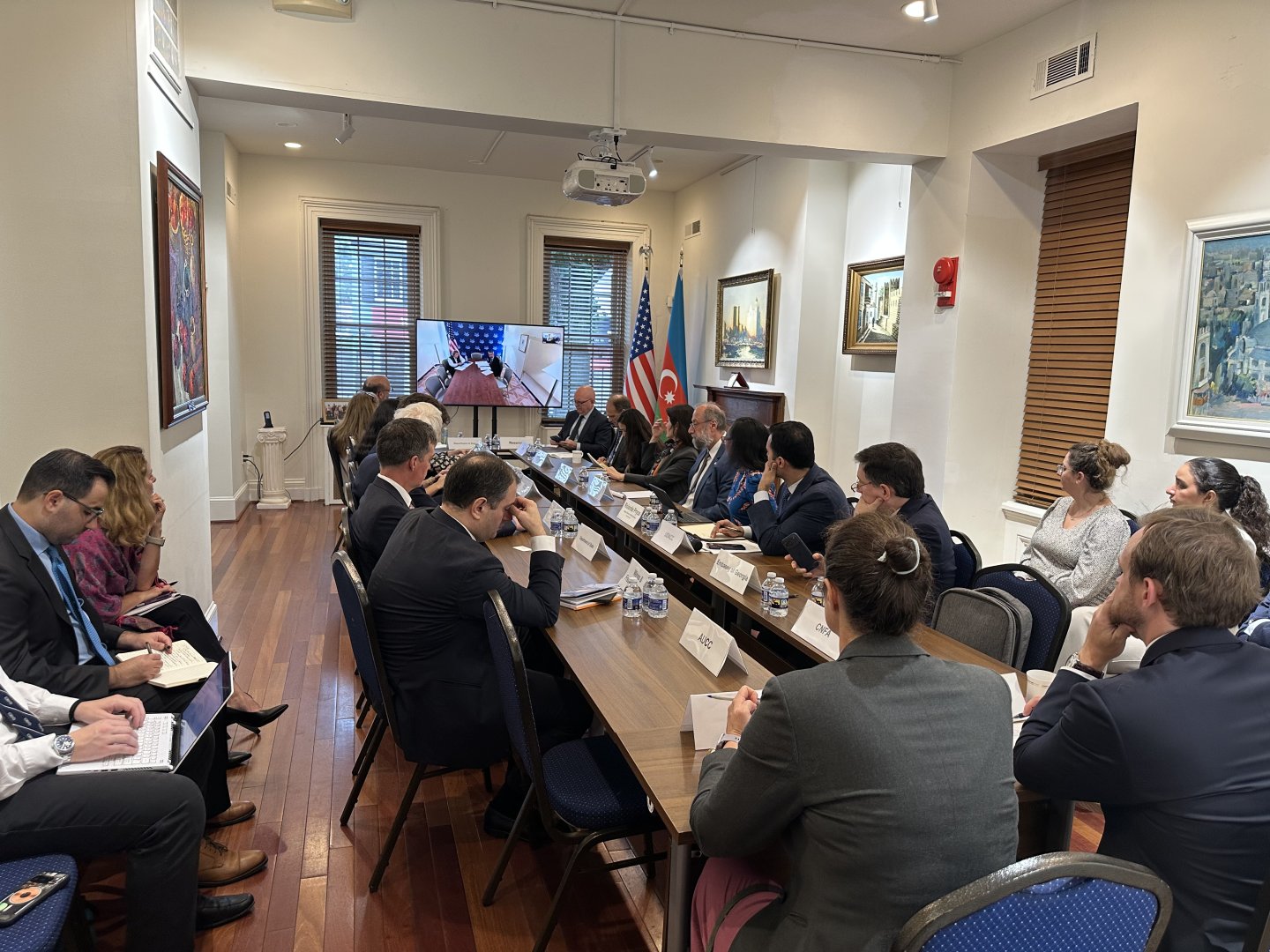
Photo: USACC

BAKU, Azerbaijan, September 23. The United States-Azerbaijan Chamber of Commerce (USACC) and the America-Georgia Business Council (AGBC) hosted a roundtable with Rolande Pryce, the World Bank’s Regional Director for the South Caucasus, on the Middle Corridor and regional cooperation.
"The discussion focused on the investments and operational improvements needed to make the route more reliable: stronger rail and port connections, more efficient border procedures, better logistics coordination, and digitalization. These steps can help turn growing interest in the corridor into trade and investment opportunities across Central Asia, the South Caucasus, Türkiye, and Europe," said the USACC.
The event was joined by Vinay Chawla, Acting Special Representative for Commercial and Business Affairs and Ambassador Ann Marine Yastishock of the U.S. Department of State.
The Middle Corridor is a transport and trade route passing through a number of countries in the region and connecting Asia with Europe. It serves as an alternative to the traditional Northern and Southern Corridors. The route begins in China and runs through the countries of Central Asia. It then crosses the Caspian Sea, Azerbaijan, Georgia, and Türkiye, before reaching Europe. The Middle Corridor is a land route that bypasses longer sea routes, connecting eastern regions of Asia, including China, with Europe.
The World Bank has highlighted the Middle Corridor’s potential to support economic growth across the countries along its route by facilitating trade, generating employment and encouraging new business activity. According to the Bank’s 2024 report, a combination of infrastructure investment and measures to improve operational efficiency could halve transit times and triple trade volumes along the corridor by 2030.
Azerbaijan is working with other countries participating in the Middle Corridor to improve transport links, simplify border procedures and expand the use of digital systems for exchanging logistics data. Key infrastructure supporting the route includes the Baku International Sea Trade Port, the Baku–Tbilisi–Kars railway, the Alat Free Economic Zone and newly developing logistics hubs.
The Baku Port is also undergoing expansion, with its annual cargo-handling capacity expected to increase from 15 million tons to 25 million tons.
Digitalization and streamlined border procedures have already contributed to significantly shorter transit times. Freight shipments between China and Europe that previously required 38–53 days can now reach their destination in around 12 days, supported by electronic permitting, systems such as e-TIR and e-CMR, real-time cargo monitoring, more efficient customs procedures and faster data exchange between government agencies.
With global trade routes becoming increasingly diversified and interconnected, the Middle Corridor has the potential to play a larger role in the evolving structure of Eurasian trade. The route is also developing beyond its traditional role as a transit link between China and Europe, increasingly generating demand for logistics services, infrastructure investment and new trade flows along the countries and markets connected to it.





















 English (US) ·
  French (CA) ·
  French (FR) ·