

 1 hour ago
9
1 hour ago
9
PROTECT YOURSELF with Orgo-Life® QUANTUM TECHNOLOGY
Orgo-Life the new way to the future Advertising by Adpathway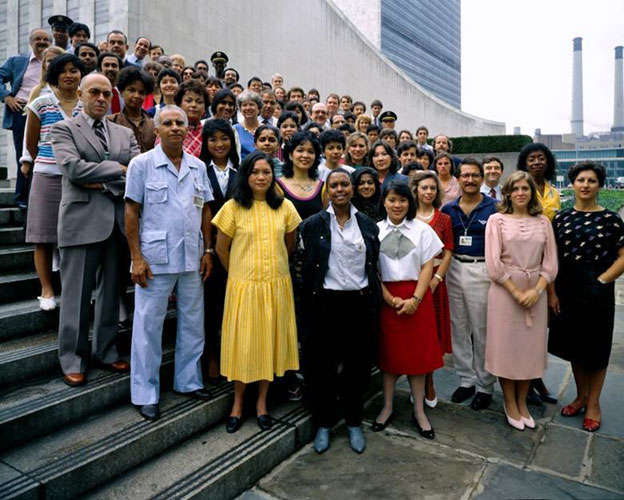 A group of UN Staffers outside the Secretariat. Credit: United Nations
UNITED NATIONS, October 13 (IPS) - The United Nations has once again revived a longstanding problem that has been left lingering behind closed doors for decades – racism and racial discrimination at the UN Secretariat.
A message sent to UN staffers last week reads: “The United Nations is founded on the bedrock principle that all people are equal in rights and dignity. Racism has no place in our Organization, and we are committed to fighting it on every front”.
“But racism often hides within systems, becoming entrenched through policies and practices that may appear neutral, but in fact reinforce biases and deepen inequities. Bringing these patterns to light is crucial, and for that we need data.”
“That is why, on 17 October, we will be launching a voluntary race data collection initiative. This exercise invites all Secretariat staff to provide information about their race, to help the Organization better identify and address discrimination. It is optional. It is anonymous. And it is one of the best tools we have to discover where action is needed.”
Approximately 3,600 to 4,800 Secretariat staff members, including UN agencies, are based in New York.
Meanwhile, the UN Secretariat in New York, faltered ingloriously last year, as it withdrew its own online survey on racism, in which it asked staffers to identify themselves either as “black, brown, white, mixed/multi-racial, and any other”.
But the most offensive of the categories listed in the survey was “yellow” – a longstanding Western racist description of Asians, including Japanese, Chinese and Koreans.
Subsequently, a non-apologetic message emailed to staffers read: “The United Nations Survey on Racism has been taken offline and will be revised and reissued, taking into account the legitimate concerns expressed by staff.”
Dr Palitha Kohona, a former Chief of the UN Treaty Section in the Office of Legal Affairs (OLA) told Inter Press Service (IPS) racism today is not overly evident at the United Nations which was founded on ideals that were very much ahead of their times, but an undercurrent of racial superiority and racial bias exists among certain elements of the Organization. This is evident in certain appointments and deep-seated attitudes, even among some delegates.
“Racism in international bodies could be traced even to the founding of the League of Nations where President Woodrow Wilson strenuously opposed the Japanese proposal to incorporate the principle of racial equality in the constitution of the Organization. His vision of international order was hierarchical and implicitly based on a racial hierarchy that placed white, Western nations at the top”.
While the United Nations is staffed by many enlightened individuals, some bias based on race still prevails at the highest levels, he pointed out, despite the organization itself having been headed by two Asians and an African in recent times.
“Curiously certain positions have been held only by Europeans. For example, the position of the UN Legal Counsel has been held only by white Europeans. There are other positions apparently reserved for European countries”.
Some delegates are also still affected by racial prejudices of an unenlightened past.
In a well reported incident, the not-so-white chairman of the WEOGs ( a Western European group) from a Southern European country once told the recently-arrived Australian delegate (an Australian citizen of Asian ancestry) that the developing countries of the Group of 77 were meeting in an adjoining room—(implying he was an Asian at the wrong meeting).
In an Organization created on the high ideals of equality and merit there is no logical reason for reserving certain positions on the basis of race, even sub consciously.
“Having gone a long way in minimizing gender bias, it is time to ensure that all vestiges of racial bias are also eliminated. One way to ensure equality and equity in appointments might be to subject all appointments to an open application process with selections being made by racially and gender mixed panels,” declared Dr Kohona, a one-time Permanent Representative of Sri Lanka to the UN, and until recently, Ambassador to China.
Ian Richards, President of the UN Geneva Staff Union told IPS: “We are concerned this is being tackled very much from a North American perspective.”
“Race is only a useful indicator if it is combined with where you grew up, which indicates opportunities or disadvantages in formative years, and where you work now. Each region has its own history and attitudes. We don’t feel this has been taken on board,” he said.
Meanwhile, the circular to staffers also points out that by understanding how colleagues identify their race, we can:
- Pinpoint areas where racial bias or disparities may exist;
- Examine institutional factors that may contribute to racist misconduct, underreporting of incidents, or barriers to racial justice; and
- Develop remedial measures to build a workplace free from racial discrimination.
Staff will be invited to participate by selecting a race category on Inspira. To ensure data protection and maintain privacy, your data will be anonymized and aggregated. It will not be used in connection with any individual human resources management processes, such as recruitment or promotions. It will not be visible to recruiters or hiring managers.
The collection of race data will be managed strictly in line with the parameters outlined in General Assembly resolutions A/RES/80/238 and A/RES/80/243 B, as well as the provisions set out in ST/SGB/2024/3.
The racial categories listed echo the language used in past United Nations staff engagement surveys. An additional question will ask staff if they consider themselves to be a member of a racialized community.
Speaking on condition of anonymity. a former UN staff member expressed concerns about the UN Secretariat Administration’s proposed race data collection initiative, particularly regarding its methodology, suitability for the UN’s diverse global workforce, and safeguards for sensitive personal information.
It was pointed out that a fundamental question remains unanswered: Is the lack of race-disaggregated data genuinely preventing the Organization from addressing racism, or does the real problem lie in the implementation of existing policies, the enforcement of accountability, and the failure to translate commitments into effective action?
This distinction must be established before sensitive personal data are collected on such a scale.
“Any approach to addressing racism and racial discrimination within the UN should also recognize the experiences of affinity groups and other minority and underrepresented communities, whose experiences of exclusion may not be adequately captured by standardized racial classifications”.
The absence of meaningful consultation with staff representatives, together with insufficient clarity regarding the conceptual or empirical basis for the selected racial categories, data protection measures, future use of the data, and independent oversight, further undermines confidence in the initiative.
The United Nations must demonstrate its commitment to equality through action, transparency, and accountability. Collecting sensitive racial data must not become a substitute for enforcing existing protections, addressing substantiated concerns, and correcting discriminatory institutional practices, the former staff member said.
“The ultimate measure of success is not how much data the Organization collects, but whether it can demonstrate that racism has been reduced, accountability strengthened, and the working environment made fairer for all staff”.
IPS UN Bureau Report



© Inter Press Service (20261013055028) — All Rights Reserved. Original source: Inter Press Service




















 English (US) ·
  French (CA) ·
  French (FR) ·