

PROTECT YOURSELF with Orgo-Life® QUANTUM TECHNOLOGY
Orgo-Life the new way to the future Advertising by AdpathwayIn May of 2022 I was invited to speak at an international conference called Flyover Fictions. Hosted by the American Studies program at the University of Innsbruck, in the Austrian Alps, the conference considered the concept of “flyover country” not as a geographical designation so much as a metaphor for cultural hierarchy, identity, and marginalization, perceived or real. Scholars gave presentations on all sorts of things: a Camelot-themed campground in the Quad Cities, the reality of the Unabomber’s cabin vs. the popular conception of it, and Straight Tik-Tok, which is, it seems, where you end up if the algorithm decides you should receive boring content.
Article continues after advertisement
The conference led to a 2025 anthology—Flyover Fictions: Polarization in U.S.-American Culture, Media, and Politics—for which I wrote an epilogue in the form of a short story. Called “Watchmaking” and concerning a roadside gun found by a teenage boy and his aunt, the story would become the first chapter of my new novel, West of Loveland. What follows are excerpts of the talk I gave in the Palais Claudiana, Innsbruck, on the closing evening of the Flyover Fictions conference.
*
In the phrase flyover country, the imagined subject is the one flying over (the person in the airliner, drinking gin and tonic in the glow of one screen or another, wondering what sort of terrible situation would actually make the oxygen masks drop down…scarcely aware of the land and lives going on below). But I want to adjust the terminology a bit, to say flownover country, shifting the perspective to the ones on the ground, because that’s who I was, growing up, the one on the ground, the one being flown over. My family lived in a rural town of a little over 200 inhabitants, surrounded by thousands of acres of farmland dedicated to the growing of corn and soybeans and raising of farm animals—pigs, cows, horses, chickens, even the occasional alpaca.
Being flown over on those summer nights of my childhood didn’t make me feel insignificant. Instead I felt a mysterious sense of possibility.
The town had three churches (Baptist, Methodist, and Catholic), two taverns, a grocery store, a hardware store, where my father worked and later my mother did too, a railroad depot, where my father had worked before he worked for the hardware store, a gas station, a grain elevator, where I myself would work as a teenager, a hatchery, a farm implement dealership, and a barbershop. At night, however, there wasn’t a lot to do if you were too young to drink in the taverns. But there was little or no light pollution, as there were not many lights, and one of the things you could do was lie on the grass and look at the stars and see them clearly. So that’s what I did, on lots of summer nights. Of constellations I only knew Ursa Major and Minor, the Big and Little Dippers, but I could see the moon and stars and the airplanes passing miles overhead, and satellites sometimes, tiny lights that looked like distant stars moving steady across the sky. I even saw a UFO once, a lighted saucer passing over our house and disappearing behind a row of grain bins on the edge of town. I went looking for it the next day, finding no trace.
The stars pulsed like petals on water. Micah and Thea saw the Milky Way drifting like smoke, the pinprick drift of a satellite moving west, the bright zipping slit of a falling star, there and gone.
– West of Loveland
If the term flyover country is taken to mean that the places and people that exist between the coasts are regarded as insignificant, to the extent they’re regarded at all, unseen and barely thinking objects huddled down there beneath the flier’s journey to the real places and real business of life, I can tell you that being flown over on those summer nights of my childhood didn’t make me feel insignificant. Instead I felt a mysterious sense of possibility, of a world and universe infinitely larger than the town. I mean, there it was, you couldn’t miss it. And just because I had no access to that larger world at the time, it didn’t mean I never would, it didn’t mean I couldn’t dream of it.
Now, you could say that to be flown over is to be dismissed or neglected (let’s call this the martyr’s position), but seen in another way, seen in the way that I saw it, it was also to be invited or called to; the Milky Way really did seem like a road going somewhere, and I have to believe, without I hope too much romanticization, that those big night skies contributed something essential to my imagination and belief that unusual things might happen in a life. Like all children, I was in the process of figuring out who I might be, and the tabula, as I recall, was pretty rasa. I had little sense of personal history. I once asked one of my elders where our family had come from and I was told Illinois, which was one state east, so this wasn’t the vast family saga I’d been hoping for. Our lives seemed bounded by the necessary.
When I would ask to do something out of the usual, I was often told, “I don’t think that’s necessary,” so I began to see necessity as a cop, keeping me from doing what I wanted to do. I admit I was an insular kid, not to say strange, though maybe a little strange. I was hard of hearing from an early age, and that kind of wraps you in a cocoon and keeps you there. I liked learning, which not everyone did. My mother, who as a young woman had graduated from business college in a nearby city, was keen on education. She acquired the most valuable intellectual resource we had while growing up—a twenty-volume set of The World Book Encyclopedia. An updated Year Book would arrive annually with sheets of perforated stickers that you were supposed to affix within the pages of the original volumes to show which subjects had been updated in a given year, and I remember my mother faithfully clipping those stickers and pressing them into the margins of the related articles so that my siblings and I would not be missing the latest developments in world knowledge. And my father was a reader, of Perry Mason novels and Zane Grey westerns.
So I had books, TV, the radio on which I listened to plays, music, baseball games. I had the sky, the fields, the farm work, the woods and streams. It was enough to get me started, and while it was true that what might be regarded as serious cultural events were happening almost entirely elsewhere, I could see distant forms of culture as more than what we had rather than opposed to what we had. What I’m saying is that the middle of the country of the latter twentieth century was not a bad beginning point for someone dreaming of being a writer—and besides, it’s the only beginning point I have, so I might as well make the most of it.
Just because I had no access to that larger world at the time, it didn’t mean I never would, it didn’t mean I couldn’t dream of it.
The essayist Meghan O’Gieblyn has written of the difficulty of living in the Midwest “without developing an existential dizziness, a sense that the rest of the world is moving while you remain still,” but maybe, for a young person, there can be something creative in that stillness, as long as you don’t understand it as a lifelong condition. Lots of artists have found themselves needing the option of solitude—a quiet space in which to imagine and create—and because of the setting I had solitude in abundance, even as one of five children. The discovery of quiet spaces is by no means unique to rural areas or small overflown towns. It can happen anywhere, to anyone. I think of the railroad yards along Mission Road in Los Angeles, a remote writing table in the New York Public Library, the far reaches of Tempelhofer Feld in Berlin. And of course it’s not only in the countryside that individuals question the meanings of mass culture and their relationship to it. Seen in this way, flyover country seems less a place than a state of mind, a restless sense that there is something more, something truer, in the world to be found.
After high school I went to college at the University of Iowa in Iowa City. Iowa City had a population of 50,000 and there were 30,000 students enrolled in the university, and it seemed unbelievable to me that I would be allowed to study and carry on among so many people. I saw the San Francisco Ballet, the Romantics, Emmylou Harris and the Hot Band. I took classes on the industrial revolution in England, CIA intervention in Southeast Asia, nuclear proliferation, ecology and evolution, photography, and chemistry (excerpts of my exhaustive paper on methamphetamines appeared in my novel The End of Vandalism). I wore my hair long, grew a beard of sorts, and drove a Triumph motorcycle that leaked oil everywhere I went. Iowa City was and remains an example of what the historian Anthony Harkins calls “diverse and urbane (if overlooked) cosmopolitanism” within flyover country, except it’s not all that overlooked, because of the presence of the Iowa Writers’ Workshop. When I was in college someone suggested that I try taking an undergraduate fiction workshop, and I said oh no, I haven’t done or seen enough to have stories to tell. Which, of course, was completely wrong. The material was in my memory and imagination, waiting for me to gain the perspective and voice needed to tell it.
It wasn’t until my senior year of college, in 1980, that I myself flew in an airplane for the first time. A friend and I hired a pilot she knew to take us up in a light plane from the Iowa City airport. We just flew around a while and I got to see the fields and houses and roadways and to experience that interesting moment when a pilot doesn’t like the way the plane is coming in to land and decides to go up and around again. That was my first flight. On my second, on a much larger plane, I flew to Boston, to see if I could make a life there.
______________________________
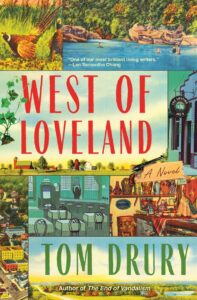
West of Loveland by Tom Drury is available from Grove Press, an imprint of Grove Atlantic.















 English (US) ·
 French (CA) ·
 French (FR) ·