

PROTECT YOURSELF with Orgo-Life® QUANTUM TECHNOLOGY
Orgo-Life the new way to the future Advertising by Adpathway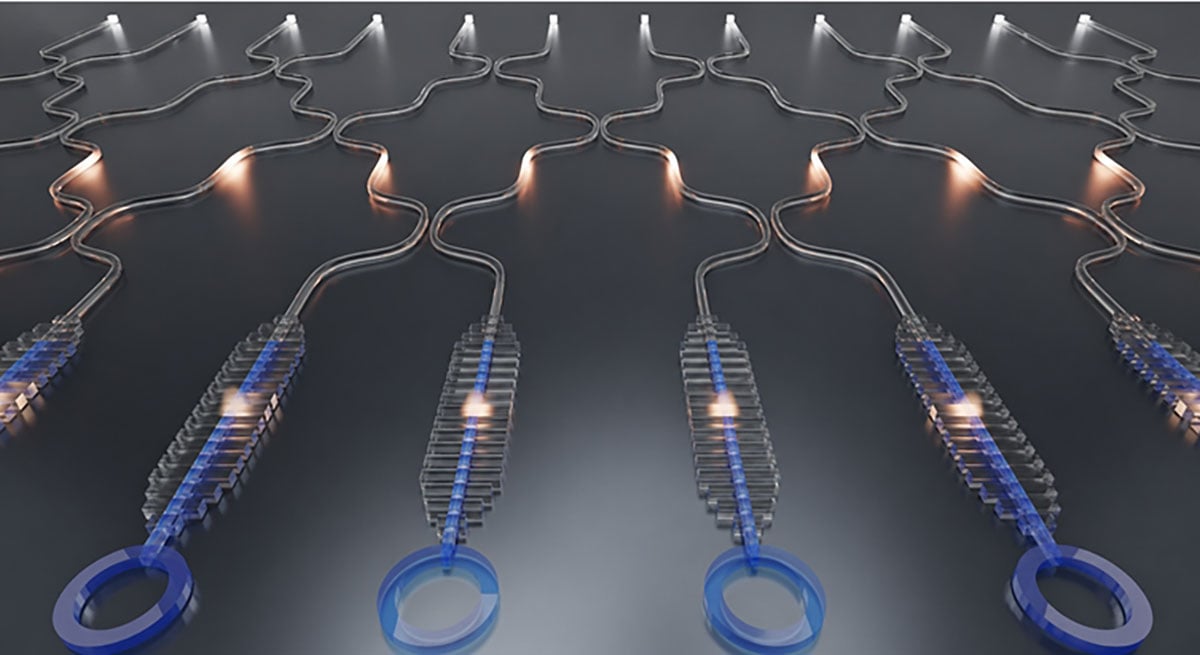 Conceptual illustration of an integrated quantum photonic circuit in which diamond nanobeams containing quantum emitters and spins are embedded within integrated photonic devices. Credit: Shuo Sun et al.
Building a circuit around a tiny diamond beam offers a way to keep more of the light that future quantum computers and networks could use.
Building a quantum network often comes down to a stubborn materials problem. Diamond can host quantum emitters, tiny systems that produce light signals, while other materials are better suited to building the optical circuits needed to carry them. Joining these materials can mean losing light at the very connection meant to pass it along.
Researchers in the United States and the Republic of Korea have connected diamond with titanium dioxide photonic circuits using a fabrication method that helps the components align themselves. Their study, published in Light: Science & Applications, demonstrates how this connection can keep light loss low while allowing a chip to interact with a diamond emitter and guide its light through a circuit.
“We wanted a practical way to combine high-quality quantum emitters with integrated photonics without paying a large price in optical loss,” said Kinfung Ngan, the first author of the study and a graduate student at JILA and the University of Colorado Boulder.
Light and spin on one chip
The researchers guided a tiny beam of diamond into a structure patterned in advance, where it naturally settled into alignment. They then formed the surrounding titanium dioxide photonic device around it. Building alignment into fabrication avoids many of the positioning errors that have caused extra light loss in earlier attempts to connect quantum emitters with optical circuits.
With the materials joined, the diamond supplied the light, and the titanium dioxide circuit provided a route for it to travel through the chip. The light source was a silicon-vacancy center, a tiny defect in the diamond’s atomic structure. By confining light around this emitter in a hybrid optical cavity, the team enhanced its emission. They also demonstrated that light from the emitter could be routed through the circuit.
The chip also allowed the researchers to set the emitter’s spin to an initial state and read that state out, giving them access to a quantum property that can carry information.
“By showing enhanced emission, on-chip spin control, and efficient photon routing in the same platform, this work points to a realistic path toward scalable quantum photonic chips,” said Dongyeon Daniel Kang, a corresponding author of the study and a senior research scientist at the Korean Institute of Science and Technology.
Building the circuit around the diamond
The platform can accommodate more advanced designs for collecting light efficiently across a broad range of wavelengths. That compatibility could allow researchers to build larger circuits with more functions using the same approach to connecting the materials.
“By overcoming a key integration bottleneck, this work opens exciting opportunities for large-scale photonic quantum processors and quantum repeaters,” said Shuo Sun, the corresponding author, a JILA Fellow, and an assistant professor at the University of Colorado Boulder. Quantum repeaters are devices intended to extend the reach of quantum communication networks.
The authors also say the assembly method could work with quantum emitters and photonic materials beyond diamond and titanium dioxide, extending the approach to other combinations of light sources and circuits.
Reference: “Self-aligned heterogeneous quantum photonic integration” by Kinfung Ngan, Yeeun Choi, Chun-Chieh Chang, Dongyeon Daniel Kang and Shuo Sun, 15 July 2026, Light: Science & Applications.
DOI: 10.1038/s41377-026-02339-w
Funding: National Science Foundation, KIST institutional program, National Research Foundation of Korea, Institute for Information and Communication Technology Planning and Evaluation
Never miss a breakthrough: Join the SciTechDaily newsletter.
Follow us on Google and Google News.























 English (US) ·
  French (CA) ·
  French (FR) ·