

PROTECT YOURSELF with Orgo-Life® QUANTUM TECHNOLOGY
Orgo-Life the new way to the future Advertising by Adpathway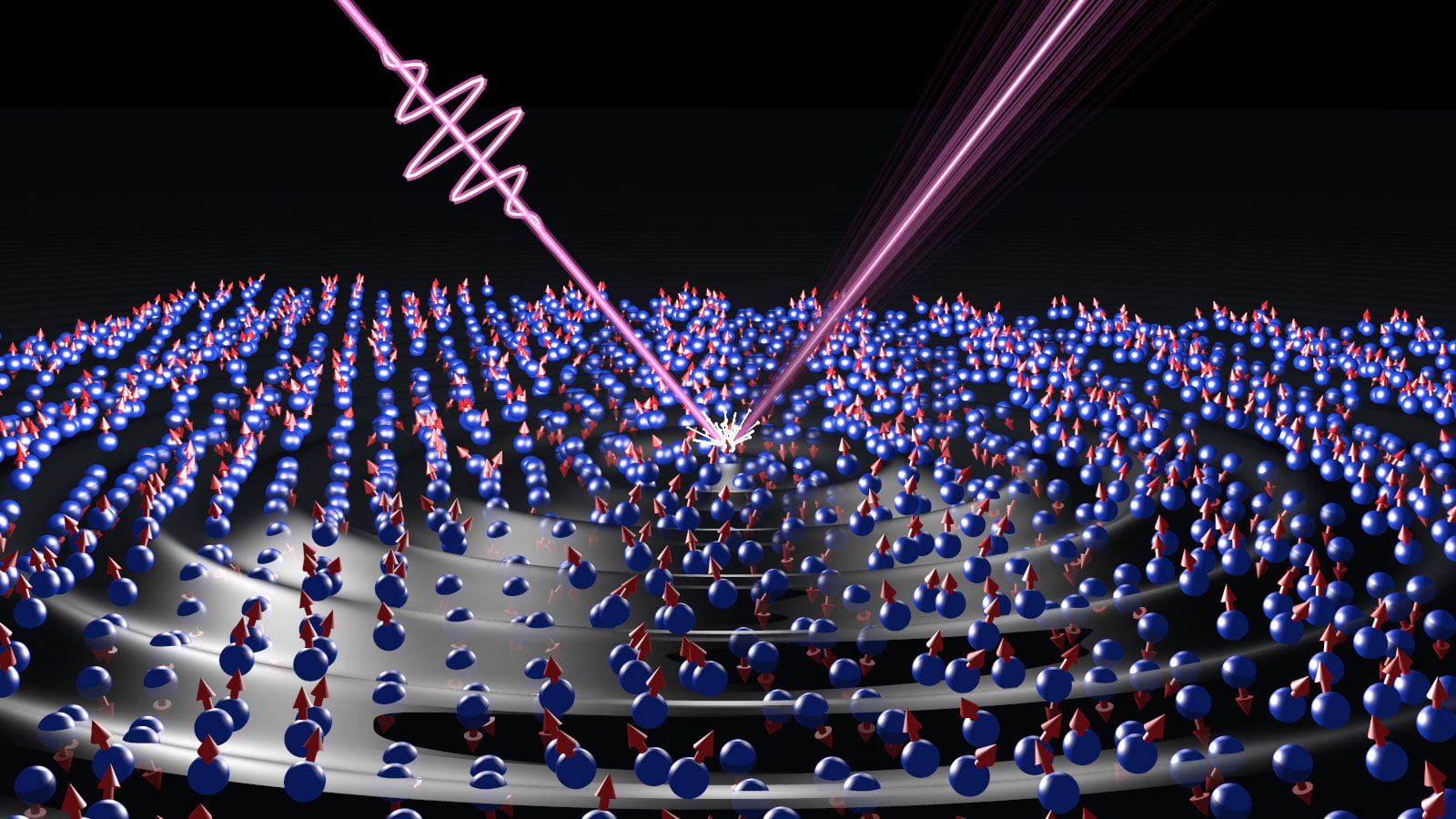 A study has revealed that magnons are surprisingly long-lived – an important insight for designing spintronic materials in the future. In the image, an ultrashort laser pulse triggers collective excitations in an antiferromagnetic material, forming a wave. A new X-ray technique at SwissFEL allowed researchers to follow how these collective excitations, such as magnons, evolve. Credit: Paul Scherrer Institute PSI/Hiroki Ueda
Scientists have discovered that tiny magnetic excitations can persist much longer than expected.
Magnetic waves inside a quantum material can hold onto their energy far longer than scientists expected, potentially opening a path toward faster computers that consume less electricity. Researchers at the Paul Scherrer Institute (PSI) discovered that these microscopic excitations survive for an unusually long time before transferring their energy to the surrounding crystal structure. That delay could provide enough time to perform the logical operations needed for future computing technologies.
Using advanced X-ray techniques, the team tracked how energy moves among electrons, magnetic excitations, and vibrating atoms across extremely short timescales. “We have now investigated the dynamics of these excitations and, in doing so, have been able to reveal in unprecedented detail all important aspects that happen in the material with a microscopic view,” says Hiroki Ueda, who led the project at PSI. “We are particularly interested in the interrelationship between the various excitations in the material,” explains Ueda.
Computing With Spin Waves Instead of Moving Electrons
Conventional computer chips rely on moving electrical charges through silicon, a process that generates heat and consumes energy. As transistors become increasingly difficult to shrink and demand for computing power continues to grow, researchers are investigating alternative ways to process information. One promising approach is spintronics, a field whose name combines “spin” and “electronics.” Instead of depending entirely on the movement of electrons, spintronic devices could transmit information by manipulating their magnetic properties.
Electrons possess a quantum property called spin, which makes them behave somewhat like tiny magnetic compass needles. When neighboring spins move collectively, they can produce waves called magnons. These waves can carry information through a material without requiring electrons themselves to travel along the same path. The process resembles a stadium wave, where a pattern moves through the crowd even though individual spectators remain in their seats.
Another type of excitation, known as a phonon, represents vibrations of atoms within a crystal lattice. Magnons and phonons are both classified as “quasiparticles” because they behave like entities with measurable energy and momentum without being individual physical particles (such as atoms, electrons, or photons). Understanding how these two types of excitation exchange energy is essential for determining whether spin waves can be controlled efficiently in electronic devices.
Following Magnetic Excitations Across Tiny Fractions of a Second
To investigate these interactions, the researchers studied copper oxide, a magnetic material in which atomic vibrations and magnetism strongly influence one another. “We chose copper oxide because it is a well-known magnetic material with strong interactions between magnetism and the lattice,” said publication first-author Arnau Romaguera of the PSI Center for Photon Science.
The experiment began with an intense, ultrashort laser pulse that excited electrons in the material and triggered coordinated changes in their spins. Magnons emerged within femtoseconds (one quadrillionth of a second). Over the following picoseconds (one-trillionth of a second), the magnons scattered off one another, producing a disordered mixture of magnetic waves.
The transfer of energy from magnons to the vibrating crystal lattice occurred much later, on the scale of nanoseconds (one-billionth of a second). During this process, magnetic excitation energy was converted into phonons. Although a nanosecond is extraordinarily brief in everyday terms, it is a relatively long lifetime for excitations produced by processes occurring on femtosecond timescales.
Why the Magnetic Waves Survive So Long
“Considering the strong coupling between magnetism and the lattice of copper oxide, we were surprised how long it then takes the generated magnons to pass their energy to the lattice,” says Romaguera. Despite the strong connection between the material’s magnetic and atomic properties, the magnons retained their energy much longer than anticipated.
The explanation involves differences in how the two kinds of excitations carry energy and momentum. “The magnons and phonons exhibit very different relationships between their momentum and energy values,” explains Ueda. These differences restrict how efficiently energy can pass from magnetic waves into atomic vibrations.
“This modulates the efficiency in which magnons can transfer their energy to the lattice, leading to the long lifetime of the magnons and providing us with important insights into how to use specifically designed materials to adjust the lifetime of the magnons as desired.”
By selecting or engineering materials with suitable properties, researchers may eventually be able to control how long magnons persist. Longer lifetimes could give spintronic circuits more time to manipulate magnetic signals before their energy dissipates, potentially supporting fast logical operations with reduced power losses.
Advanced X-Rays Reveal the Quantum Energy Flow
Capturing the full sequence required observing different microscopic processes across timescales separated by six orders of magnitude. Earlier experimental approaches could measure individual aspects of spin wave behavior, but they could not provide a unified view of how electronic, magnetic, and lattice excitations interact.
“We used several X-ray techniques for this,” says Romaguera. “What they all have in common is that a highly brilliant X-ray pulse from a free-electron laser is directed at the sample shortly after the optical laser pulse that generates the magnons.”
This approach, known as the pump-probe technique, allows scientists to reconstruct the evolution of a material by changing the delay between the initial optical laser pulse and the X-ray pulse used to examine its response. The team combined two established X-ray methods with a novel application of “time-resolved resonant diffuse scattering.” Experiments took place at the Furka experimental station of SwissFEL (FEL for “free-electron laser”) at PSI, with additional measurements performed at the ESRF synchrotron in Grenoble, France.
Bringing Spintronic Computing Closer to Reality
The researchers also used quantum kinetic simulations to model the transfer of energy among the different excitations. Comparing these calculations with the experimental measurements helped establish whether existing theoretical descriptions could reproduce the observed behavior.
“Our measurements are largely consistent with the theoretical calculations,” explains Ueda. The agreement supports the underlying physical models, although they will need to be adapted to account for the structures and properties of different materials.
Reference: “Hierarchical quasiparticle dynamics in antiferromagnets revealed by time- and momentum-resolved X-ray scattering” by Arnau Romaguera, Elizabeth Skoropata, Yun Yen, Biaolong Liu, Abhishek Nag, Shih-Wen Huang, Ludmila Leroy, Katja Sophia Moos, Gian Parusa, Serhane Zerdane, Ritwika Mandal, Céline Mariette, Matteo Levantino, Eugenio Paris, Luc Patthey, Ekaterina Pomjakushina, Urs Staub, Monica Ciomaga Hatnean, Michael Schüler, Elia Razzoli and Hiroki Ueda, 29 September 2026, Nature Communications.
DOI: 10.1038/s41467-026-77964-5
Never miss a breakthrough: Join the SciTechDaily newsletter.
Follow us on Google and Google News.

















 English (US) ·
 French (CA) ·
 French (FR) ·