

 2 months ago
70
2 months ago
70
PROTECT YOURSELF with Orgo-Life® QUANTUM TECHNOLOGY
Orgo-Life the new way to the future Advertising by Adpathway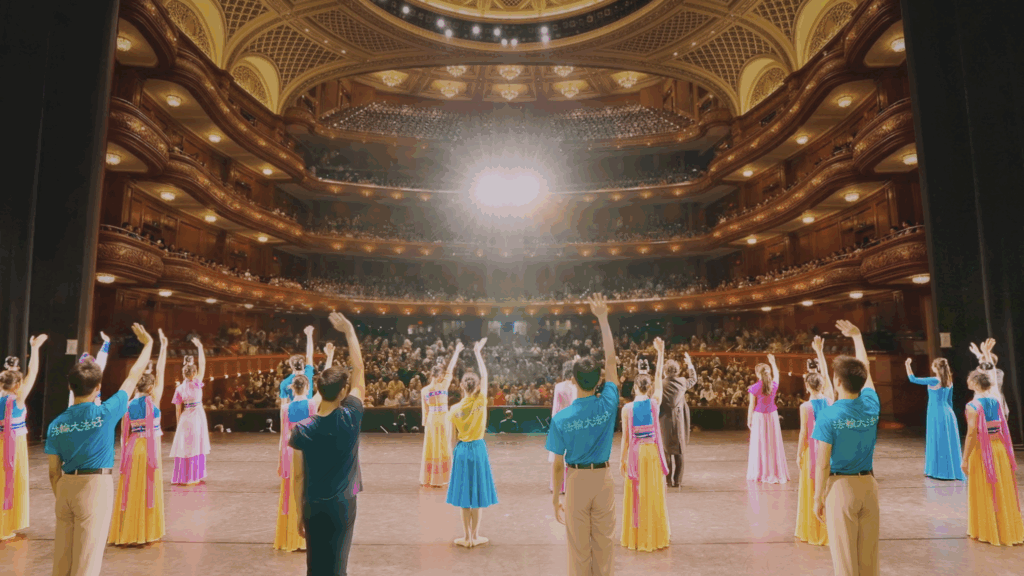
Still from UNBROKEN: The Untold Story of Shen Yun. © 2026 Sincere Films, courtesy of Paulio Shakespeare and NTD.
There’s this old joke from the Cold War. An American is on a flight next to someone from the USSR; they strike up a friendly conversation. The American says: “I’m really impressed by your country’s propaganda. It’s so persuasive, so sophisticated.” The Soviet is sheepish. “Thank you, but it’s nothing compared to yours,” he says. The American blanches. “What do you mean? We don’t have propaganda.” The Soviet laughs.
For a decade now, online misinformation has been a core anxiety for politically engaged Americans: a warehouse or an airplane hangar full of Russians at desktop computers, wearing headsets, Putin himself on a dais with a conductor’s baton leading them through a regimen of slanderous Facebook posts about Hillary Clinton. Of course, the most effective social engineering is subtler and more insidious, and any foreign power’s attempt at social engineering pales beside what American intelligence has done here for at least the past century. There’s something quaint, even charming, about the MSNBC dads who became convinced that Bernie Sanders’s youth support was a psyop, but would laugh you out of the room if you cited a CIA operation that had been declassified for decades.
But it’s hard to be too tough on those who are suddenly aware (or: “aware”) of top-down plots to mislead Americans. For some time now, the internet has felt like a petri dish for useful confusion, lab-grown paranoia multiplying so fast it can’t help but break containment. Even the most credulous adults today suspect that the news ecosystem—outside of their chosen sources—is a sham. That belief is the very engine behind the hugely profitable conservative media sphere. Here is the disease, a man with a coiffed beard who wants us to RETVRN to some imagined state of ethnonationalist bliss will say. The cure is a digital subscription.
It helps that most users have a vague sense that the communication we witness online is partially, even largely, a scam—chatbots and bad actors feigning sincere communication to rig elections and juice advertising fees. If these plots are ever made public, they tend to have an elaborate through-the-looking-glass quality. In June, a Wired investigation found that Meta had directed employees to pose as suicidal teens in an attempt to bait rival tech companies’ chatbots into giving dangerous, legally actionable advice. What a climax to the last quarter-century of life online: a company worth more than $1.5 trillion entrapping robots on behalf of the hypothetical teens said company has been psychologically terrorizing for its entire existence.
All this to say: what a relief, a breath of fresh air, to be reminded what the barest, sloppiest propaganda can look like. UNBROKEN: The Untold Story of Shen Yun, which purports to be a documentary defending the famous dance company against allegations that it mistreats its performers and other employees, would be an effective tool to teach adolescents how the syntax of news can be wholly divorced from anything resembling reality. The film, which is available online and recently had its Los Angeles premiere, is at points so silly that it’s sincerely funny, like when a supposed journalist in supposedly candid footage draws an organizational chart on a whiteboard and circles Xi Jinping’s name at the top. By the end, though, it becomes a bizarrely comforting artifact of a time when no one seemed to know that it was legal to lie.
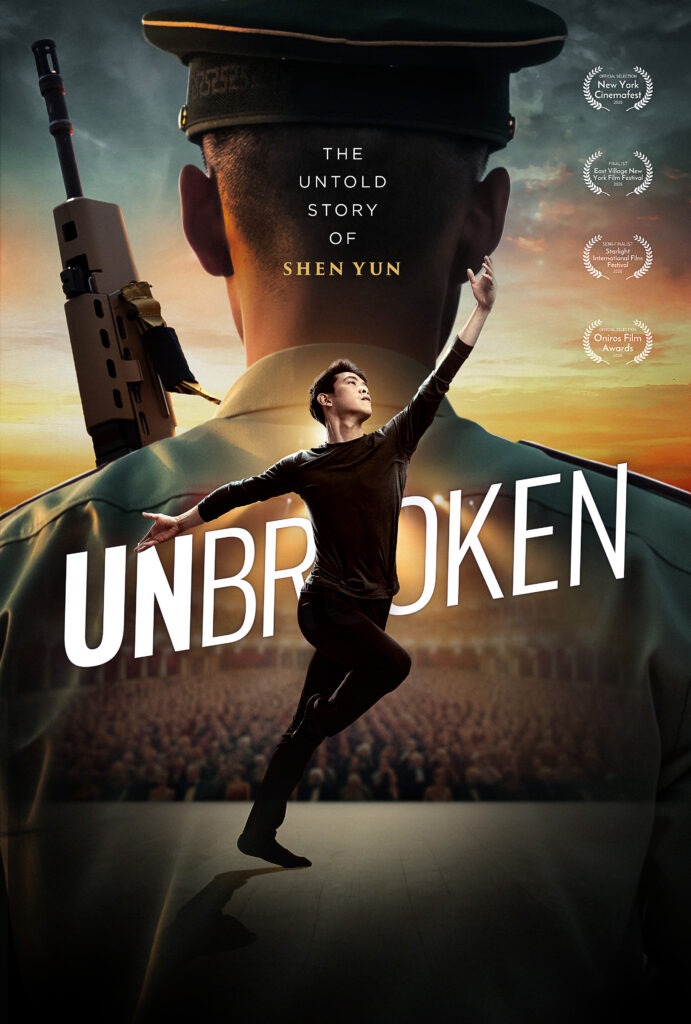
Poster for Unbroken: The Untold Story of Shen Yun. © 2026 Sincere Films.
Shen Yun was founded as a nonprofit in 2006 by Chinese expatriates who were members of the Falun Gong spiritual movement—and by Li Hongzhi, the movement’s leader. In 1999, China issued an arrest warrant for Li; since then, Li, who has claimed that races of people will be separated once they get to heaven and that the gods have a plan to eliminate gay people, has lived in New York State. Over the past twenty years, the company has grown to include nearly five hundred dancers, who are divided into several different troupes and blanket the world with performances (you can buy tickets for 2027 dates in Worcester, Massachusetts, and Richardson, Texas). The company markets itself through fliers on subways and at bus stops, as well as print ads and pamphlets tucked under windshield wipers, advertising a glimpse of “China before communism.” In the course of doing so, Shen Yun has amassed considerable wealth. In 2024, a New York Times investigation into the dance franchise estimated that its holdings hovered around $265 million.
Beyond the tagline about communism, that ubiquitous advertising makes no mention of an ideological bent to the show. And so crowds of all ages sit down for what they imagine is a historically informed dance revue and are subjected instead to allegations that the Chinese government is harvesting the organs of Falun Gong practitioners and that the theory of evolution is a mask hiding an “evil specter.”
Li oversees Shen Yun from Dragon Acres, a 427-acre compound in upstate New York (complete with a statue of Buddha whose face looks oddly like Li’s) where many Shen Yun dancers live and train. Some arrive before they’ve turned twelve years old. The 2024 Times report detailed rampant and systemic abuse within the organization: dancers being discouraged from seeking medical care (on the basis that Falun Gong’s spiritual practices generally, and Li specifically, can cure illness and injuries, but also presumably to control costs); employees working fifteen-hour days without pay; and, perhaps most troublingly, people being barred from leaving the compound or communicating with outsiders. Performers who hoped to leave “were told that they would go to hell,” the Times reported, “or face stiff financial penalties, or be put in physical danger if they lost Mr. Li’s spiritual protection.”
At its beginning, UNBROKEN appears to be about Lucas and Jesse Browde, Chinese American brothers who joined Shen Yun as teenagers. Their white father, Levi, is introduced in unassuming fashion, the supportive aw-shucks dad who says he knew nothing about Shen Yun when his boys asked to try out. And maybe that’s true! But probably not, because Levi is the executive director of the Falun Dafa Information Center, an organization “dedicated to ending the human rights abuses against people who practice Falun Gong in China.” His LinkedIn profile says he’s been in the role since 1999.
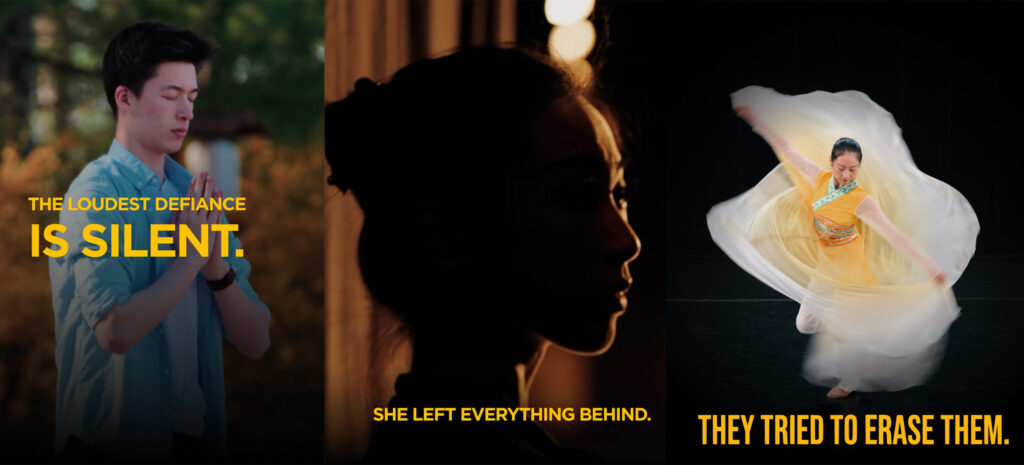
Social media assets for UNBROKEN: The Untold Story of Shen Yun. © 2026 Sincere Films.
In 2024, I edited an essay by the writer Arielle Gordon about her grandmother’s falling victim to the algorithmic winds and becoming a devoted reader of The Epoch Times. The far-right publication is an instrument of the Falun Gong in the English-speaking world, though, as Gordon points out, you wouldn’t know it from the publication or its masthead. As with the Trojan Horse element of Shen Yun shows, Epoch mostly traffics in banal culture-war slop, reactionary angles on world news, and seemingly innocuous health and consumer explainer pages. There is no funnel toward a bullet-point list of Falun Gong principles or legislative goals, just a giant, invisible hand turning dials.
In her piece, Gordon noted that the collapse of print and digital media had been crucial in Epoch’s rise to quasi-respectability, as legitimate but un- or underemployed journalists desperate for gigs have laundered Epoch’s reputation. Two years later, I think it’s now clear there’s another key element: the continued degradation of the online news environment. AI has accelerated the already uncontrollable infestation of automated or nearly automated news so much so that legitimate reporting is obscured not only by ideology, but by the internet’s very architecture. (It doesn’t help that, in an effort to claw their way back to solvency, many major daily newspapers have barely functioning websites beset with pop-up ads.) It’s all been dragged down to a distinctly embarrassing level; if no source is obviously and irrefutably trustworthy, then people are not only free but encouraged to construct their own realities.
UNBROKEN is produced by Steve Lance, the Washington bureau chief of NTD, which can broadly be understood as the television equivalent to The Epoch Times. (NTD stands for New Tang Dynasty, but you have to go to the “About Us” section of its website and scroll past a six-paragraph summary to find those words written anywhere.) Lance fancies himself a journalist, but in the film, he mostly poses for staged B-roll in which he takes notes while wearing a suit and looks gravely concerned as Shen Yun sources tell him nakedly ridiculous things.
If you spend any time online these days, you’ve witnessed the phenomenon of people posting screenshots of arguments they’ve participated in, oblivious to the fact they come across as the insane party. During a scene in UNBROKEN, Lance calls one of the authors of the Times piece, Michael Rothfeld, and basically asks him to go through the allegations in the piece and defend them one by one, as well as answer for why the Times did not interview the alternate sources Shen Yun sought to provide. Rothfeld responds how anyone would: he declines. In another scene, Lance says that he wants to investigate the allegations himself—a mission he undertakes by asking Shen Yun’s lawyers. At the LA premiere, when he said this in voice-over, I laughed, only for a couple two rows in front of me to turn around and glare.

Social media asset for UNBROKEN: The Untold Story of Shen Yun. © 2026 Sincere Films.
The documentary offers a litany of unsurprising and unpersuasive explanations for the critiques of Shen Yun and the Falun Gong: the protesters handing out information about Shen Yun’s abuse are paid; the American news media is in bed with the Chinese Communist Party. Why would the New York Times not want to talk to all the dancers we offered them who say they have been to doctors? At one point, Shen Yun’s longtime emcee, Leeshai Lemish, shows Lance a glossy photograph of a slashed tire. This is apparently one of the tires from a Shen Yun tour bus, which Lemish alleges, bizarrely, has been slashed with a special technique—designed to stagger the loss of air, such that the tire wouldn’t deflate immediately, but would explode on a delay, while the bus is on a highway. A terrorist attack, he says. Setting aside the coyote-versus-roadrunner physics, it is an absolute delight to watch Lance in this interaction: the Journalist seeking Truth, awed by a blurry photograph with no context, with no proof of intent, and which could very easily have been fabricated entirely.
It is neither surprising nor telling that UNBROKEN fails to truly enumerate the Times’s allegations. This is standard crisis comms: keep your own accounting of the charges against you vague enough that you can set the terms of their litigation. What’s notable, though, is the film’s reticence to articulate what Shen Yun or the Falun Gong actually do believe in. As this iteration of the American right wing has consolidated power, its coalition has become less dominated by evangelicals; perhaps Shen Yun knows that its hyperreligiosity (including the suggestion that Li himself is divine) would turn off even politically aligned Western audiences. In any case, we are told repeatedly that it is Important that the company spread its Message; we’re simply not told what that message might be.
UNBROKEN is so laughably ineffective at making its central argument that by its end I was playing four-dimensional chess against myself. I’m supposed to feel this way, I thought—the obvious rhetorical, journalistic, and legal failures are misdirection for something else. I briefly entertained the theory that its director, Fiona Young, was a double agent, intent on destroying Shen Yun from within. (This was before I watched her other most recent project, The Real Story of January 6 Part 2: The Long Road Home.) But it’s hard to walk away from UNBROKEN without feeling as if your grandfather has given you a nickel to take your sweetheart to a malt shop. The idea that any of this would persuade a viewer is so outdated that the film might as well be in sepia. Maybe we have RETVRNED after all.
Paul Thompson is the editor-in-chief of POW Magazine. His criticism, essays, and profiles have appeared in GQ, Pitchfork, New York, Playboy, the Washington Post, and Rolling Stone, among other publications; his fiction has appeared in Hobart. He was previously the senior editor of the Los Angeles Review of Books.



















 English (US) ·
  French (CA) ·
  French (FR) ·