

 3 hours ago
6
PROTECT YOURSELF with Orgo-Life® QUANTUM TECHNOLOGY
Orgo-Life the new way to the future Advertising by AdpathwayAnother new show, another old story. This film-to-stage adaptation is from the 2006 German-language romantic thriller about Stasi surveillance and suppression of art in the former GDR. The accompanying, now almost obligatory, high-prestige screen actor is Keira Knightley, presumably whipping up ticket-selling frenzy and stage-door brouhahas.
Except this production is helmed by theatre wunderkind Robert Icke, whose work is marked by the utmost integrity and who has a record of making fast-moving, suspense-filled work of canonical material (from the Greeks in Oedipus and Oresteia to Arthur Schnitzler’s Professor Bernhardi reimagined as The Doctor).
Icke chooses a difficult story to adapt and direct here. The film follows a Stasi officer who secretly changes sides while spying on a writer and his girlfriend. So much of the power of Florian Henckel von Donnersmarck’s Oscar-winning drama lies in subtlety: a maelstrom of emotion rumbling beneath a taut surface, and the understated brilliance of late actor Ulrich Mühe, who played Stasi captain Gerd Wiesler, and was himself a former East German with a backstory involving the Stasi.
All that is conveyed by inference and suggestion in the film but takes on the feverish nature of a melodrama on stage. Luke Thompson plays writer George Dreyman, and seems too puppyish in the role. Knightley is his girlfriend, Christa-Maria Sieland, a stage actor and the object of jealous lust for venal government minister Hempf (Andrew Woodall), who seeks to destroy Dreyman so he can claim her. She gives a committed performance, but the character feels overheated and underwritten. She wears glamorous dresses with cinched waists and coiffed hair, looking like a woman who could be from wartime Berlin rather than 1980s East Germany, and quotes lines from Romeo and Juliet which hang oddly: this couple are not star-crossed teenagers but grownups carrying their own secrets.
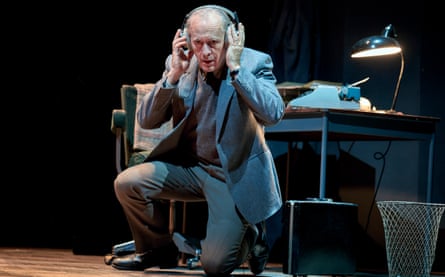
Dillane’s Wiesler sits listening to these secrets after their apartment has been bugged. He also weaves physically between them, and it is a theatrical way of showing the intimacy and intrusion building in his surveillance. But where the film was able to deliver Wiesler’s interiority through lingering closeups and looks, there are fewer ways of opening up his inner world when the story relies on the same mode of suggestion to convey his disenchantment with a system he has believed in, but which he now realises is corrupt or exploited by Grubitz and Hempf.
Wiesler stays largely silent, although he interacts with his boss Grubitz (Paul Higgins), who really is grubby.
His inner change is portrayed too subtly and not subtly enough. He lies curled and sobbing when he hears Dreyman playing the piano, after the news that his artist friend has hanged himself. The sobbing suggests a new appreciation of the arts but it does not feel enough for his dramatic shift.
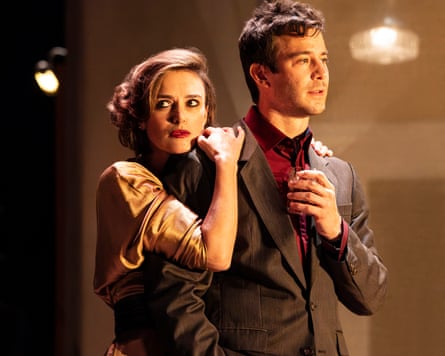
Icke makes a good decision to centralise the drama so that much of it is enacted from Dreyman’s apartment, but would Hempf really assault Christa-Maria in a place he has instructed the Stasi to monitor? When the Stasi find the hiding place for a smuggled typewriter which is central to the plot, why does Dreyman start shouting at Christa-Maria in front of them about her (presumed) betrayal – wouldn’t this raise further suspicion rather than lead the Stasi to drop their investigation? And is that David Bowie’s Sound and Vision playing in a cafe where Christa-Maria and Wiesler meet? Listening to music from the west might have been a private act of defiance for artists, but wasn’t it publicly banned in the GDR?
These are small threads but they do not contain Icke’s signature meticulousness. A penultimate scene features a TV interview with Dreyman, who explains the entire story, twist and all, to his interviewer, and to us. It is a coda we shouldn’t need.
“Writers are engineers of the soul,” Hempf says, borrowing a phrase from Stalin about the power, and therefore the danger, of art. You don’t have to be living in the former GDR to find evidence of artistic suppression: Sally Rooney’s work in the UK is one case in point, the Home Office’s ban on the pro-Palestinian Swedish author Andreas Malm from entering the UK, is another. This story should hit home, given its underlying anxiety and anger about the political will to control and diminish art; sadly, it doesn’t.
Where the production excels is in raising suspense through stagecraft, especially the thuds of sound, lighting and whirl of movement. The face of the stage sometimes becomes a camera shutter, expanding and contracting threateningly. Hildegard Bechtler’s set design transforms from interrogation room to the couple’s revolving home with diaphanous screens that leave all secret activity exposed. These elements become bigger and come faster, bringing their own exciting momentum.
Is this enough to justify an adaptation? Some may think so. The osmotic relationship between film and the West End stage is not inherently toxic. Enough adaptations have shown that films can become their own thing on stage. But to me, this does not manage the immensely difficult task it sets itself.























 English (US) ·
 French (CA) ·
 French (FR) ·