

 1 month ago
24
1 month ago
24
PROTECT YOURSELF with Orgo-Life® QUANTUM TECHNOLOGY
Orgo-Life the new way to the future Advertising by AdpathwayBeyond the Mekong | Economy | Southeast Asia
A logistics specialist discusses the nuts and bolts of getting goods to market as the U.S.-Israeli war with Iran continues into its second month.
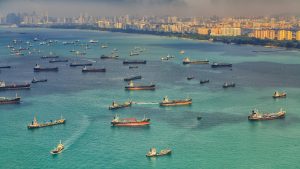
Cargo ships approach Singapore, one of the world’s busiest shipping hubs, after passing through the Malacca Strait.
Credit: DepositphotosChris Catto-Smith is a logistics specialist, a career that began with the Royal Australian Air Force in the 1970s. He then moved into the private sector and used his experiences in Southeast Asia and the Pacific Islands, helping farmers and small businesses in getting their goods to market.
It’s a difficult job made harder by the U.S.-Israeli war in Iran that has upended oil deliveries through the Straits of Hormuz, which Catto-Smith says has led to “vessel bunching” out of ports like Singapore resulting in supply chain disruptions and lengthy delays.
As a result, perishable goods are rotting before they can be delivered and that is punishing financial returns for farmers at the gate and leading to higher prices in Southeast Asian markets where people by their food.
Catto-Smith, managing director of Freshport Asia, returns to Beyond the Mekong where he spoke with The Diplomat’s Luke Hunt in Kampot, Cambodia, about the issues confronting supply chains and what can be done to mitigate the impact of the war in Iran.
This is in addition to his usual work which aligns with Corporate Social Responsibility, or CSR, where he focuses on cold storage and the logistics needed in remote areas, where crops are grown but infrastructure and post-harvest skills required for market are lacking.












 English (US) ·
  French (CA) ·
  French (FR) ·