

 2 months ago
27
2 months ago
27
PROTECT YOURSELF with Orgo-Life® QUANTUM TECHNOLOGY
Orgo-Life the new way to the future Advertising by AdpathwayThe Web3 gaming sector has shifted focus from early speculative token models toward building sustainable gameplay, high-performance infrastructure, and seamless player onboarding. Modern video game development requires networks that can process thousands of microtransactions per second without disrupting gameplay mechanics or charging prohibitive gas fees.
You can open Table of Contents show
Selecting the right blockchain platforms for game development determines how assets are minted, how smart contracts execute game logic, and how players interact with digital economies. Whether you are building an indie 2D card game or a high-fidelity AAA multiplayer shooter, this guide details the top blockchain networks powering interactive games today.
Ethereum Layer-2 Blockchain Platforms for Game Development
Layer-2 (L2) scaling solutions leverage the underlying security and decentralization of the Ethereum network while processing transactions off-chain to reduce costs and increase speed.
1. Immutable: Specialized Web3 Gaming Infrastructure
Immutable (featuring Immutable zkEVM and Immutable X) is purpose-built to eliminate technical barriers for game developers and players. Powered by zero-knowledge rollups, Immutable enables gas-free NFT minting and trading for players while giving developers EVM compatibility to deploy custom smart contracts.
-
Architecture: Ethereum Layer-2 (zk-Rollup and zkEVM).
-
Core Languages: Solidity and EVM-compatible bytecode.
-
Key Strength: Immutable Passport offers passwordless, non-custodial onboarding, allowing traditional gamers to log in without managing raw private keys or seed phrases.
2. Polygon: EVM Compatibility and Scalable CDK Rollups
Polygon has established itself as one of the most widely adopted ecosystems in Web3 gaming. Through its Chain Development Kit (CDK), studios can deploy custom zero-knowledge Layer-2 chains tailored to specific game economies, maintaining full interoperability with the broader Polygon ecosystem.
-
Architecture: Ethereum Layer-2 Sidechain and zk-CDK Application Chains.
-
Core Languages: Solidity, Vyper, and Rust.
-
Key Strength: Extensive developer documentation, deep liquidity, and native integration with major engine plugins for Unity and Unreal Engine.
3. Arbitrum Orbit: Customizable Layer-3 Gaming Chains
Arbitrum is a leading optimistic rollup ecosystem that allows developers to launch dedicated Layer-3 (L3) Orbit chains. Utilizing Arbitrum Stylus, programmers can write smart contracts in high-performance languages like Rust and C++ alongside standard Solidity, drastically reducing compute overhead for complex on-chain logic.
-
Architecture: Ethereum Layer-2 and Layer-3 (Optimistic Rollup).
-
Core Languages: Rust, C, C++, and Solidity via Arbitrum Stylus.
-
Key Strength: Allows studio teams to build custom sub-networks with dedicated gas tokens and low execution costs.
Dedicated Ecosystems and App-Chains for Web3 Gaming
Custom application chains (app-chains) isolate a game’s network traffic from general public activity, preventing network congestion caused by unrelated decentralized finance (DeFi) trading spikes.
4. Avalanche Subnets: Dedicated Application Architecture
Avalanche allows developers to spin up isolated, highly scalable subnetworks called Subnets. Subnets allow studio teams to define custom gas tokens, set validator rules, and isolate game state processing to ensure consistent throughput for resource-intensive titles.
-
Architecture: Multi-Chain Layer-1 with Custom Application Subnets.
-
Core Languages: Solidity, Go, and C++.
-
Key Strength: Predictable performance and complete control over validator sets and compliance requirements.
5. Ronin Network: Proven Infrastructure for Gaming Communities
Originally created by Sky Mavis to support Axie Infinity, Ronin has evolved into a dedicated EVM-compatible blockchain designed exclusively for gaming apps. Optimized for high transaction volumes and minimal gas fees, Ronin provides built-in community distribution channels and gaming wallet integrations.
-
Architecture: EVM-Compatible Gaming Blockchain (Delegated Proof of Stake).
-
Core Languages: Solidity.
-
Key Strength: Native player base with established user retention metrics across social and mobile gaming communities.
6. WAX: Resource-Staking Model for Digital Collectibles
WAX (Worldwide Asset eXchange) is an established blockchain designed specifically for digital collectibles, NFTs, and microtransaction-heavy games. Operating on a Delegated Proof of Stake (DPoS) consensus model, WAX utilizes a CPU/NET/RAM resource allocation model that allows developers to sponsor gas fees for players entirely.
-
Architecture: Purpose-Built Gaming and NFT Layer-1.
-
Core Language: C++ (EOSIO-based smart contracts).
-
Key Strength: Zero gas fees for end users when developers pre-stake resources for their game contracts.
High-Performance Layer-1 Blockchain Platforms for Game Development
Monolithic Layer-1 (L1) networks aim to process all transactions directly on a single base layer using specialized consensus mechanisms and parallel execution engines.
7. Solana: High Throughput and Sub-Second Finality
Solana uses a Proof of History (PoH) consensus mechanism paired with Proof of Stake to process thousands of transactions per second with sub-second finality. Its low latency makes it a popular choice for real-time multiplayer titles requiring fast on-chain asset minting and inventory swaps.
-
Architecture: High-Speed Layer-1 Blockchain.
-
Core Languages: Rust, C, and C++.
-
Key Strength: Fast transaction finality and minimal fees without relying on Layer-2 scaling bridges.
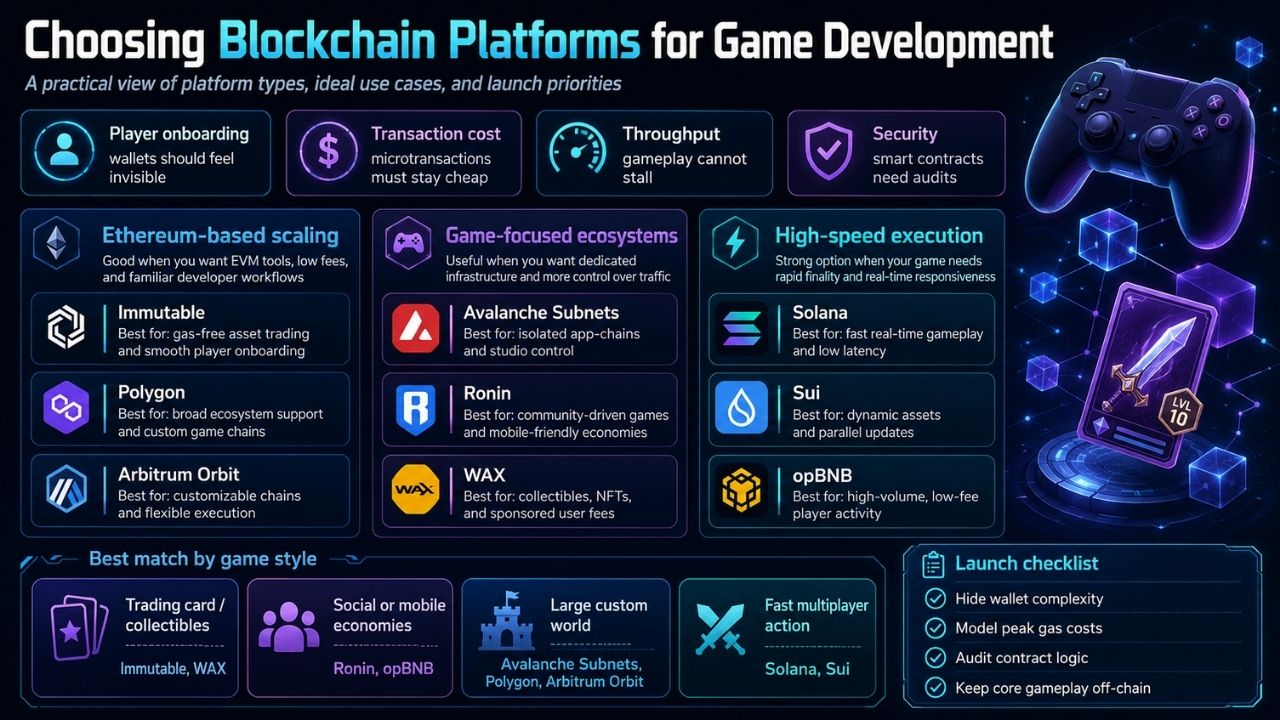 A practical comparison of blockchain platform types, suitable gaming use cases, and essential factors developers should assess before launching.
8. Sui: Object-Centric Data Model and Move Smart Contracts
Sui is a next-generation Layer-1 platform engineered by former Web3 architects from Meta. Sui utilizes an object-centric data model powered by the Move programming language, allowing dynamic NFTs (such as leveling weapons or customizable avatars) to update on-chain attributes instantly without complex smart contract calls.
-
Architecture: Object-Centric Parallelized Layer-1.
-
Core Language: Move.
-
Key Strength: Parallel transaction processing allows independent assets to update simultaneously without bottlenecking the network.
9. BNB Chain and opBNB: High-Volume Retail Ecosystem
BNB Chain offers a dual-layer strategy consisting of the BNB Smart Chain (BSC) and opBNB, an optimistic rollup Layer-2 solution built on the OP Stack. Designed for high transaction volume and fast execution, opBNB offers ultra-low gas fees and direct exposure to a massive retail user ecosystem.
-
Architecture: Layer-1 paired with Layer-2 OP-Stack Rollups.
-
Core Languages: Solidity.
-
Key Strength: Ultra-low transaction fees (under $0.001) paired with deep exchange integration and user reach.
Comparing Top Blockchain Platforms for Game Development
| Platform | Architecture Type | Primary Language | Consensus / Execution | Best Gaming Use Case |
| Immutable | Ethereum Layer-2 (zkEVM) | Solidity | Zero-Knowledge Rollup | Gas-free NFT trading and AAA titles |
| Polygon | L2 Sidechain / zk-CDK | Solidity / Rust | PoS / ZK-Rollups | Multi-platform Web3 game ecosystems |
| Arbitrum Orbit | Layer-3 Custom Chain | Rust / C++ / Solidity | Optimistic Rollup | Custom L3 chains with custom gas tokens |
| Avalanche | L1 Subnets | Solidity / Go | Avalanche Consensus | Isolated app-chains for AAA studios |
| Ronin Network | Dedicated Gaming L1/L2 | Solidity | Delegated PoS | Mobile and community-driven titles |
| WAX | Purpose-Built L1 | C++ | Delegated PoS | High-volume NFT minting & trading |
| Solana | Monolithic Layer-1 | Rust / C++ | Proof of History (PoH) | High-speed, real-time arcade titles |
| Sui | Object-Centric L1 | Move | Parallelized Execution | Dynamic NFTs and customizable assets |
| opBNB | Layer-2 Rollup | Solidity | Optimistic Rollup | High-volume, low-fee mobile games |
Limitations and Trade-offs of Blockchain Platforms for Game Development
Integrating blockchain infrastructure into game engines introduces technical and design challenges that studios must carefully navigate.
Player Onboarding Friction
Requiring players to set up external crypto wallets, manage seed phrases, and buy native tokens before starting a game severely degrades player conversion rates. Successful Web3 games bypass this friction by integrating invisible wallet solutions (such as Immutable Passport or Web3Auth) that create non-custodial accounts behind familiar social logins.
Gas Fee Volatility vs. Studio Costs
On-chain interactions cost network gas. If a network experiences sudden congestion, transaction fees can spike unpredictably. Studios must decide whether to pass these costs to players, absorb gas fees using developer-sponsored accounts, or build on dedicated app-chains with controlled resource models.
Smart Contract Security Audits
Unlike traditional server code that can be patched instantly, deployed smart contracts are immutable on-chain. Vulnerabilities in asset minting or staking logic can lead to exploited game economies. Game development pipelines must budget time and funds for third-party security audits before launching on-chain systems.
Selecting the Right Blockchain Platforms for Game Development
Selecting among the top blockchain platforms for game development depends on your game’s structural requirements, target target audience, and required transaction throughput. If your priority is effortless player onboarding with zero gas fees, specialized ecosystems like Immutable offer ready-to-use infrastructure. If your title demands fast throughput without layer-2 bridges, high-speed monolithic networks like Solana or Sui provide low-latency execution.
Evaluate the SDK support for your chosen game engine, model your economic gas costs under high player load, and select a blockchain platform that enhances player asset ownership without sacrificing core gameplay performance.
Frequently Asked Questions(FAQs) About Blockchain Platforms for Game Development
Which blockchain platform is best for beginner game developers?
Immutable and Polygon are excellent choices for beginners. Both offer mature Software Development Kits (SDKs) for Unity and Unreal Engine, clear documentation, and EVM compatibility, allowing developers to utilize standard Solidity smart contracts.
How do games prevent players from paying high gas fees for every move?
Modern games store core gameplay loops (like moving, aiming, and shooting) on traditional game servers. Only permanent asset ownership changes, item crafting, and economy settlements are written to the blockchain, minimizing unnecessary gas consumption.
Can I integrate blockchain features into Unity and Unreal Engine?
Yes. All major blockchain platforms for game development provide native engine plugins for Unity and Unreal Engine, allowing developers to manage wallet authentication, query player inventory, and trigger on-chain minting directly in C# or C++ scripts.
























 English (US) ·
  French (CA) ·
  French (FR) ·