

PROTECT YOURSELF with Orgo-Life® QUANTUM TECHNOLOGY
Orgo-Life the new way to the future Advertising by AdpathwayI came of age as a writer reading N. Scott Momaday’s The Way to Rainy Mountain, House Made of Dawn, and Angle of Geese (his creative nonfiction memoir, novel, and collection of poems). Momaday, like Louise Erdrich, Leslie Silko, Joy Harjo, Gerald Vizenor and other tribal writers often created works across the arts. Harjo, who began as a visual artist, we now know as both musician and poet. My Indigenous literary ancestors danced across genre lines.
Article continues after advertisement
My own career began in journalism—I easily fell into other people’s stories. Through the years, I wrote scholarship on Native American literature, created plays, and have always made photos of wildlife and the watery regions I paddled. Before my debut short fiction collection, I published six books of poetry and served as Wisconsin Poet Laureate. Inspired by Anishinaabe pictographs and Native American ledger art, I joined my photography and poetry in a form I call picto-poems. Still when the stories I carried began to insist strongly, this latest extension of my oeuvre—from haiku, lyric, and concrete poetry to fiction—required some careful blending of old skills with new ones.
What happens when a poet of spare lines and gesture turns to fiction? She carries with her the tight construction of the line.
Rereading each draft aloud from start to end point before continuing, as I do with poetry, is impractical ten or fifteen pages into a story. I learned to prime each session with less preamble. In the margins of early story drafts I kept writing the same directions to myself: Expand. Build scene. Include example. While the “more” I called for did often serve the story, I began to see clearly how my poetic tendencies also inspired craft choices that built the energy of the fiction, that gave it a distinctive voice.
What happens when a poet of spare lines and gesture turns to fiction? She carries with her the tight construction of the line. Word play. The training in sonics. The turn, the image, the absence. Each of these elements of poetic craft can serve fiction well—sometimes in unexpected ways.
Dialogue, for example, trips up many fiction writers. The notification that my story “Waiting, A Quintet” had been selected for an O. Henry Prize, included this comment: “The five voices that comprise the quintet are so remarkably unique, yet the poetry and storyline pull them together.” In fiction, each characters’ distinct voice, its unmistakable music, comes in equal parts from cadence and linguistic fingerprint—here poetic attention to rhythm and precise word choice carry over.
I lean heavily into poetic suggestion in my fiction. This practiced restraint can manifest as understatement, unexpected phrasing, or fruitful ambiguity. Restraint in fiction, as in poetry, might also involve absence. An early review of Red Ants noted, “a nuanced ending that…allows some things to remain unspoken.” Indeed, the gesture and absence in my stories place part of the meaning-making into the imagination of the readers. In this particular choice I follow the example of Indigenous storytellers I grew up with who often require the listener to help make the story.
Absence is invitation. Gesture builds story energy. Both the not said and the unsayable—the ineffable—pull new elements into a telling. Just as in poetry, the range of the possible expands beyond the printed words.
In my dark futuristic story, “The Making of Monsters,” my narrator declares, “Don’t ask for the blood-and-gore war story. I could not bear to tell it, nor you to hear it.” Here, the line invokes the possible; the spoken decision not to tell acts as any secret—to whet the listener’s own desire to know. The pathway to that knowing is to enter the story and imagine the unsaid.
In my teaching, I often talk about strategies of generosity. Gesture and absence as invitation always number among them. I often choose to leave an entrance for a reader rather than close down a poem by plotting a definitive reading or including all that could be told. That tendency I carry over to fiction. Ambiguity multiplies intrigue.
Sometimes, however, accumulating the “all” creates a rich foundation for story. As in poetry, details abutted against details—the “is-ness”—evokes the essence of place, person, or incident without the need for bald statement. Sensuous details allow the reader to experience the experience rather than have to satisfy themselves with a summary or explanation of it. With a writing background that includes catalogues or list poems, that includes sense-laden detail, I often employ those strategies of specificity to create the aura of time or place.
In “River Dreams,” I spread the following series of images across several paragraphs: “water winked in the sun, trees on the banks bent low toward the river like they were women about to wash their hair….the wet cedar scent soothed me. I fell into the forever of the river world….breeze lifted the petals of lily pads….A beaver crossed from one shore to the other, a small branch in its mouth. The splat of its tail-warning brought me back.” Readers familiar with northern waterways have the satisfaction of recognition and the opportunity to bring what haiku scholars call their “funded knowledge” to the scene, while unacquainted readers receive some grounding.
Both the not said and the unsayable—the ineffable—pull new elements into a telling. Just as in poetry, the range of the possible expands beyond the printed words.
The above sequence of place-based images also showcases several of poetry’s sonic techniques: alliteration, assonance, and sibilance. I find myself tapping the aural, asking it to perform in fiction in ways similar to its function in poetry. The s and z sounds of cedar scent, soothed, breeze, petals, pads, crossed, shore, and small create a peaceful line of sound that mimics the smooth flow of a river. The onomatopoetic and staccato splat of the beaver tail with its plosive t disturbs the sound pattern as much as it disturbs the imaginary water of the story. That double impact adds emphasis to the action depicted—to the words on the page.
Other decisions I make around sentence or paragraph length (that stand in for lines or stanzas in poetry) enhance the visual architecture of the page. I employ stark one-word sentences or one-line paragraphs for contrast and emphasis. Their visual and aural movements also impact the rising or falling rhythm of sentences. In “Copper Traces,” a bare declaration in a one-line sentence mirrors the isolation of the narrator: “ I have told no one; I have no one to tell.” In the first half of the sentence, the inflection rises, the speaker’s explanation working as a plea for understanding or a question. In the second half of the sentence, the speaker’s tone drops in a painful admission of their aloneness. My craft choices here around the music of the sentence and its visual presentation as a solitary line originate from my work in poetry. The succinct turn within the line, emphasizes a key plot point—the deep aloneness of the narrator.
My long tenure writing poetry means I often use its techniques instinctively. Strong image, which lies at the heart of much poetry, resonates in fiction. A story can turn on image or be remembered through a particularly haunting image. In Red Ants one story features the magnificent Wintermaker constellation, another a half-moon scar on a wolf’s flank. I find the many tools of lyric compliment storytelling, expand its impact. Do I think about each of these choices as I draft a story? No. I write fiction with a poetic inflection because I have honed my poetry muscles over decades.
Neither do I dwell consciously on creating from an Indigenous story aesthetic. I write from an Anishinaabe perspective because that is my identity. Mythic figures, water knowledge, the Anishinaabe language, trickster energy, rez humor, and sometimes unexpected story structures emanate from long immersion in a culture whose story rituals may include song, dance, and raucous humor; in a culture where stories may not “end” in conventional ways. Our stories, after all, must remain alive because they will be retold again in new times and circumstances.
______________________________
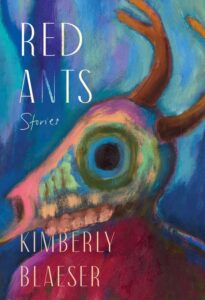
Red Ants: Stories by Kimberly Blaeser is available from Counterpoint Press.
















 English (US) ·
  French (CA) ·
  French (FR) ·