

.png) 2 weeks ago
3
2 weeks ago
3
PROTECT YOURSELF with Orgo-Life® QUANTUM TECHNOLOGY
Orgo-Life the new way to the future Advertising by Adpathway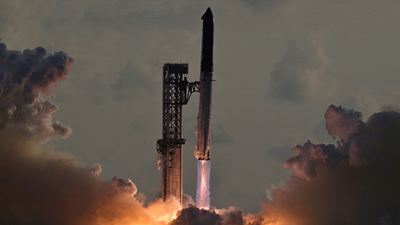
SpaceX launches Starship on first orbital test around Earth (Reuters photo)
SpaceX’s massive Starship reached orbit for the first time on Monday and successfully deployed its most advanced Starlink satellites yet, but the company ended the flight early as a safety precaution.The spacecraft re-entered the atmosphere over the Pacific Ocean and splashed down north of Hawaii about three hours after taking off from Texas. SpaceX had planned a 10-hour flight with six laps around Earth to demonstrate Starship’s readiness for Nasa's Artemis moon programme.Starship tipped over and burst into flames after hitting the water, bringing a dramatic end to the mission.The rocket nearly failed to reach orbit after one of its engines shut down earlier than planned.
However, the other systems were working well and the engine was no longer needed, so flight controllers decided to continue the mission after several tense minutes.“Starship is orbital,” Mission Control announced to cheers.Nasa administrator Jared Isaacman congratulated SpaceX on reaching orbit and “managing every step in a safe, responsible and especially inspirational way.”
Starship deploys 26 advanced Starlink satellites
The 407-foot (124-metre) Starship, the biggest and most powerful rocket ever built, carried 26 of Elon Musk’s latest Starlink satellites.
They were deployed one by one and will join about 11,000 older Starlink satellites already providing internet services.The satellite deployment drew cheers from SpaceX supporters watching from the company’s Starbase launch site in Texas.The decision to end the flight early came soon after the satellites were deployed. SpaceX did not give a reason for cutting the mission short.It was the 14th full-scale Starship launch from the southern tip of Texas in three years.
Earlier test flights travelled no farther than the Indian Ocean, covering about half the Earth, and several ended with the spacecraft crashing or breaking apart in flames.This time, SpaceX wanted Starship to complete six trips around Earth over nearly 10 hours at an altitude of about 170 miles (275 kilometres). The spacecraft reached the planned orbit and travelled at around 17,500 mph (28,000 kph), but flight controllers decided to bring it back after only a couple of laps.The first-stage booster was also not designed to return to the Starbase launch site. Instead, it fell into the Gulf of Mexico within minutes of liftoff.SpaceX wants to make sure Starship is safe before attempting to return it to the launch site. If the spacecraft breaks apart over land and sends debris onto people, “our popularity would diminish very rapidly,” Musk said at a business summit earlier this month. “That’s why we’re being extremely cautious here.”Depending on the findings from Monday’s flight, the next Starship could attempt to return to the launch pad, where giant mechanical arms would try to catch the hovering spacecraft.Musk has said the catch has even or slightly better odds of succeeding. If it works, SpaceX could fly the spacecraft again by the end of this year or early next year.
SpaceX aims to make Starship fully reusable
Starship was designed to be fully reusable, which SpaceX says will help reduce launch costs.
The company recovered its previous Starship from the Indian Ocean in July.Engineers used what they learned from inspecting that spacecraft to modify the heat shield of the newly launched Starship. The recovered spacecraft is now being transported back to Starbase.SpaceX is now pushing to get Starship certified for orbital flights, a major step towards its plans for the Moon and Mars.Nasa's Artemis III mission could launch as early as next summer.
The mission is planned as a three-spacecraft docking exercise around Earth involving an Orion capsule carrying astronauts and two competing lunar landers.Jeff Bezos’ Blue Moon would launch first, followed by Orion. Starship would then launch and dock with Orion after Blue Moon is released.The next mission, Artemis IV, is currently planned for no earlier than 2028.Astronauts could land on the Moon using either Blue Moon or Starship, depending on which spacecraft is ready first.
Later lunar missions are expected to alternate between the two landers.Musk originally developed Starship with Mars in mind, planning to send large numbers of the spacecraft to the Red Planet with the first settlers.For now, however, SpaceX is focusing on the Moon and plans to use Starship to launch large numbers of satellites into orbit. The company eventually plans to phase out its Falcon 9 rocket.A second Starship launch site is nearing completion at Florida’s Kennedy Space Center, while a third site is planned in Louisiana.

























 English (US) ·
  French (CA) ·
  French (FR) ·