

PROTECT YOURSELF with Orgo-Life® QUANTUM TECHNOLOGY
Orgo-Life the new way to the future Advertising by Adpathway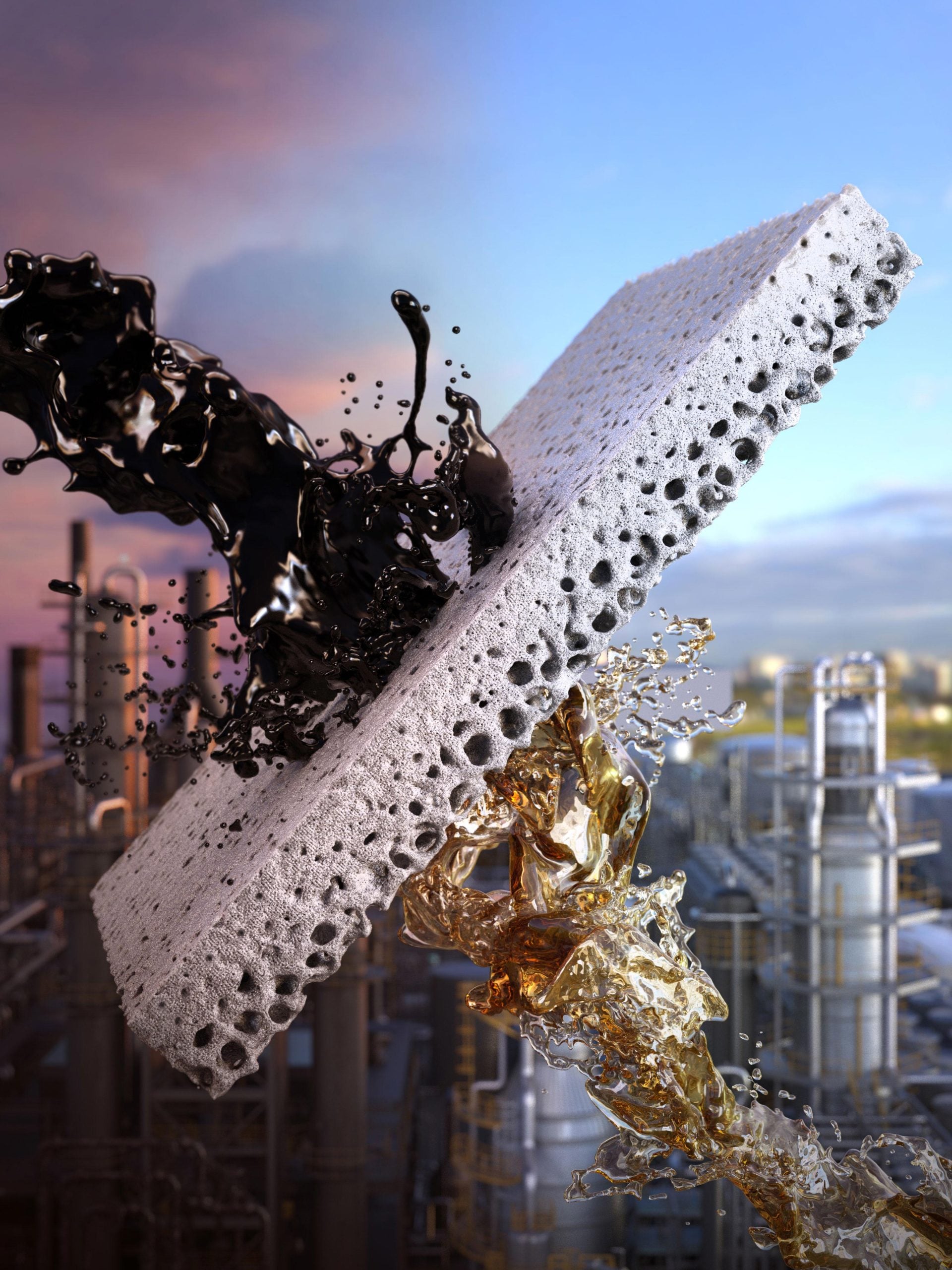 Simple synthetic membrane supports yield surprisingly selective separation of real crude oils at steady state. Credit: KAIST
A simple membrane uses crude oil’s own deposits to separate lighter components at room temperature, with simulations suggesting nearly one-third less energy use when paired with distillation.
Refineries heat crude oil above 350°C (662°F) to separate a mixture that supplies transportation fuels and raw materials for plastics, packaging, textiles, and other consumer products. This century-old process, called distillation, vaporizes the oil and then cools the vapor to recover different fractions. Worldwide, crude oil distillation consumes approximately 1,100 terawatt-hours of energy each year, roughly the annual output of 130 gigawatt-scale nuclear power plants operating continuously.
An international research team has demonstrated a simple, inexpensive membrane that could handle part of this separation at room temperature, without heating. As crude oil flows through it, components of the oil create the narrow channels that allow the membrane to distinguish between lighter and heavier molecules.
The study, published in Nature, was led by Professor Dong-Yeun Koh of KAIST in collaboration with Professor Ryan Lively’s group at Georgia Tech.
Process simulations showed that using the membrane to pretreat crude oil before conventional distillation could reduce energy consumption by 31.6%, carbon dioxide emissions by 37.6%, cooling water use by 20.7%, and operating costs by 36%. Such savings could matter beyond the refinery, since refining costs influence the prices of fuels and many everyday products. Increasing cost pressures in global petrochemical markets have also intensified demand for more efficient separation technologies.
Oil buildup creates the separation channels
Manufacturing membranes for molecularly precise separation has been challenging. Conventional designs require ultrathin surface coatings that raise costs and risk defects at scale. Instead, the team passed crude oil through bare porous polyacrylonitrile (PAN), an inexpensive, chemically stable polymer widely used in industrial membranes.
“This study reveals a new scientific principle in which a membrane interacts with a complex mixture and spontaneously forms its own separation channels. Working with real crude oil supplied by HD Hyundai Oilbank allowed us to validate the technology under conditions relevant to industrial operation,” Koh said.
As the oil passed through the PAN membrane, heavy hydrocarbons selectively deposited on the pore walls. These deposits gradually narrowed the openings, forming separation channels smaller than 2 nanometers. Lighter fractions, including naphtha, gasoline, and kerosene, passed through rapidly, while heavier components were retained. The buildup known as membrane fouling, normally a cause of declining performance, became the mechanism that made selective separation possible.
The bare PAN membrane achieved crude oil permeation rates approximately 23 times higher than those of previously reported state-of-the-art crude oil membranes. It also maintained stable performance for 28 consecutive days.
A refinery retrofit could cut emissions
The technology could fit into existing refineries as a modular filtration unit, reducing the need for major equipment replacement and making adoption easier. Lively said, “One of the key challenges facing membrane systems for crude oil separation was the low productivities of the membrane units – the PAN membranes with their surprising separation mechanism – dramatically increase the productivity of the membrane unit, to the point where industry should seriously consider adopting the technology.”
Distillation remains one of the refining industry’s largest sources of energy consumption and greenhouse gas emissions. If adopted throughout Korea’s refining and petrochemical sector, the membrane technology could reduce greenhouse gas emissions by approximately 10 million metric tons annually, equivalent to the emissions of roughly four million internal combustion vehicles.
Dr. Jihoon Choi and Dr. Hyeokjun Seo of KAIST, the study’s co-first authors, said, “Our goal is to precisely control this spontaneous pore-constriction phenomenon and develop it into a membrane platform applicable to the entire refining process. We also aim to expand the technology to plastic recycling, biofuel purification, and other sustainable chemical processes that support carbon neutrality.”
For waste plastics, a proposed application is purifying pyrolysis oil, the oil obtained by breaking down plastics with heat. Other possible uses include recovering solvents used in battery manufacturing and pharmaceutical purification. These remain potential applications of the membrane platform.
Professor Jae W. Lee of KAIST, a co-corresponding author of the study, said, “By advancing large-area membrane modularization and long-term operational reliability, we hope to broaden the adoption of membrane-based processes throughout the refining and petrochemical industries.”
Reference: “Crude oil fractionation by means of mesoporous polyacrylonitrile membranes” by Jihoon Choi, Hyeokjun Seo, Minyong Lee, Woong-Chul Shin, Jaemin Choi, Keonwoo Choi, Min-Jun Jang, Sung Gap Im, Jae W. Lee, Ryan P. Lively and Dong-Yeun Koh, 24 June 2026, Nature.
DOI: 10.1038/s41586-026-10677-3
This research was supported by the Ministry of Science and ICT of Korea through the Basic Research Program for Outstanding Early-Career Researchers and the Engineering Research Center (ERC) Program.
Never miss a breakthrough: Join the SciTechDaily newsletter.
Follow us on Google and Google News.




















 English (US) ·
 French (CA) ·
 French (FR) ·