

PROTECT YOURSELF with Orgo-Life® QUANTUM TECHNOLOGY
Orgo-Life the new way to the future Advertising by Adpathway Psilocybin, the naturally occurring psychedelic compound found in certain “magic mushrooms,” is gaining attention for its potential to treat depression and other mental health conditions. Credit: Stock
Mouse experiments suggest psilocybin’s ability to rebuild brain connections may be separable from its psychedelic effects, opening new possibilities for non-hallucinogenic psychiatric medications.
Chronic stress can strip away connections between brain cells, disrupting the circuits they form. Researchers at the University of California, Santa Cruz, found that psilocybin, the psychoactive compound in “magic mushrooms,” reshapes this wiring differently in healthy mice and those affected by stress.
The study, published on October 15 in Nature Neuroscience, also identified a group of brain cells that supported new connections without triggering a rodent behavior used as a proxy for hallucinogenic activity.
“I consider this work a major advance, particularly in our understanding of how psilocybin reshapes neural circuits and its potential implications for treating mental disorders,” said senior author Yi Zuo, professor of molecular, cell, and developmental biology at UC Santa Cruz.
Psilocybin’s effects depend on prior stress
Using two-photon microscopy, a high-resolution imaging technique, the team tracked individual dendritic spines on living mouse brain cells over several weeks. These tiny protrusions act as receiving docks, collecting signals from neighboring neurons at junctions called synapses. Within 24 hours of administering psilocybin, the researchers observed a rapid increase in new spine formation.
In mice subjected to unpredictable mild stress, a model that mimics aspects of human depressive states, psilocybin produced a significantly larger surge in new spines than in healthy controls. It also halted the excessive loss of existing connections. In healthy mice, the growth spurt was temporary. As some connections that predated treatment were removed over three weeks, connectivity gradually returned toward baseline, preserving structural stability while the wiring changed.
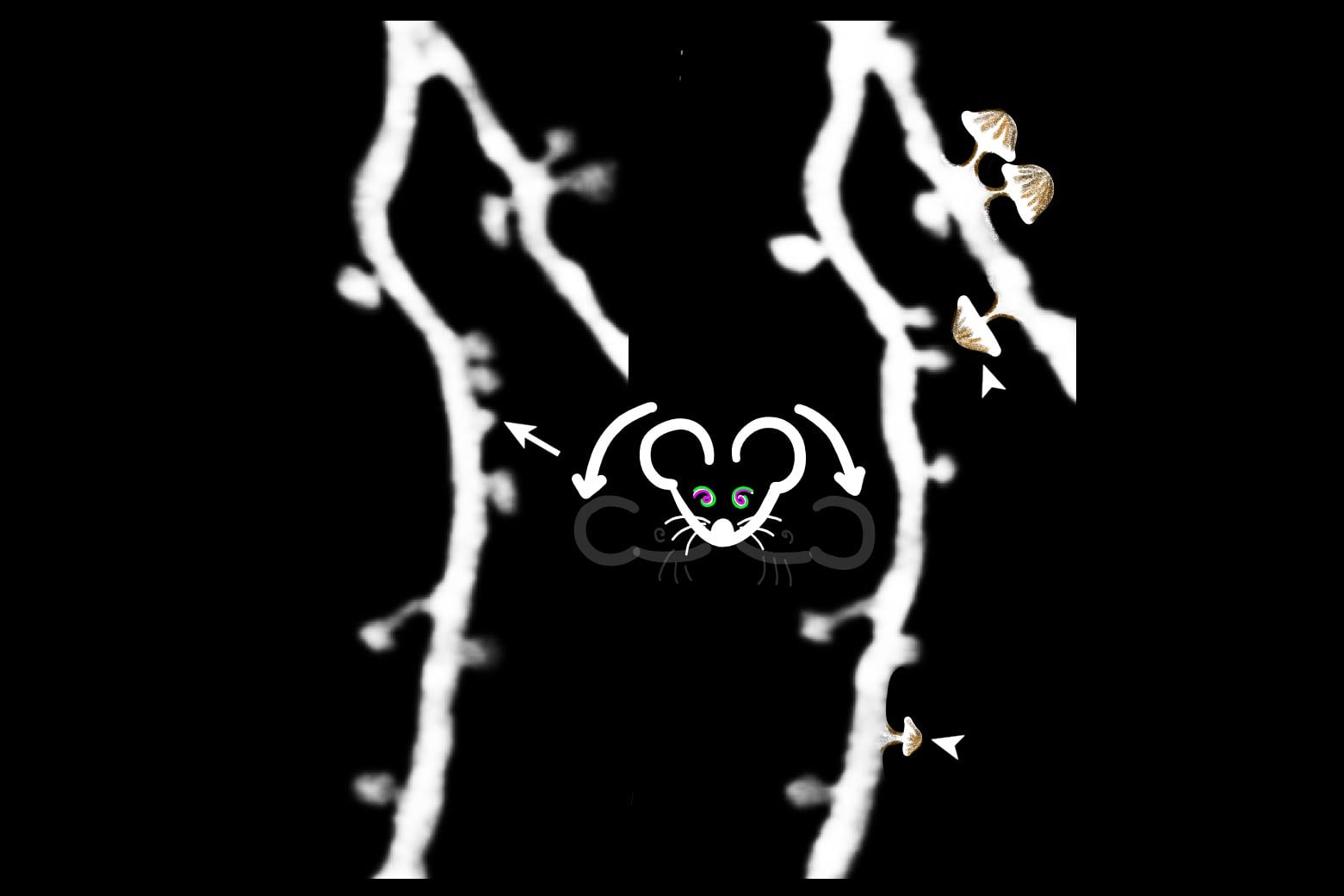 An artistic illustration of the dual effects of psilocybin, the psychedelic compound derived from “magic mushrooms,” on a mouse’s brain. Psilocybin promotes the formation and maturation of dendritic spines, tiny protrusions from the dendritic branches that serve as neuronal connection sites, here portrayed as little mushrooms. At the same time, psilocybin induced the mouse’s head to twitch rapidly, a proxy of hallucinations in humans. Credit: Illustration by Emily Kogan, UC Santa Cruz
“These findings challenge the prevailing view that psilocybin simply increases neural connectivity and suggest that its effects depend on the brain’s underlying condition,” Zuo added. “This provides a new perspective on how psychedelics might help restore neural circuits disrupted by stress, with potentially important implications for understanding their therapeutic effects in depression and other psychiatric disorders.”
In untreated mice, newly formed spines typically had an immature “stubby” shape and were unstable and short-lived. Psilocybin accelerated their development, with a significantly higher proportion quickly growing into large “mushroom” shapes. These mature, stable structures have abundant neurotransmitter receptors, which receive chemical messages from other neurons and help sustain strong signals involved in memory and mood.
“Psychedelics are fascinating compounds because they have the potential to profoundly transform who we are by reshaping the neural circuits in our brains,” said lead author Jacob Baker, a Ph.D. student in Zuo’s lab. “These newly formed connections can integrate into existing neural circuitry and persist over time, leaving a lasting structural trace of psilocybin’s effects on the brain.”
Psychedelic therapies reach the FDA’s agenda
Psychedelic research has changed course several times over the past century. Natural psychedelics entered Western scientific study in the mid-20th century, and researchers identified active compounds such as psilocybin and LSD that profoundly altered consciousness and mood. Early clinical investigations suggested potential uses in psychiatric care, but research largely stalled after passage of the federal Controlled Substances Act in 1970.
Renewed interest now focuses on psychedelics as “psychoplastogens,” compounds capable of rapidly stimulating changes in neural structure and function after a single dose. The U.S. Food and Drug Administration (FDA) previously granted Breakthrough Therapy designations for substances including psilocybin and MDMA.
Last month, the FDA hosted a public hearing titled “Considerations for Potential Future Therapeutic Use of Psychedelic Drugs.” Experts addressed standardized frameworks for provider credentialing, protocols for Risk Evaluation and Mitigation Strategy (REMS), and clinical-trial designs as regulators consider how psychedelic-assisted therapies might fit into healthcare.
Brain rewiring without a marker of hallucinations
One question could shape the development of those treatments, according to Baker: whether lasting changes in brain connectivity require the psychedelic experience itself.
To investigate the cellular pathways involved, the team focused on serotonin 2A receptors, also called 5-HT2ARs. These proteins sit on cell membranes and help mediate psilocybin’s effects. They are particularly abundant on Layer 5 pyramidal neurons, principal output cells in the cerebral cortex. Using specialized mouse lines, the researchers manipulated the receptors specifically in those neurons.
When serotonin 2A receptors were restored exclusively in Layer 5 pyramidal neurons, psilocybin triggered new synapse formation and structural stabilization. Yet the mice did not show the head-twitch response, a rodent movement widely used to assess hallucinogenic activity. The reverse experiment produced the opposite pattern. Selectively deleting the receptors from those neurons prevented structural synapse growth, while leaving the head-twitch response fully intact.
In these experiments, serotonin 2A signaling in Layer 5 pyramidal neurons was both necessary and sufficient for psilocybin’s structural effects, but was not required for the head-twitch behavior. Whether this separation could support effective treatments for depression, post-traumatic stress disorder (PTSD), or other psychiatric conditions in people remains to be tested.
“By showing that therapeutic circuit remodeling and hallucinogenic effects operate through distinct cellular pathways, our study provides a promising blueprint for designing non-hallucinogenic drug analogs,” Zuo said. “Such therapeutics could deliver the fast and lasting antidepressant benefits of psychedelics while eliminating hallucinogenic side effects—making neuroplasticity treatments safer, more scalable, and accessible to a broader patient population.”
Reference: “5-HT2A receptors in layer 5 pyramidal neurons mediate the neuroplastic but not the hallucinogenic effects of psilocybin” by Jacob J. Baker, Emily Kogan, Shaorong Ma, Ju Lu and Yi Zuo, 15 October 2026, Nature Neuroscience.
DOI: 10.1038/s41593-026-02490-y
This research was supported by grants from the National Institute of Mental Health and the National Institute on Aging.
Disclosure: Psilocybin was provided by the National Institute on Drug Abuse (NIDA) Drug Supply Program.
Never miss a breakthrough: Join the SciTechDaily newsletter.
Follow us on Google and Google News.






















 English (US) ·
 French (CA) ·
 French (FR) ·