

PROTECT YOURSELF with Orgo-Life® QUANTUM TECHNOLOGY
Orgo-Life the new way to the future Advertising by Adpathway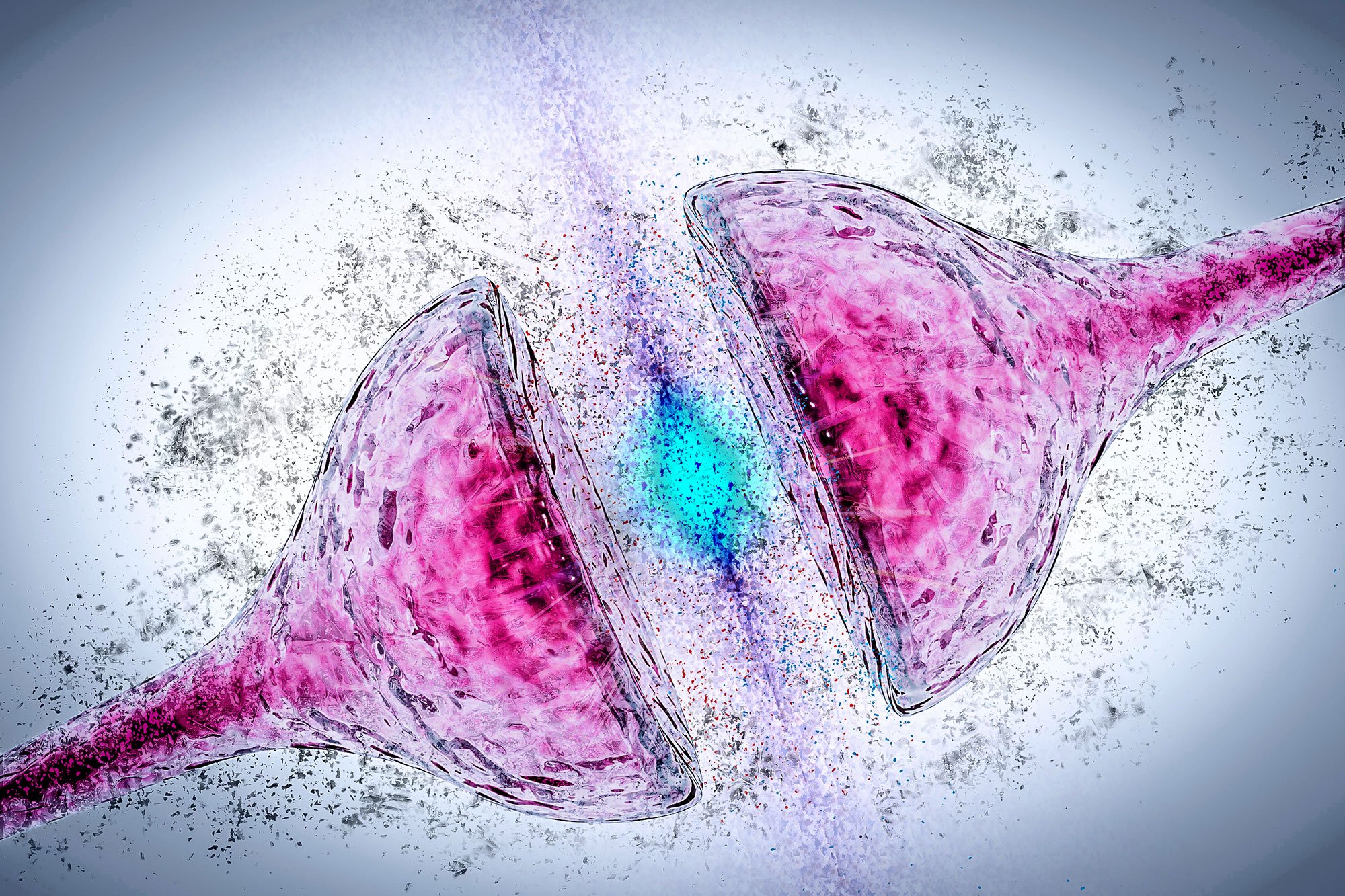 New research suggests that Alzheimer’s may disrupt the brain’s delicate balance of neural activity in surprising ways. Credit: Shutterstock
Boosting a protein restored brain rhythms and improved memory in mice with Alzheimer’s-like disease, pointing to a potential treatment strategy focused on how brain cells coordinate.
The brain relies on rapid electrical rhythms called gamma oscillations when focusing on a task, learning a skill, or retrieving a memory. These rhythms cycle 30 to 90 times a second, and scientists have known for decades that they weaken in Alzheimer’s disease. What remained unclear was how individual brain cells coordinate their activity to generate them, and why that coordination fails.
Researchers at Gladstone Institutes have now watched specialized brain cells called parvalbumin (PV) interneurons organize these rhythms in awake mice. Their study, published in Neuron, found that the cells take precisely timed turns firing. In mice engineered to develop Alzheimer’s-like disease, that sequence broke down. More cells fired together, yet the gamma rhythms grew weaker.
“Gamma oscillations are essential for clear thinking and memory, but we’ve lacked a complete picture of how the brain creates them,” says Jorge J. Palop, PhD, a Gladstone investigator and senior author of the study. “What makes this discovery so exciting is that we didn’t just figure out how healthy cells pass the baton; we discovered a way to reset their timing when Alzheimer’s related processes throw them off beat.”
 A new discovery led by scientists at Gladstone Institutes offers a promising therapeutic target for restoring cognitive function in Alzheimer’s disease. Credit: Michael Short/Gladstone Institutes
Too much synchrony weakens brain rhythms
In healthy mice, each burst of gamma oscillations involved successive groups of PV cells. The first cells to respond fired strongly, followed by groups with progressively weaker activity. Roughly a third of the cells stayed quiet.
The Alzheimer’s mice lost that balance. Cells that normally responded first were sluggish, later participants were overactive, and fewer cells remained silent. With more cells firing at the same time and at similar activity levels, the orderly sequence gave way to excessive synchrony, weakening the rhythm.
“The important thing here is that more activity is not always going to produce better oscillations or better cognition,” says first author Keran Ma, PhD, who led the work as a postdoctoral scholar at Gladstone and is now an assistant professor at UTHealth Houston. “The dynamics of the cells are most important.”
The recordings also captured epileptic spikes after sudden drops in PV interneuron activity. That observation could help explain why more than a quarter of people with Alzheimer’s show epilepsy-like activity in the brain, although the relationship still needs investigation in humans.
Tracking brain cells participating in gamma rhythms
Seeing how individual cells participated required a different approach from earlier experiments. Scientists had previously used methods such as optogenetics, which uses light to activate cells, to switch on PV interneurons simultaneously and demonstrate that they can generate gamma rhythms.
 The findings by Keran Ma and her colleagues could help explain why more than a quarter of people with Alzheimer’s also show epilepsy-like activity in the brain. Credit: Gladstone Institutes
“Turning on all the cells at once shows you what they can do, but not how they naturally work together or how they’re recruited to generate spontaneous gamma oscillations,” Ma says. “Until now, no one has actually been able to image these cells and look at gamma oscillations at the same time in an awake animal during natural behavior.”
The Gladstone team combined real-time electrical recordings with imaging of living cells, allowing them to track brain rhythms alongside the activity of individual PV interneurons. They engineered the cells to glow fluorescently whenever they fired an electrical pulse and monitored awake mice running on a treadmill, an activity that naturally prompts attention-related brain rhythms.
“The relationship between the PV cells and the gamma oscillations was much more dynamic and complex than we expected going into this,” Palop says. “Rather than all the cells contributing to the rhythm at once, each cell contributes for just a brief moment, and those small contributions add up to create the larger brain rhythm. It’s less like a military lockstep march and more like a flock of birds in the sky—each responding to the others, shifting turns and trajectories, yet together creating a remarkably coordinated pattern.”
Nav1.1 restores brain rhythms in mice
Palop’s lab had previously identified a molecular change that could affect this timing. Levels of Nav1.1, a sodium channel protein on the surface of PV cells that helps them fire electrical pulses, were reduced in both Alzheimer’s mouse models and people with the disease.
For the new study, the researchers engineered the Alzheimer’s mice to produce more Nav1.1, then monitored their PV cells and brain activity. The additional channels restored the normal waves of interneuron activity and strengthened gamma oscillations. They also reduced epileptic activity and amyloid plaques, a pathological hallmark of Alzheimer’s, while improving the mice’s memory, cognition, and lifespans.
 For this study, Jorge Palop collaborated with scientists at the Allen Institute to better understand how individual cells fail in disease and start designing treatments that act only on the specific cells responsible for restoring healthy brain function. Credit: Gladstone Institutes
Those benefits were demonstrated in mice. More work is needed to understand the connection between PV cell failure and Alzheimer’s in humans, as well as how Nav1.1 levels or activity could be increased.
“We still don’t know why interneuron dysfunction happens early in Alzheimer’s disease,” Ma says. “But this is another study underscoring that a lot of the pathology of the disease could arise downstream of disrupted interneurons and the abnormal brain rhythms this disruption produces.”
Even in healthy brains, the researchers do not yet know what determines which PV cells participate at any given moment.
“It could be that different thoughts or brain processes are regulated by different assemblies of PV cells,” Palop says. “A lot of interesting questions remain to be answered in the future as we continue our research.”
Targeting rhythm-keeping cells across species
The ability to target these cells specifically could help researchers pursue treatments. To pinpoint PV interneurons, the team used genetic tools developed at the Allen Institute. Study co-authors Boaz P. Levi, PhD, and Jonathan T. Ting, PhD, helped design these delivery vehicles to reach particular brain cell types across different species.
“One of the most exciting aspects of this work is our ability to target a single cell type out of the hundreds in the brain,” Levi says. “Because these tools work in both mice and humans, they help us bridge the gap between understanding how individual cells fail in disease and developing targeted treatments to fix them.”
“This collaboration illustrates where this field is headed,” Ting adds. “By combining precise delivery tools with a deep understanding of Alzheimer’s, we can start designing treatments that act only on the specific cells responsible for restoring healthy brain function.”
Palop and his team are now working to develop small-molecule Nav1.1 enhancers designed to boost interneuron activity in Alzheimer’s disease and other disorders, moving toward potential therapies while continuing to investigate how the cells coordinate brain rhythms.
Reference: “Parvalbumin cell state dynamics regulate gamma oscillations and are disrupted in Alzheimer’s disease” by Keran Ma, Kyerl Park, Patrick S. Honma, Yutong Zhang, Erica Brady, Yuechen Qiu, Ximena Opitz-Araya, Jonathan T. Ting, Boaz P. Levi, Katerina Akassoglou and Jorge J. Palop, 15 October 2026, Neuron.
DOI: 10.1016/j.neuron.2026.09.025
The work was supported by the Ray and Dagmar Dolby Family Fund, the Cure Alzheimer’s Fund, the Simon Family Trust, the Alzheimer’s Association (24AARG-1247332), the Texas Alzheimer’s Research and Care Consortium (1271368), and the National Institutes of Health (AG094667, AG092683, AG082147, AG062629, AG073082, UG3/UH3 MH120095, R35 NS097976, R35 NS143067, RF1AG064926, K99/R00AG062776).
Never miss a breakthrough: Join the SciTechDaily newsletter.
Follow us on Google and Google News.





















 English (US) ·
 French (CA) ·
 French (FR) ·