

PROTECT YOURSELF with Orgo-Life® QUANTUM TECHNOLOGY
Orgo-Life the new way to the future Advertising by Adpathway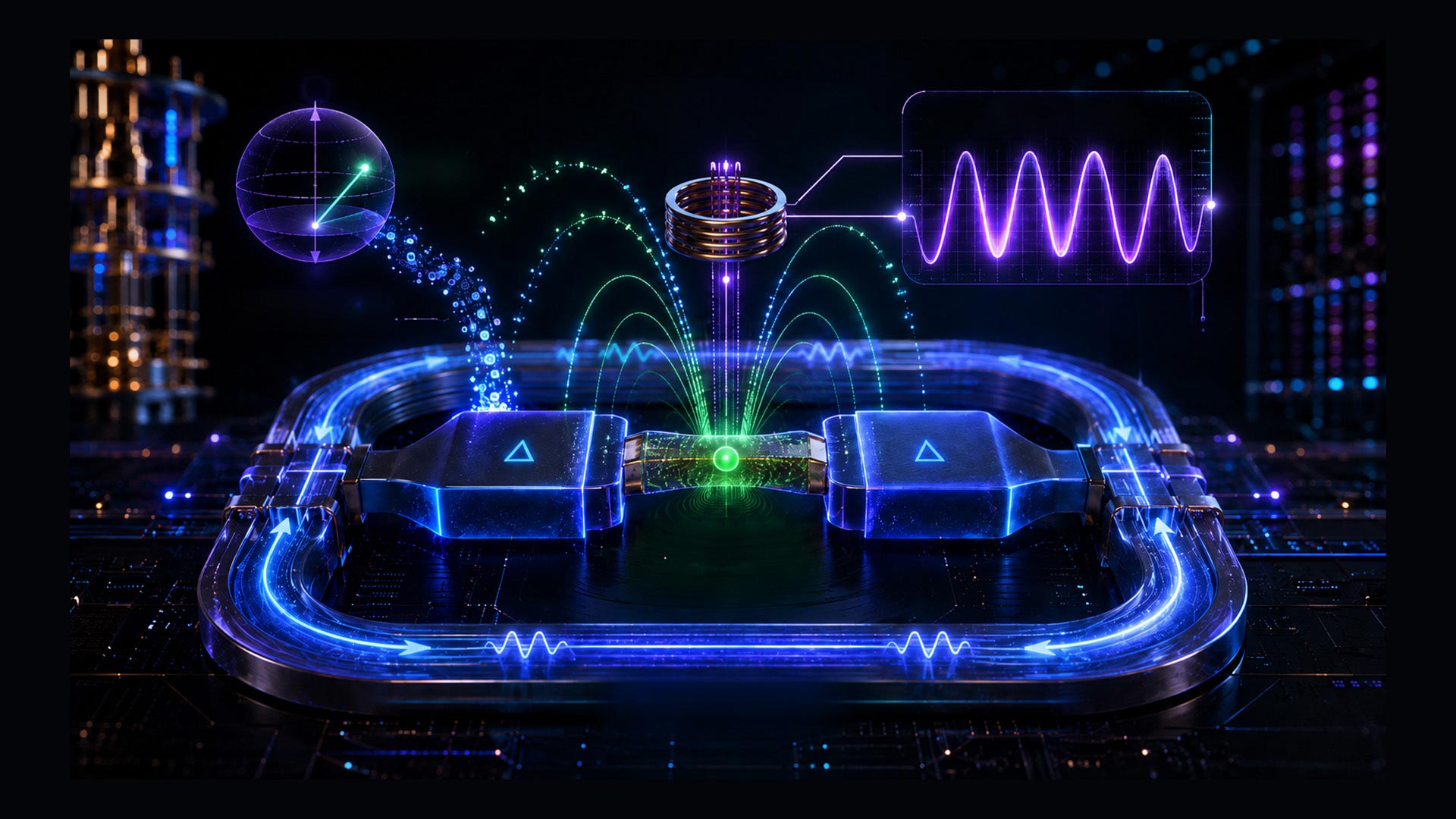 Schematic of a readout of an Andreev qubit without using auxiliary qubits. Credit: Marcus Egues and José Carlos Egues, with assistance from ChatGPT
Simulations suggest that one type of qubit could reveal its state through its own electric current, helping researchers monitor quantum computers with less disturbance and fewer components.
Like a bit in an ordinary computer, a qubit stores information using states labeled 0 and 1. A qubit can also be prepared in a superposition, a quantum combination of the two. These states belong to a physical system that researchers build and control. In the design explored here, that system is a tiny wire connected to superconducting materials.
The aim of quantum computing is to use quantum behavior to perform certain calculations more efficiently than conventional computers. That requires control: researchers must prepare qubits and change their states deliberately. Unwanted interactions with the surroundings can disrupt them, and measuring a qubit can alter it, too.
A theoretical study proposes reading one type of qubit through an electric current it produces itself. This could let researchers follow its behavior with minimal disturbance and without the extra qubits used in many existing methods.
Quantum information in a tiny wire
Andreev qubits hold information in states formed between superconducting materials, which carry electric current without resistance. They are named after Soviet physicist Alexander Andreev (1939–2023), who described the underlying process at the boundary between normal and superconducting materials in 1964.
“In the system under consideration, this region is a quantum dot—that is, a nanoscale structure in which electrons are spatially confined – formed in an indium arsenide [InAs] nanowire connected to superconducting materials on both sides. It’s in this environment that the states characterizing the Andreev qubit are formed,” explains José Carlos Egues, a full professor at the São Carlos Institute of Physics at the University of São Paulo (IFSC-USP) in Brazil.
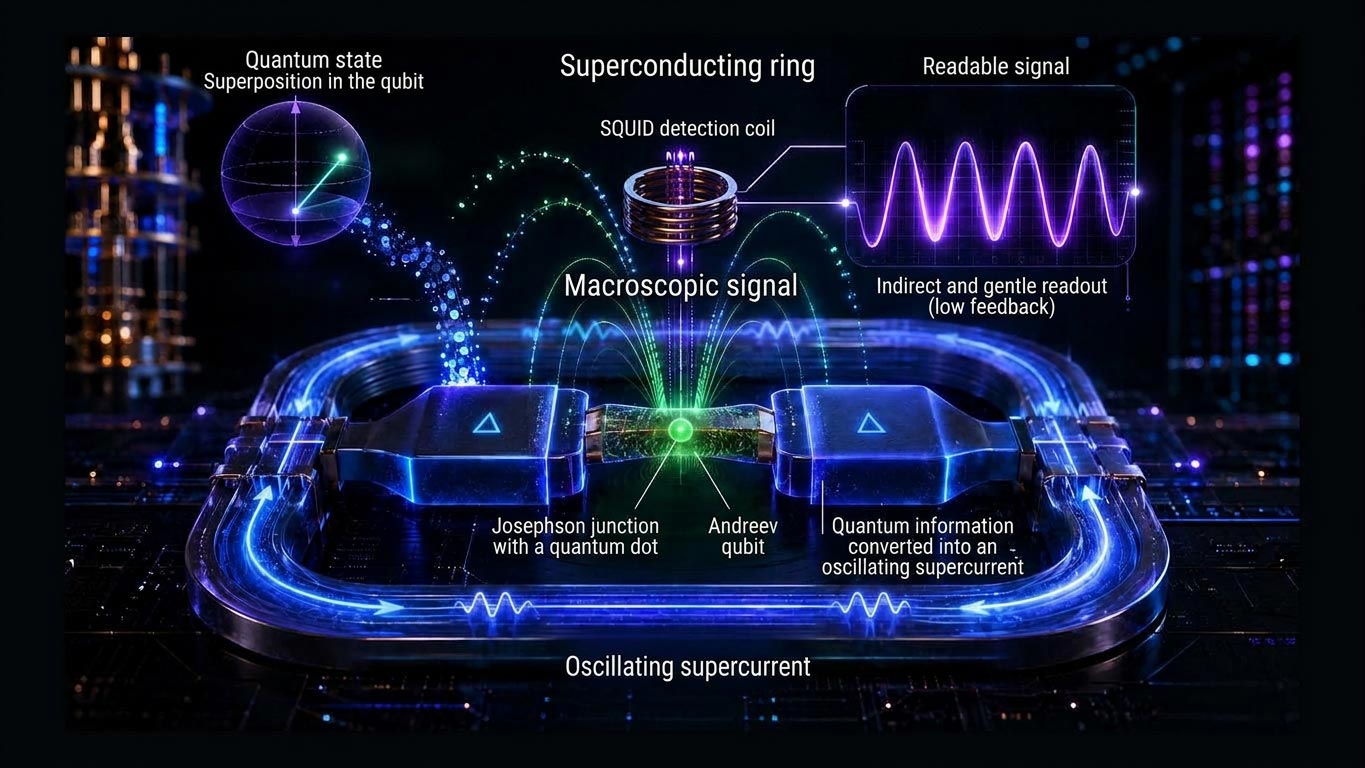 Schematic of a readout of an Andreev qubit without using auxiliary qubits. In the proposed device, the qubit’s quantum information appears as an oscillating supercurrent circulating in a large superconducting loop. The magnetic signal generated by this current is detected by a small coil coupled to a SQUID, allowing the qubit’s state to be inferred with minimal perturbation. Credit: Marcus Egues and José Carlos Egues, with assistance from ChatGPT
“In the conventional formulation of quantum mechanics, a projective measurement causes the system to assume one of the states associated with the measured quantity. Thus, if a qubit has been prepared in a certain superposition of 0 and 1, its direct measurement tends to destroy that superposition and, consequently, the information it contained,” says Egues.
Many existing methods use a helper quantum system called an ancilla. Researchers prepare it, connect it to the qubit, transfer information to it, and measure it to preserve the original qubit as much as possible. These steps add time and equipment. “Our strategy is different. Instead of transferring the information to an auxiliary qubit, we seek to obtain it from a signal produced by the qubit under study itself,” says Egues.
Reading the signal a qubit produces
The qubit would sit in a closed superconducting circuit carrying a supercurrent, an electric current that flows without resistance. The calculations predict that interference between the states in the qubit’s superposition makes part of this current oscillate. “It’s precisely that property that we use to read the qubit. It’s that supercurrent that lies at the heart of our proposal,” Egues points out.
An applied voltage usually causes this kind of oscillation, known as the AC Josephson effect. “Our system generates a supercurrent that varies over time like an alternating current but without voltage. It’s the very evolution of the qubit’s state that produces that oscillation,” says Egues.
A nearby superconducting quantum interference device, or SQUID, would act as the detector. These instruments are extremely sensitive to weak magnetic fields. Egues explains, “We can think of the qubit as one compass and the SQUID as another compass. The current in the circuit produces a magnetic field, and the SQUID ‘senses’ that field. Since the coupling between the two is very weak, the effect of the measuring instrument on the qubit tends to be very small.”
Identifying the qubit’s state requires knowing both the balance of 0 and 1 and their relative phase, or how the two components line up.
“Our study showed that this information is encoded in the supercurrent itself. The supercurrent has a constant component and a fluctuating component. The value of the constant component and the amplitude of the oscillation reveal the proportion of each state (0 and 1) in the superposition, and the moment when that oscillation begins reveals the phase relationship between them. Thus, by measuring how the current varies over time, it’s possible to reconstruct the initial state of the qubit,” Egues explains.
Researchers could also track the qubit through repeated readings without resetting it to its initial state after each measurement.
The design still needs experimental testing
Simulations included measurement noise and feedback from the small detection coil. They indicated that the detector’s influence could become negligible, with readout accuracies of 99.52%, 99.81%, and 99.85%, depending on the number of measurements. These values fall within standard thresholds adopted in quantum error correction schemes.
“Our method doesn’t eliminate the fundamental problem of quantum measurement. But it can approach the limit of a non-destructive readout and, at the same time, avoid the use of auxiliary qubits – the ancillas – employed in other non-destructive quantum measurement protocols,” Egues notes.
The work, published in Physical Review B Letters, was led by Egues and Yugui Yao of the School of Physics at the Beijing Institute of Technology in China. SQUID detection of extremely small currents and magnetic fields is already established, and Egues says the proposal would not require future advances in materials or device fabrication.
“All the numbers we used are realistic. In principle, this can be achieved. In fact, we used parameters from existing systems in our calculations. What doesn’t yet exist is that geometry, that setup that we proposed,” he argues.
Reference: “Andreev qubit readout from dynamic interference supercurrent” by Xian-Peng Zhang, Chuanchang Zeng, Zhen-Biao Yang, Jose Carlos Egues and Yugui Yao, 5 August 2026, Physical Review B.
DOI: 10.1103/6gkt-hghj
Never miss a breakthrough: Join the SciTechDaily newsletter.
Follow us on Google and Google News.




















 English (US) ·
 French (CA) ·
 French (FR) ·