

PROTECT YOURSELF with Orgo-Life® QUANTUM TECHNOLOGY
Orgo-Life the new way to the future Advertising by Adpathway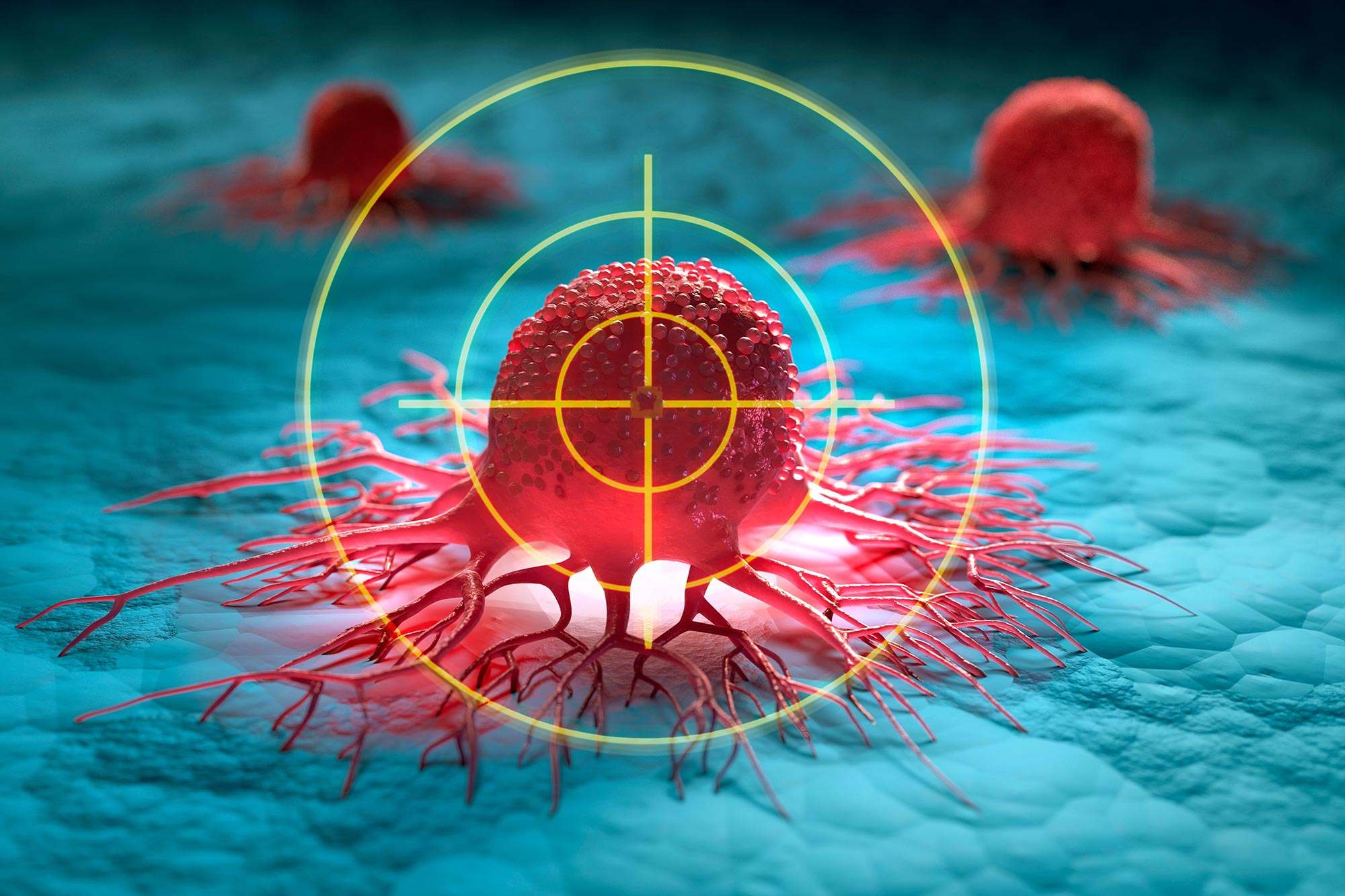 Researchers investigating new strategies for treating aggressive breast cancers uncovered a potent natural compound from an unexpected plant source. By interfering with a key metabolic enzyme and destabilizing the cancer cell’s ability to manage oxidative stress and DNA damage, the compound demonstrated broad antitumor effects across advanced experimental models. Credit: Shutterstock
A newly discovered plant-derived molecule disrupts a critical cancer enzyme in an unconventional way.
Scientists looking for new ways to tackle hard-to-treat breast cancers turned to an unexpected source: Munronia henryi, a plant known for producing limonoids, a family of complex natural compounds that plants often use for chemical defense.
In Acta Pharmaceutica Sinica B, the team reports isolating two previously unknown prieurianin-type limonoids from this species. One stood out immediately. They named it DHL-11, and it showed strong activity against triple-negative breast cancer (TNBC), the subtype linked to the worst outcomes and fewest targeted treatment options.
Broad Effects on Cancer Cell Behavior
In cell tests, DHL-11 hit several cancer hallmarks at once. It slowed TNBC cell growth, reduced their ability to migrate, and pushed cells into G2/M arrest before triggering apoptosis. At the same time, treated cells accumulated more reactive oxygen species (ROS) and showed increased DNA damage, a combination that can overwhelm a tumor cell’s ability to survive and repair itself.
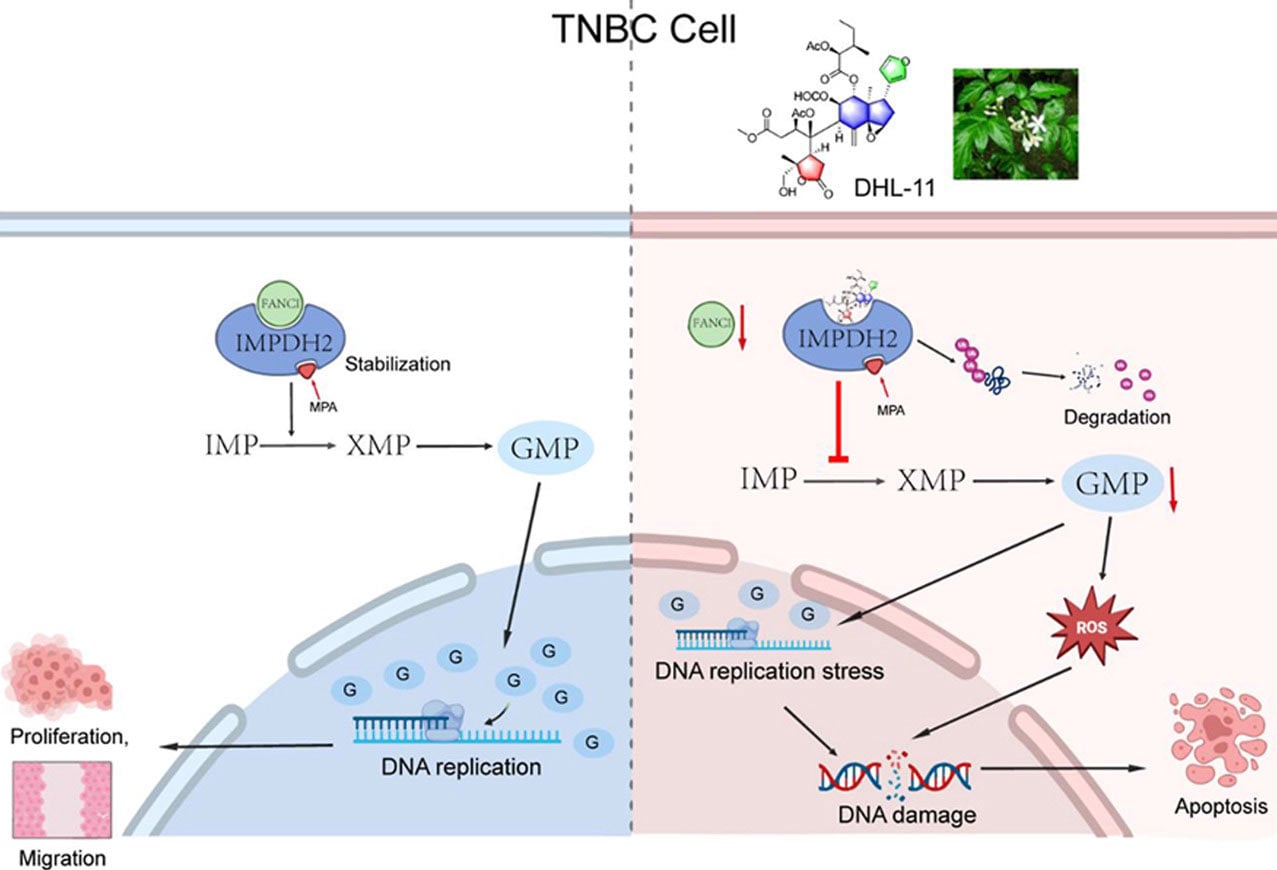 DHL-11 competes with FANCI to bind IMPDH2, destabilizing it, reducing GMP synthesis, causing DNA damage and replication stress, and inducing TNBC cell apoptosis. Credit: 10.1016/j.apsb.2025.10.031
The most intriguing part was how DHL-11 achieved these effects. Rather than simply blocking an enzyme’s active site, the compound latched onto a non-catalytic pocket on IMPDH2 and interfered with the partnership between IMPDH2 and FANCI. That disruption set off the breakdown of the IMPDH2 protein itself. With less IMPDH2 available, guanine production dropped, ROS rose further, and DNA damage increased, creating a cascade that helps explain the compound’s multi-pronged impact on TNBC cells.
Validation in Advanced Models
The results also held up in more lifelike models. DHL-11 significantly suppressed the growth of breast cancer patient-derived organoids that had high IMPDH2 expression, an important detail because organoids often preserve features of real tumors that simple cell cultures miss. In animal experiments, the compound reduced both tumor growth and metastasis in TNBC xenografts and did so with favorable biosafety profiles.
The study positions DHL-11 as a promising new kind of targeted therapy candidate: a novel IMPDH2 degrader that could be especially relevant for IMPDH2-positive (TNBC).
Reference: “DHL-11, a novel prieurianin-type limonoid isolated from Munronia henryi, targeting IMPDH2 to inhibit triple-negative breast cancer” by Yu Zhu, Zhibi Zhang, Xueqin Dai, Wenjing Liu, Jian Sun, Jialing Liu, Yuxin Zhao, Wenlong Ren, Chenglong Pan, Zhongmei Zhou, Ying Yan, Longlong Zhang and Ceshi Chen, 28 October 2025, Acta Pharmaceutica Sinica B.
DOI: 10.1016/j.apsb.2025.10.031
Never miss a breakthrough: Join the SciTechDaily newsletter.
Follow us on Google and Google News.























 English (US) ·
  French (CA) ·
  French (FR) ·