

PROTECT YOURSELF with Orgo-Life® QUANTUM TECHNOLOGY
Orgo-Life the new way to the future Advertising by Adpathway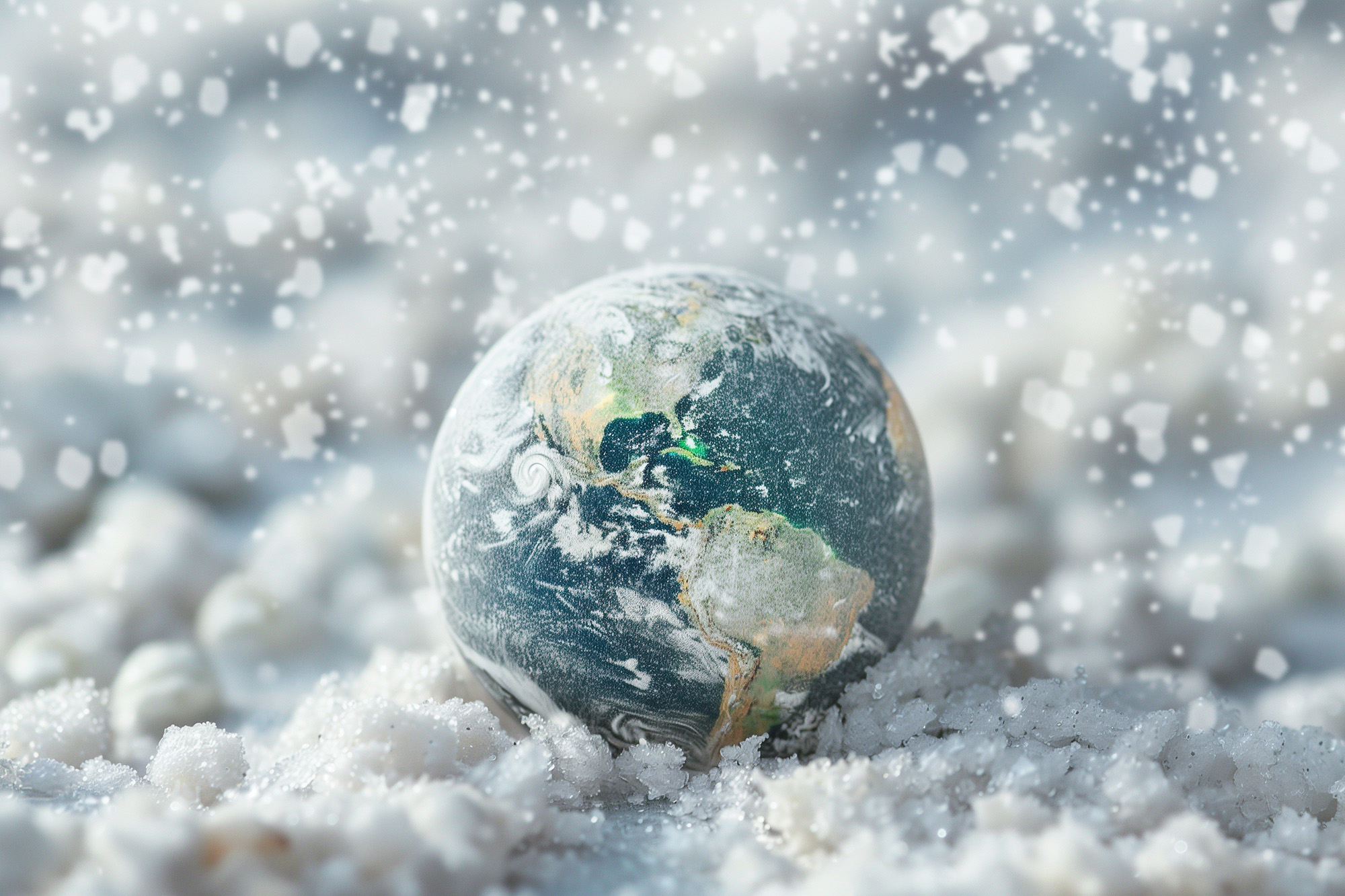 Scientists have uncovered evidence that Earth may have been entering a new glacial period thousands of years ago before rising temperatures abruptly reversed the process. Credit: SciTechDaily.com
A new glacial period may have been taking shape in the Arctic until global warming brought its slow advance to a halt.
An ice cap in northern Canada began expanding about 2,000 years ago, according to research published in Science. The researchers argue that this growth marked the beginning of Earth’s next glacial period. By the 1960s, however, warmer summers had reversed the process, causing the ice to retreat.
“It was just getting started, everything was normal, the next glaciation was about to happen—and yet it stopped,” says Nicolás Young, a geochemist at the Lamont-Doherty Earth Observatory, part of the Columbia Climate School. “It’s a very powerful example of how we have jolted the system.”
Young, fellow Lamont geochemist Joerg Schaefer, and their colleagues investigated the surviving remnant of the Laurentide Ice Sheet. That enormous ice mass covered much of Canada and the northern United States from about 95,000 to 20,000 years ago. At its largest, it extended from above the Arctic Circle to Illinois, with ice more than two miles (3.2 kilometers) thick in places.
The Ice Sheet That Never Fully Disappeared
Today, the Laurentide survives as the Barnes Ice Cap, an ice mass roughly the size of Delaware on central Baffin Island in Nunavut, Canada. “People always say that it disappeared, but that’s not true,” says Young.
The Laurentide repeatedly expanded and retreated after widespread continental glaciation began about 2.6 million years ago. The team wanted to determine whether its remaining ice had once occupied an even smaller area than it does today before growing again.
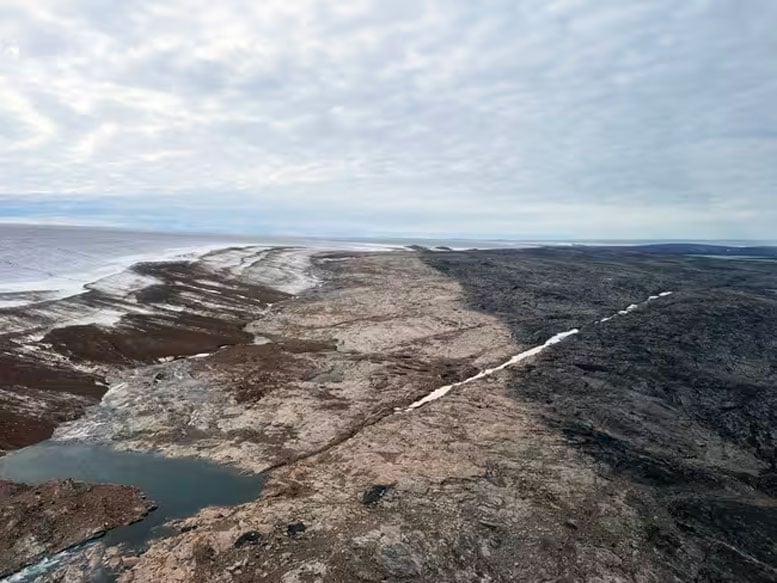 The end of a glaciation. Prominent trimline marks the 1960 extent of the Barnes Ice Cap. The dark-colored landscape hosts mature vegetation and lichen cover, whereas the light-colored rock is vegetation-free. Ice margin retreat from this trimline has reversed ~2,000 years of ice margin expansion. Credit: Nicolás Young
Finding the moment an ice sheet stopped shrinking and began rebuilding is difficult because advancing glaciers usually erase the evidence of their earlier boundaries. Barnes offered an unusual way around that problem: plants preserved beneath the ice.
Buried Plants Reveal The Ice’s Return
Unlike most glaciers, the Barnes Ice Cap is frozen to its bedrock and does not slide over the ground. When it expanded, it buried vegetation instead of scraping it away. Its retreat since 1960 has gradually exposed those preserved plants.
Researchers dated the vegetation using carbon-14, a harmlessly radioactive form of atmospheric carbon that living organisms absorb. After an organism dies, its carbon-14 decays at a predictable rate, allowing scientists to estimate when the plants died as the ice advanced over them.
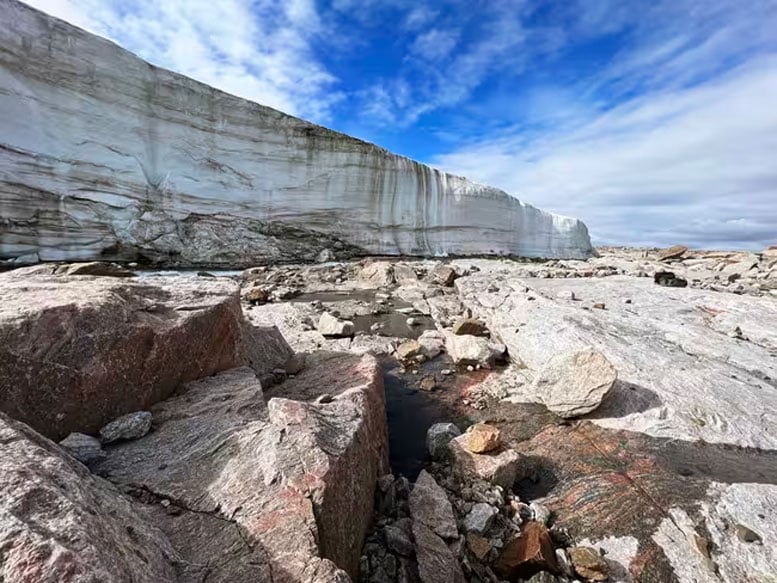 Margin of the Barnes Ice Cap. Bedrock has only become exposed sometime over the last decade. Credit: Nicolás Young.
“If you do this enough times, you can actually develop a timeline of that ice margin systematically advancing over plants. You’re actually tracking the expansion of that ice margin,” says Young.
Combining samples from Barnes with vegetation exposed by recently melted smaller ice caps nearby, the team reconstructed the region’s climate history. The Laurentide reached its smallest extent about 3,000 years ago. Roughly 1,000 years later, conditions became cold enough for ice to accumulate again.
When Does A Glacial Period Begin?
The researchers propose that this first renewed growth should count as the beginning of a glacial period. That definition places the starting point long before ice sheets spread across continents.
Earlier modeling studies have suggested that the next glaciation would remain thousands or even tens of thousands of years away. Young and his colleagues argue that waiting for enormous continental ice sheets to form overlooks the much earlier stages of their development.
Their findings also revisit controversial claims made by some climate scientists in the 1970s that another ice age was approaching. “It actually was happening,” Young says. “They couldn’t quite prove it, but now we sort of have the evidence.”
The process would have unfolded far too slowly to transform the climate within a human lifetime. Young says noticeable cooling would have taken thousands of years, while restoring Laurentide’s continental reach would have required about 30,000 years. In the team’s interpretation, warming interrupted that process near its beginning.
A Vanishing Starting Point for Future Ice Sheets
By the 1960s, the Barnes Ice Cap was losing more ice during summer than it gained during winter. Models project that it will melt completely within the next few centuries. “That will be the true very last remains of the Laurentide, disappearing for good,” Young says.
Its loss could also reshape the conditions for future glaciations. The Laurentide once provided a ready starting point for expansion when the climate cooled. Its frigid mass supported feedback processes that encouraged more ice to accumulate.
With greenhouse gas concentrations elevated, scientists cannot say when another glaciation might begin. If continental ice sheets eventually grow again, they may have to develop without this surviving foundation.
“What has been an extremely natural and predictable phenomenon is now gone,” says Young.
References:
“Late Holocene reexpansion of the Laurentide Ice Sheet” by Nicolás E. Young, Gifford H. Miller, Martha Raynolds, Helga Bueltmann, Scott J. Lehman, Jonathan H. Raberg, Kylie Seward, Simon L. Pendleton, John T. Andrews, Patrick J. Webber and Joerg M. Schaefer, 22 October 2026, Science.
DOI: 10.1126/science.aed3379
“Has the next ice age already come and gone?” by Shaun A. Marcott, 22 October 2026, Science.
DOI: 10.1126/science.aem3295
Never miss a breakthrough: Join the SciTechDaily newsletter.
Follow us on Google and Google News.


















 English (US) ·
 French (CA) ·
 French (FR) ·