

PROTECT YOURSELF with Orgo-Life® QUANTUM TECHNOLOGY
Orgo-Life the new way to the future Advertising by Adpathway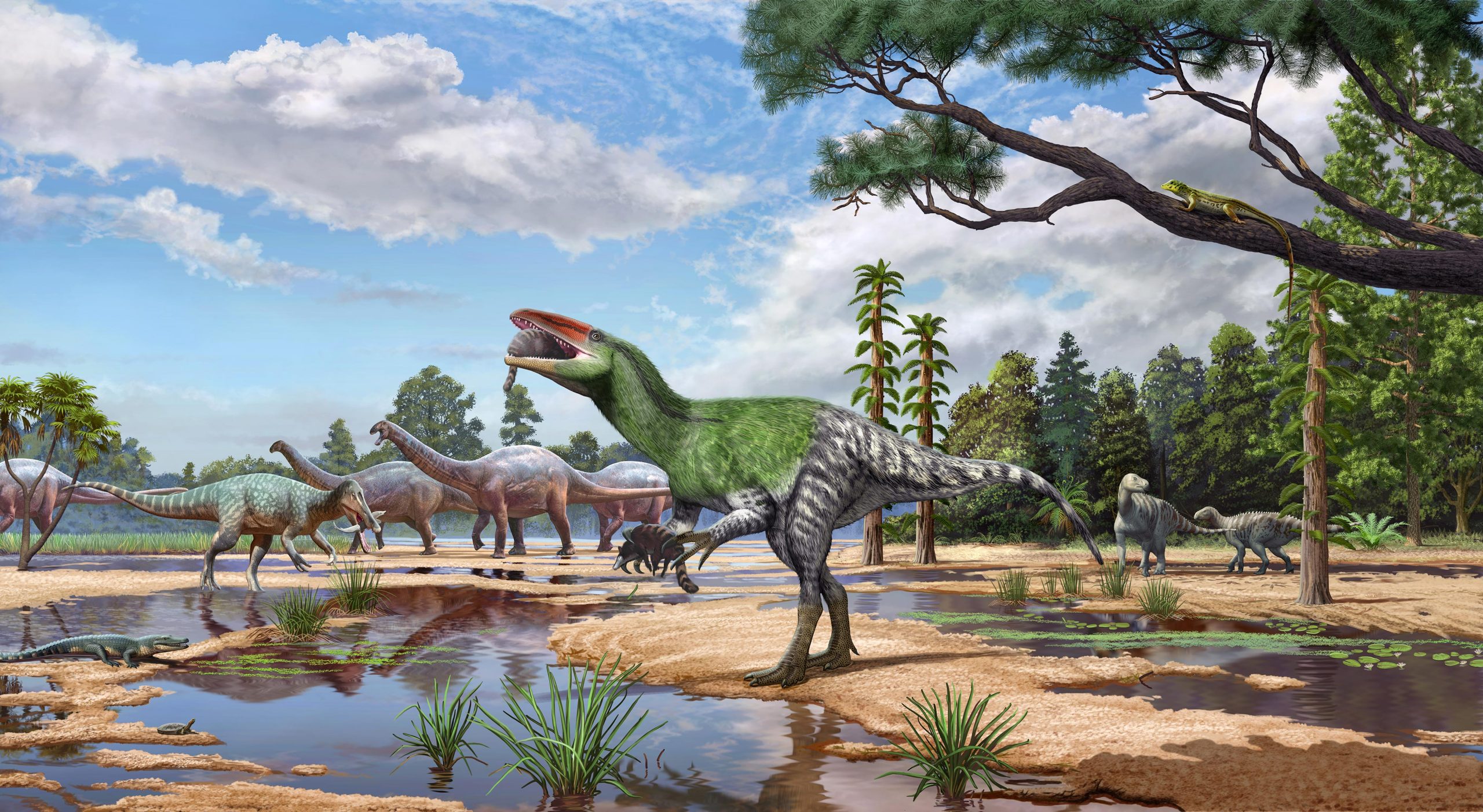 An artist’s illustration of the new theropod dinosaur, Invictibellatrix amberina (center of the image), in its ecosystem on the Isle of Wight, United Kingdom in the Early Cretaceous (around 120 million years ago). It lived in what was likely a seasonally wet-to-dry floodplain environment and is surrounded by other dinosaurs including large long-necked rebbachisaurid sauropods (directly behind Invictibellatrix, center) and relatives of Iguanodon (right). A spinosaurid theropod, potentially the apex predator of the time, fishes (left). Invictibellatrix has just caught and is consuming two small mammals. Gymnosperms dominate the environment as flowering plants (angiosperms) were not common at this time. Other reptiles including relatives to modern lizards, crocodiles and turtles enjoy the warm Early Cretaceous weather of the UK. Credit: Sergey Krasovskiy and Pedro Salas
A dinosaur fossil that sat unnoticed in a museum collection for nearly a century has turned out to belong to a previously unknown predator with enormous curved claws. The animal, roughly the size of a large tiger, lived in what is now Britain about 120 million years ago.
The discovery was made by a research team led by University College London (UCL) using a fossil originally found on the Isle of Wight. Described in the journal Royal Society Open Science, the dinosaur is the first known European member of a mysterious group of meat-eating dinosaurs called megaraptorans.
These agile predators walked on two legs and were closely related to tyrannosaurs, including the famous Tyrannosaurus rex. However, their hunting strategy was very different. Rather than relying primarily on powerful jaws, megaraptorans had relatively narrow heads and used their muscular arms and large, curved claws to capture prey.
Some eventually grew into enormous predators comparable in size to the largest tyrannosaurs. The newly identified species, however, was among the earliest and smallest known members of the group. It lived during the Early Cretaceous period, approximately 120 million years ago.
Researchers named the dinosaur Invictibellatrix amberina. The genus name Invictibellatrix translates to “unconquered female warrior,” recognizing the group’s eventual rise to dominance as massive apex predators.
Remarkably, the fossil consists of a fragment from the back of the dinosaur’s skull that entered the Natural History Museum’s collection in 1924. Despite its scientific importance, it remained largely overlooked until researchers examined it nearly 100 years later.
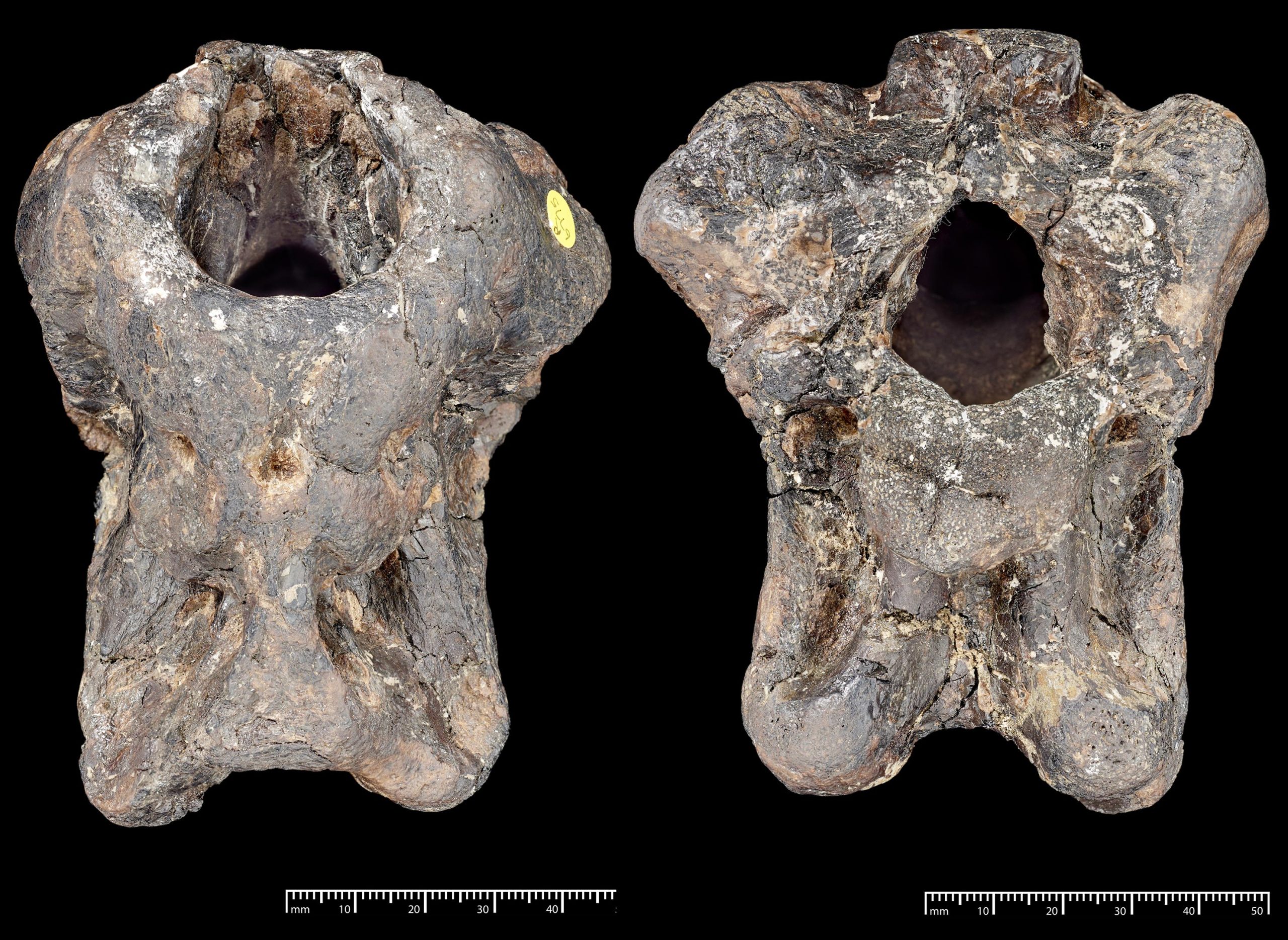 Fossil of newly identified theropod dinosaur, Invictibellatrix amberina. The oval hole is where the brain would have been. The fossil was acquired by the Natural History Museum in 1924. Credit: The Trustees of the Natural History Museum, London
A Dinosaur That Might Have Been More Dangerous Than T. Rex
Lead author Dr. Cassius Morrison (UCL Earth Sciences) explained what the animal may have looked like and how it hunted.
“Based on what we know about its closest relatives, Invictibellatrix would have been three to four meters long and just over a meter and a half in height – about as tall as a human. It would likely have had feathers, and its claws might have been about 10cm to 20cm long. It would have eaten small dinosaurs, lizards and mammals – occupying a similar role in the food chain to the hyena today.
“It was not the apex predator of its time, but for humans this dinosaur would have been more dangerous than a T. rex. We would have been perfectly sized prey, about a third of their body weight. They definitely would have chased us. A T. rex would not have bothered, as we would have been too small.
“It is a real mystery that this fossil was overlooked for so long, sitting in a drawer for nearly 100 years. Lots of bones are found on the Isle of Wight – who knows what else is waiting to be discovered.”
Although humans did not exist when these dinosaurs lived, Morrison’s comparison illustrates how the smaller predator’s size and hunting behavior might have made it particularly dangerous to human-sized prey.
A Missing Link in the History of Giant Predators
Megaraptorans remain among the least understood groups of large carnivorous dinosaurs, largely because their fossils are so rare. For years, scientists have struggled to piece together where they originated and how they spread across the ancient continents.
One leading theory suggests that megaraptorans first evolved in Asia before traveling through Europe and eventually reaching Gondwana (including present-day Africa, South America and Antarctica). There, some species became apex predators, meaning they occupied the very top of their ecosystems’ food chains.
Until this discovery, however, an important piece of evidence was missing. No megaraptoran fossils had ever been identified in Europe, leaving a major gap in the proposed migration route.
The discovery of Invictibellatrix now provides direct evidence that these dinosaurs inhabited Europe.
Co-author Charlie Scherer, a PhD student at UCL Earth Sciences, said: “This new species is the first proof we have that megaraptorans were also present in Europe and that they reached Gondwana this way rather than island-hopping further south.”
CT Scans Reveal a Previously Unknown Dinosaur
To investigate the fossil, the researchers used computed tomography, or CT scanning, a technique that uses X-rays to examine the internal structure of an object without damaging it.
The scans allowed the team to produce a detailed 3D reconstruction of the skull fragment, along with a digital model of the internal space that once housed the dinosaur’s brain.
They then compared these structures with skulls and braincases from other carnivorous dinosaurs, including tyrannosaurs, spinosaurs, raptors, and various other predators that walked on two legs.
Several unusual anatomical details helped distinguish the specimen from previously identified species. Among them were an oval opening where the spinal cord connected to the brain and a distinctive crest shaped like an hourglass.
Together, these features convinced the researchers that the fossil represented a new dinosaur species.
Computer algorithms provided further support. By comparing the fossil’s anatomical characteristics with those of other dinosaurs, the researchers repeatedly found that it belonged within the megaraptoran group.
How Megaraptors Spread Across the Ancient World
The researchers also investigated the evolutionary history of megaraptorans and how their geographic range changed over millions of years.
Using mathematical models, they combined evidence from known fossils, evolutionary relationships between dinosaur species, ancient geography, and prehistoric climate conditions.
Their results suggest that megaraptorans were distributed widely across the world during the Early Cretaceous (i.e., at the time of Invictibellatrix).
However, their fortunes appear to have changed dramatically over the following tens of millions of years.
By the Late Cretaceous, the group had probably disappeared from Laurasia (including modern-day Europe), the vast northern landmass that once contained much of what is now North America, Europe, and Asia.
Meanwhile, megaraptorans in the southern supercontinent of Gondwana became some of the most formidable predators of their time. Several evolved into enormous hunters equipped with curved claws reaching 35 cm (14 in) in length.
One particularly impressive example was Maip macrothorax, discovered in what is now Argentina. Scientists estimate that this giant carnivore measured approximately nine to 10 meters long and weighed as much as an elephant.
Exactly why megaraptorans disappeared from northern regions remains uncertain. The study did not establish a definitive cause, but changes in climate, shifting environmental conditions, and competition from other large predators, including tyrannosaurs, may have contributed to their decline.
A Century-Old Museum Fossil Reveals a New Species
The fossil that revealed Invictibellatrix amberina was originally collected by amateur paleontologist Reginald Walter Tooley near the base of a cliff on the southwestern coast of the Isle of Wight.
Tooley was an exceptionally productive fossil collector who discovered more than 1,000 specimens. Following his death, those fossils became part of the Natural History Museum’s collections.
For nearly a century, the skull fragment remained among those historic specimens without its true identity being recognized.
Professor Paul Barrett, the study’s senior author from the Natural History Museum, emphasized that even extensively explored fossil sites can continue to produce unexpected discoveries.
“Despite over 200 years of collecting, the Isle of Wight continues to surprise us with new dinosaur species, and finds of carnivorous dinosaurs, such as Invictibellatrix, have been particularly elusive.
“Work like this shows the exceptional value of working with historical museum collections where there are still many discoveries to be made.”
The dinosaur’s name also carries a message beyond its evolutionary significance.
In their paper, the researchers explained that Invictibellatrix was chosen to “give hope and strength to all those who are bullied, discriminated, victimized, and oppressed that tomorrow will be theirs and not to give up in face of such odds.”
The species name amberina refers both to the amber preserved in the rocks where the fossil originated and to the female given name.
The discovery highlights the continuing scientific importance of museum collections. Even specimens gathered generations ago can contain valuable clues about prehistoric life, and some may still represent species that scientists have never recognized.
Reference: “A new megaraptoran dinosaur from the Lower Cretaceous Wessex Formation, UK, and its implications for theropod evolution and biogeography” by Cassius Morrison, Charlie R. Scherer, Philip Mannion, Laura B. Porro, Brett Clark, Daniel D. Folkes and Paul M. Barrett, 14 October 2026, Royal Society Open Science.
DOI: 10.1098/rsos.260937
The research received funding from the Palaeontographical Society, the Royal Society, and UKRI.
Never miss a breakthrough: Join the SciTechDaily newsletter.
Follow us on Google and Google News.



















 English (US) ·
  French (CA) ·
  French (FR) ·