

 2 months ago
155
2 months ago
155
PROTECT YOURSELF with Orgo-Life® QUANTUM TECHNOLOGY
Orgo-Life the new way to the future Advertising by AdpathwayColombia · Business
Key Facts
—Positive EBITDA Rappi Colombia has reached profitability with positive EBITDA and is reinvesting 100% of its earnings back into the local business, signaling a mature operational phase.
—30% Annual Growth The Colombian unit grew more than 30% year-on-year, showing strong demand even as the company shifted focus from blitzscaling to unit-economics discipline.
—Super App Engine Higher-margin services like fintech, advertising, and subscriptions are diversifying revenue beyond thin delivery fees, accelerating the path to sustainable profit.
—Market Dominance Rappi is Colombia’s market leader with over 50% share, connecting more than 30,000 businesses and roughly 3 million active shoppers across the country.
—IPO Signal Sustained profitability strengthens Rappi’s case for a potential New York IPO, with timelines discussed for 2025–2026, though local expansion is the current priority.
Rappi has reached profitability in Colombia for the first time, with positive EBITDA and reinvestment of all earnings locally, marking a pivotal shift for Latin America’s largest delivery and fintech ‘super app’.
One-stop reference
Company Intelligence
Every listed company in Latin America — financials, ownership and structure for 1,450+ companies across 26 exchanges, in one place.
From Blitzscaling to Black Ink
For years, Rappi pursued a ‘growth at all costs’ strategy, explicitly prioritizing scale over short-term profit. That changed profoundly between 2023 and 2025.
The company pivoted to unit-economics discipline, optimizing delivery algorithms, reducing marketing spend, and concentrating on high-value services. By the end of 2023, Rappi reached break-even globally for the first time, and by December 2025 CEO Simón Borrero confirmed four consecutive profitable quarters with positive EBITDA.
Analysts estimate Rappi’s refined unit economics now allow it to break even per order with just two drops per hour and reach profitability in a new zone about 3.5 months after launch. In Colombia, the transformation is complete: the local operation is not only profitable but growing more than 30% year-on-year, with every peso of profit reinvested to deepen its presence.
What Drove the Turnaround in Colombia
Rappi evolved from a Bogotá grocery courier into a multi-vertical ‘super app’ combining restaurant delivery, groceries, travel, and a full fintech suite called RappiPay. Revenue now flows from delivery fees, merchant commissions often estimated at 15–30% of order value, Prime subscriptions, advertising sales to consumer brands, and financial products.
This blended model reduces dependence on thin delivery margins and channels users toward higher-margin transactions.
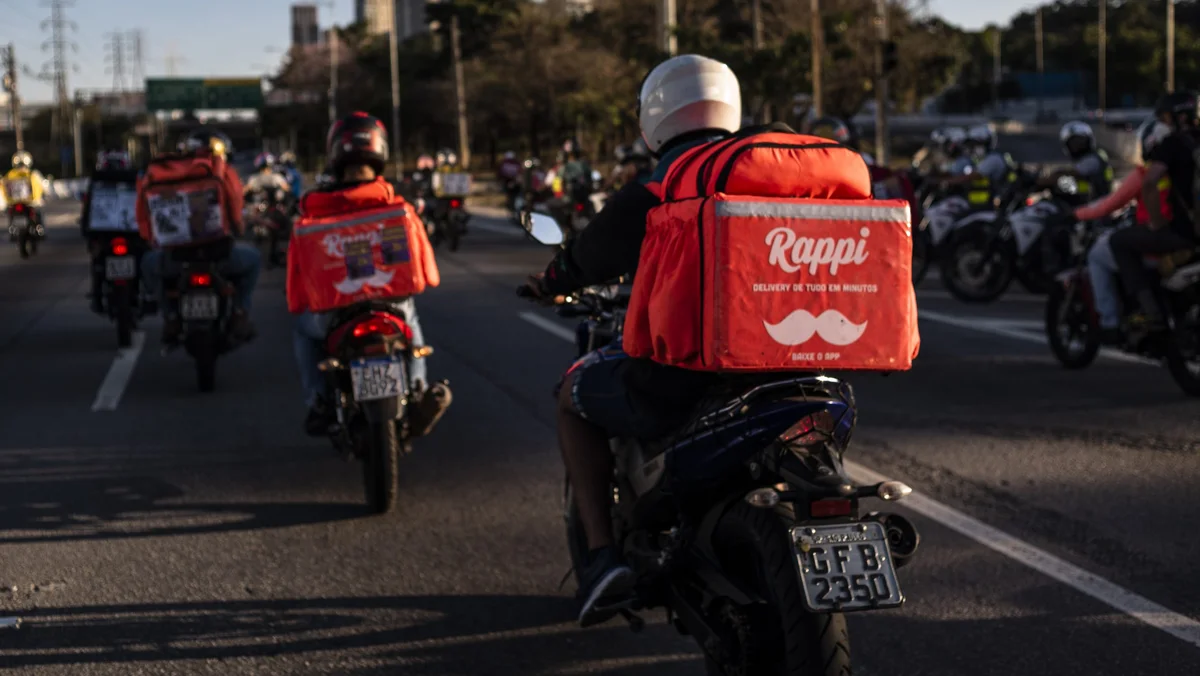
A lean cost structure also helps. Rappi relies on self-employed gig couriers, known locally as ‘rappitenderos,’ who are paid per order and tips.
BBC Mundo reporting cites courier income of about COP 4,700 (around US$1.5) per order, with 2–3 drops per productive hour. Lower regional labor costs give Rappi an edge over Western peers, though a new Colombian labor reform bill will require platforms to make social security contributions, potentially reshaping those economics.
Super App Scale and Consumer Impact
Rappi is Colombia’s undisputed delivery leader with more than 50% market share. It covers roughly half of the national territory, works with over 30,000 affiliated businesses—about 92% of them small and medium enterprises—and counts approximately 3 million active shoppers.
Restaurants and consumer packaged goods alone generate an estimated 80% of Rappi’s revenues in Colombia.
For consumers, the platform has become ‘almost like having a mall inside an application.’ Home deliveries jumped from 21% of total restaurant sales in 2019 to 35% in 2021, and Rappi saw a 300% order surge early in the pandemic. The company is now expanding into mid-size cities and middle-income segments, widening access beyond its original high-income user base.
Fintech, Data and the Next Growth Engine
RappiPay has emerged as a critical profitability lever. The digital wallet and credit card offering has attracted hundreds of thousands of users in Colombia, with more than 120,000 credit cards issued in partnership with Davivienda.
Rappi has also received authorization to operate as a digital bank, paving the way for deposits, broader lending, and a full financial ecosystem inside the app.
Combining high-frequency delivery with fintech creates rich data advantages over traditional retailers. Analysts note that every order, payment, and subscription feeds an intelligence loop that sharpens targeted advertising and personalized offers.
Micro-fulfillment centers and dark stores now enable 10–15 minute deliveries in major cities, cementing the convenience proposition that keeps users inside Rappi’s ecosystem.
Why This Matters for Investors and the Region
Rappi’s local profitability transforms its narrative from a cash-burning startup to a self-sustaining platform with IPO potential. Valued at around US$5.25–5.4 billion as of early 2025, it is Colombia’s largest unicorn and one of Latin America‘s top tech assets, having raised roughly US$2–2.3 billion in total funding including a US$1 billion SoftBank investment in 2019. Four consecutive profitable quarters put a New York listing firmly in sight, with management discussing 2025–2026 timelines.
Yet local reports indicate Rappi Colombia is prioritizing domestic expansion over an immediate IPO—targeting new cities and broader consumer segments with the cash it now generates. Investors should weigh this growth runway against rising regulatory scrutiny, including the incoming labor reform, and the possibility of renewed competition.
For Latin America’s tech sector, Rappi’s Colombian profit proves that the super app model, blending delivery and fintech, can work at scale.
Frequently Asked Questions
Is Rappi profitable in Colombia?
Yes. Rappi Colombia has reached profitability with positive EBITDA, is growing more than 30% year-on-year, and is reinvesting 100% of its profits locally.
What made Rappi profitable after years of losses?
Rappi shifted from ‘growth at all costs’ to unit-economics discipline. It optimized delivery algorithms, cut marketing spending, expanded high-margin services like fintech and advertising, and benefits from a lean gig-courier cost structure.
Will Rappi go public with an IPO?
Sustained profitability has put a New York IPO on the table, with timelines discussed for 2025–2026. However, the company is currently prioritizing local expansion in Colombia over an immediate public listing.
Sources: Rappi Colombia alcanza rentabilidad y prioriza expansión local sobre una salida a bolsa, Rappi: Latin America’s $5.25B Super App Betting Big on Delivery, Fintech, and AI, Colombia’s First Unicorn Keeps Delivering, Rappi: Colombia’s Decacorn Pivots from Blitzscaling to Profitability, Rappi – The Meituan of Latin America, Rappi Evolving Business Model: Impact on LatAm Logistics























 English (US) ·
  French (CA) ·
  French (FR) ·