

 2 months ago
23
2 months ago
23
PROTECT YOURSELF with Orgo-Life® QUANTUM TECHNOLOGY
Orgo-Life the new way to the future Advertising by AdpathwayPitching venture funds or angel investors for seed funding requires concrete proof of execution speed, defensible unit economics, and early customer validation. If you want to succeed at raising seed capital for SaaS, you have to run your raise like a disciplined sales pipeline rather than a series of informal chats.
You can open Table of Contents show
Seed-stage investors don’t expect a fully mature organization, but they do want evidence that your core business engine can turn capital into scalable revenue.
Realistic Metrics and Benchmarks for Seed-Stage SaaS
While early investors bet heavily on team pedigree and market size, your SaaS metrics serve as hard evidence of execution capacity.
| Metric | Standard Seed Target | Why Investors Look at It |
| Annual Recurring Revenue (ARR) | $100k – $500k ARR | Verifies that buyers willingly pay real money for the software |
| Growth Velocity | 15% – 20% Month-over-Month | Measures early product traction and market demand |
| Gross Margin | 75% – 85%+ | Separates high-margin software from service-heavy agencies |
| CAC Payback Period | Under 12–18 months | Demonstrates customer acquisition efficiency |
| Target Dilution | 15% – 20% equity sold | Preserves enough founder equity for future Series A and B rounds |
How Sales Motions Alter Investor Expectations
These targets aren’t rigid thresholds. The metrics investors prioritize change based on your go-to-market model:
-
Product-Led Growth (PLG): If your software relies on self-serve onboarding, investors look for steady organic user growth, strong weekly usage activity, and low monthly churn (ideally under 2%).
-
Enterprise B2B SaaS: For high-ticket software ($50k+ ACV) with longer sales cycles, institutional funds often accept lower baseline ARR if you have 5 to 10 paid pilot programs or signed design-partner agreements with established enterprise brands.
Assembling an Indispensable Data Room
Do not begin investor outreach until your data room is fully organized. Having to build financial models or locate legal docs mid-pitch stalls deal momentum and creates an impression of operational clutter.
Organize your data room into four straightforward folders:
1. The Core Pitch Deck (10 to 12 Slides)
Your deck should cover the essentials cleanly:
-
Problem: The specific business pain point, anchored to the financial cost of leaving it unaddressed.
-
Solution: Product overview, demonstrating why your tech solves the issue better than existing workarounds.
-
Traction: MoM revenue growth, key customer logos, or active usage numbers.
-
Market Size: Total Addressable Market (TAM) built from bottom-up calculations rather than generic industry reports.
-
Go-To-Market Strategy: Specific channels you use to acquire customers sustainably.
-
Team: Founder background and unique domain expertise.
-
The Ask: The exact capital amount being raised and the 18-month milestones it unlocks.
2. The Financial Model
Build a 24-month financial model. It does not need to forecast the distant future with perfection, but it must map out your monthly burn rate, hiring cadence, acquisition costs (CAC), average revenue per user (ARPU), and runway timeline.
3. Legal and Governance
Ensure your company is structured as a Delaware C-Corp. Include clean cap table documentation, founder vesting schedules, signed IP assignment agreements for all creators, and records of any active convertible notes.
4. Customer Evidence
Store anonymized customer survey data, interview transcripts, or case studies showing how users interact with your software on a daily basis.
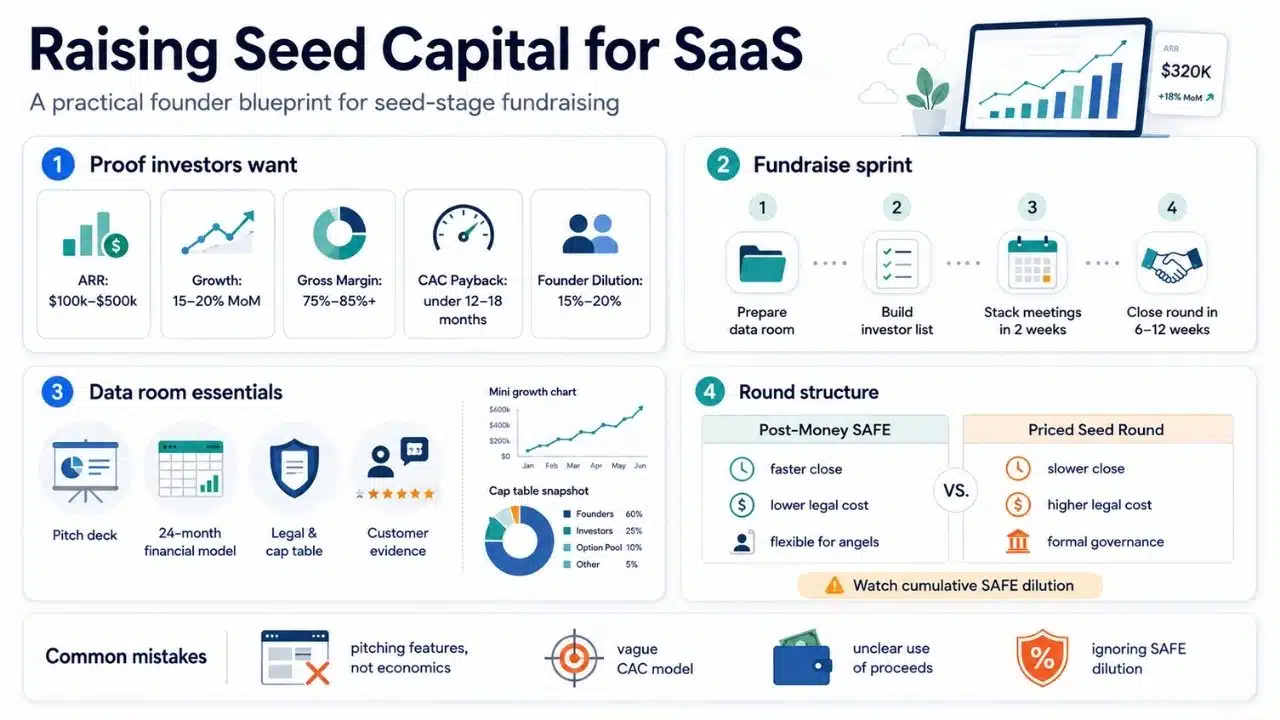 This infographic summarizes the core metrics, documents, round structures, and process steps founders should understand before raising SaaS seed funding.
Running Your Fundraise Like a Sales Pipeline
Dripping out pitch meetings over several months kills urgency. If an investor suspects you have been fundraising for a quarter without closing lead capital, they tend to pass or sit back to wait for more quarterly data.
To generate natural leverage, condense active outreach into a structured 4-to-6-week sprint.
Targeting Aligned Investors
Start by building a master list of 60 to 80 seed funds, micro-VCs, and active software angels. Filter specifically for investors who have backed companies in your software domain. Pitching a consumer brand fund for a vertical B2B infrastructure tool wastes time on both sides.
Building a Warm Introduction Engine
While cold outreach can work with extraordinary traction, warm introductions convert at a much higher frequency. Map your investor list against your professional network on LinkedIn.
The most effective intro comes from a founder who has generated positive returns for that target investor. The second-best intro comes from a mutual co-investor or trusted industry operator.
Compressing Meeting Timelines
Stack all initial pitch calls within a tight two-week window. Aiming for 15 to 20 initial meetings per week creates operational momentum. When venture firms know you are presenting to multiple groups simultaneously, it accelerates their internal review process.
Structuring the Round: Post-Money SAFEs vs. Priced Equity
Choosing how to structure your raise impacts legal fees, execution speed, and cap table complexity.
| Consideration | Post-Money SAFE | Priced Seed Round |
| Execution Speed | Fast; closes continuously per investor | Slow; requires synchronous legal closing |
| Legal Costs | Minimal ($2k – $5k) | High ($20k – $40k+) |
| Governance Changes | Typically no board seats required | Usually requires formal board creation |
| Lead Investor Requirement | Not required | Required to set valuation and terms |
Post-Money SAFEs
Simple Agreements for Future Equity (SAFEs)—specifically post-money SAFEs—are the primary mechanism for early software rounds. They allow founders to collect checks incrementally from multiple angels or micro-VCs without issuing equity immediately or running up substantial legal bills.
Post-money SAFEs make calculating dilution simple:
Ownership Percentage = Investment Amount ÷ Post-Money Valuation Cap
Priced Equity Rounds
Institutional venture capital firms leading rounds above $3M often require a formal priced equity round. This process involves issuing preferred stock, setting an explicit pre-money valuation, drafting shareholder agreements, and assigning board seats. While legal fees are higher, priced rounds establish clear governance structures for scaling teams.
Four Common Mistakes That Derail SaaS Seed Pitfalls
-
Focusing on features instead of unit economics: Spending half the pitch demoing product UI details rather than explaining how you find, close, and retain customers efficiently.
-
Hand-waving your customer acquisition model: Stating that you will rely primarily on “word-of-mouth and content marketing” is incomplete. Investors look for clear customer profiles, tested distribution channels, and realistic CAC figures.
-
Vague allocation of proceeds: Stating that capital will be used “to scale operations” provides little clarity. Explicitly state how the funding gives you 18 to 24 months of runway to hire key personnel and reach Series A revenue targets.
-
Ignoring cumulative SAFE dilution: Issuing multiple SAFEs at varying valuation caps across a long timeline can quietly dilute founder ownership far past the standard 20% target before a Series A round even begins.
Final Takeaway
Successfully raising seed capital for SaaS comes down to running an organized process. Prepare your data room thoroughly, focus on metrics that prove real market demand, batch your investor meetings to maintain timeline pressure, and protect your capital structure so you remain well-positioned for future growth.
Frequently Asked Questions(FAQs) on Raising Seed Capital for SaaS
How long does raising seed capital for SaaS usually take?
Expect 6 to 12 weeks from initial outreach to cleared funds.
Can you raise seed capital for a SaaS startup with zero revenue?
Yes, but the burden of proof shifts heavily to team background and qualitative market validation. Pre-revenue startups that successfully secure seed capital typically have founders with prior exits, deep domain expertise, or signed enterprise pilot agreements with major corporate partners.
What valuation cap should I set for my SaaS seed round?
Valuation caps depend on founder track record, current traction, and market dynamics. Most rounds aim for 15% to 20% dilution. For instance, raising $1.5M usually results in a post-money valuation cap between $7.5M and $10M.
Should I hire a broker or third-party finder to raise seed capital?
No. Early-stage venture funds view third-party brokers as a significant red flag. Investors want direct relationships with founders who will be executing the business plan day-to-day.





















 English (US) ·
  French (CA) ·
  French (FR) ·