

PROTECT YOURSELF with Orgo-Life® QUANTUM TECHNOLOGY
Orgo-Life the new way to the future Advertising by Adpathway Quantum mechanics has long relied on complex numbers to describe the strange behavior of particles, from tunneling to entanglement. A new analysis suggests that this mathematical language may not be fundamental after all. Credit: Stock
Physicists have shown that imaginary numbers may not be fundamentally required in quantum mechanics.
Physicists at Heinrich Heine University Düsseldorf (HHU), working with the German Aerospace Center (DLR), have revisited a basic feature of quantum mechanics. Their study shows that the theory can be expressed using real numbers rather than relying on imaginary numbers.
Quantum mechanics was built to describe nature at its smallest scales, where matter does not behave the way everyday objects do. At the level of atoms and subatomic particles, particles can act like waves, pass through barriers they seemingly should not cross, and become linked in ways that defy ordinary intuition.
The theory began taking shape in the early 1900s through the work of physicists including Max Planck, Niels Bohr, Werner Heisenberg, and Erwin Schrödinger. Since then, quantum mechanics has become one of the most successful frameworks in physics. It explains effects such as particle diffraction in the double-slit experiment, which shows wave-like behavior, and quantum tunneling, in which particles can sometimes pass through a barrier even without enough classical energy to cross it.
Today, phenomena such as entanglement and coherence are especially important because they underpin emerging technologies, including quantum computers and quantum communication.
Complex numbers shape quantum theory
Complex numbers have long been central to the mathematics of quantum mechanics. Unlike ordinary real numbers, complex numbers include both a real part and an imaginary part. In quantum theory, they help represent a quantum state’s amplitude and phase, two features needed to calculate how quantum systems evolve and what outcomes experiments may produce.
For many processes, this mathematical structure has seemed indispensable. But physicists have continued to debate whether complex numbers are truly built into the foundations of quantum mechanics or whether they are mainly a powerful calculation tool. The deeper question is whether quantum mechanics can be formulated using only real numbers.
A 2021 study argued that complex numbers are essential under the standard postulates of quantum mechanics. Experimental work later supported that conclusion.
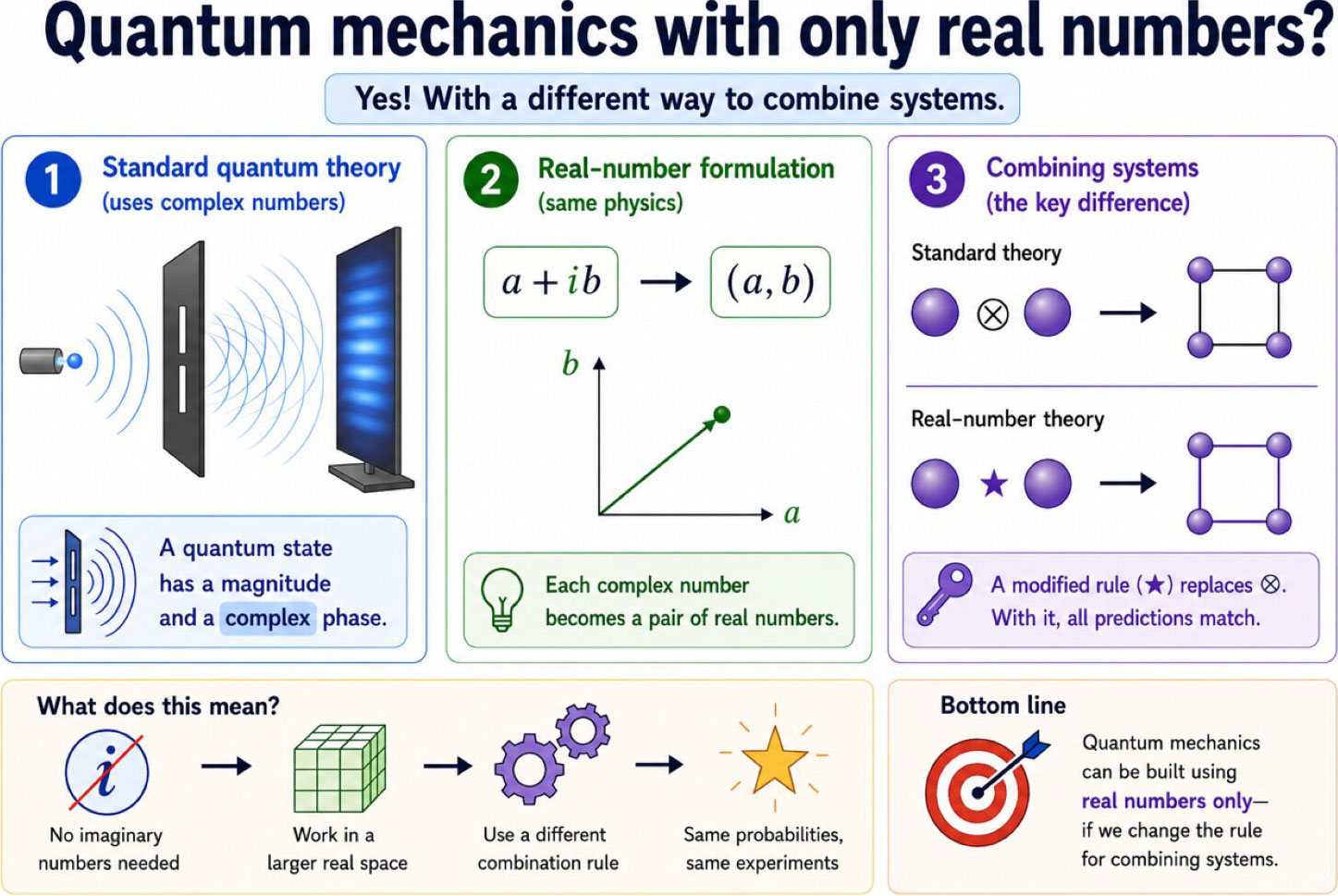 Explanatory diagram for the research question—is quantum mechanics possible with only real numbers?—and results of the study. Credit: Pedro Barrios Hita, HHU
A new postulate changes the answer
A new analysis now suggests that the answer depends on how the theory describes combined systems. A team of physicists from HHU and the DLR, led by Professor Dr. Dagmar Bruß and doctoral researcher Pedro Barrios Hita, reexamined the postulates used in the earlier work.
In a paper published in Physical Review Letters, the team argues that one of those postulates is too restrictive. They propose a physically motivated alternative for formalizing system composition. With that change, they identify a class of theories that can be written entirely with real numbers while remaining experimentally indistinguishable from standard quantum mechanics.
Professor Bruß: “This means that both frameworks yield identical predictions for any conceivable experiment. Within this framework, imaginary numbers are thus not fundamentally necessary in quantum mechanics and can in principle be replaced by alternative formulations using real numbers.”
Reference: “Quantum Mechanics Based on Real Numbers: A Consistent Description” by Pedro Barrios Hita, Anton Trushechkin, Hermann Kampermann, Michael Epping and Dagmar Bruß, 18 June 2026, Physical Review Letters.
DOI: 10.1103/4k13-sdjh
Never miss a breakthrough: Join the SciTechDaily newsletter.
Follow us on Google and Google News.





















 English (US) ·
  French (CA) ·
  French (FR) ·