

 2 hours ago
6
2 hours ago
6
PROTECT YOURSELF with Orgo-Life® QUANTUM TECHNOLOGY
Orgo-Life the new way to the future Advertising by Adpathway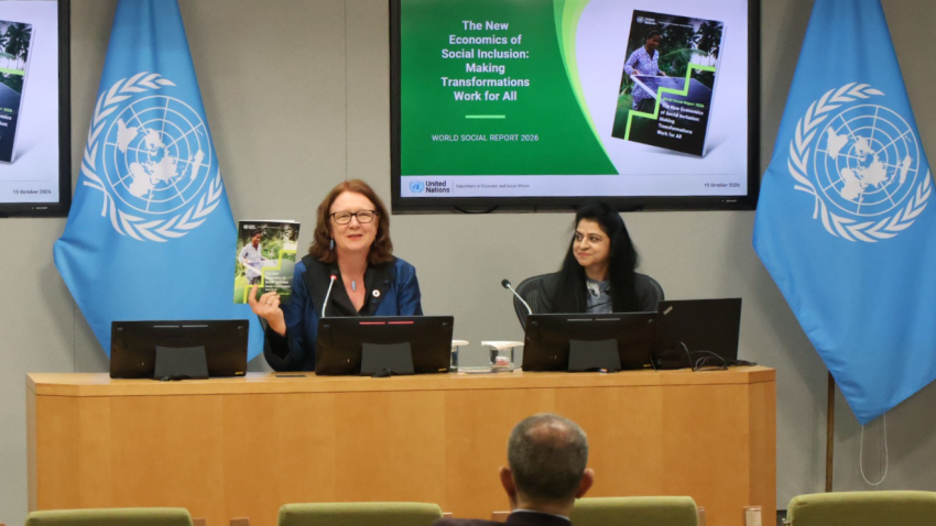 UN DESA Assistant Secretary-General Bjørg Sandkjær (right) and Rashmi Banga, Chief of the Development Research Branch, brief journalists at UN Headquarters on the launch of the 2026 World Social Report, emphasizing the need for social inclusion as economic, digital, and climate transformations widen existing divides. Credit: UN DESA / P. Vasic
 UNITED NATIONS, October 16 (IPS) - The United Nations Department of Economic and Social Affairs (UN DESA) new report, which addresses the rapid global transformations driven by artificial intelligence (AI), demographic shifts, climate change, and conflict, highlights the widening disparities in employment, social inclusion, and access to services.
The report titled The New Economics of Social Inclusion: Making Transformations Work for All was released on October 5.
Despite decades of progress in income, health, and education that drove development worldwide, the report warns that millions of people risk falling behind. Drawing on data collected over 25 years and across 168 countries, this year’s edition introduces a new Socially Inclusive Transformation (SIT) dashboard, which examines how a nation’s economic, digital, and energy transformations align with social and economic inclusion.
“On one hand, rapid transformations are reshaping our world: digital technologies, artificial intelligence, renewable energy, and the demographic and economic transition,” said UN Secretary-General António Guterres during a press briefing at the UN Headquarters coinciding with the report’s release. “On the other hand, these transformations are not working for all. Poverty and deprivation are widespread. Billions are locked out of opportunities because of income, gender, age, disability, ethnicity, or many other fault lines that undermine equality.”
In 2025, UN DESA found that roughly 58 percent of workers were informally employed, while approximately 27 percent of young women aged 15 to 24 were neither employed nor in education or training programs. The same year, UN DESA estimated that around 26 percent of the world’s population, or 2.2 billion, still lacked internet access. Roughly 730 million people lacked access to electricity. The report underscores that even among digitally connected communities, affordability and service quality continue to hinder meaningful participation.
Between 2000 and 2024, the agency reported that more than 50 countries experienced rising income inequality, including in 23 high-income countries. These gaps continue to stifle productivity and weaken community resilience to economic shocks from technological shifts, climate disasters, and geopolitical tensions.
Marginalized groups—including women and girls, youths, disabled persons, migrants, and Indigenous peoples—disproportionately experience limited access to essential resources, economic opportunities, and decision-making processes.
Rashmi Banga, Chief, Development Research Branch, Economic Analysis and Policy Division at UN DESA, stressed that transformations do not automatically translate into inclusion. She noted that none of the top five best-performing countries in transformation, specifically Malta, Ireland, the U.S., Singapore, and China, rank among the top five in inclusiveness, which mainly consist of European countries. The report reveals that numerous African countries continue to fall behind, especially with the proliferation of new digital technologies and the energy transition.
The report highlights the compounding climate crisis as a major driver of social exclusion, noting that approximately 887 million of the 1.1 billion people living in multidimensional poverty are also exposed to at least one major climate hazard. These impacts are most pronounced in regions entrenched in humanitarian crises, where communities have the fewest resources to adapt, significantly threatening long-term economic resilience.
Guterres warned that cascading global shocks, such as the Middle East crisis, are compounding existing threats through rising food, fertilizer, and fuel prices, resulting in more than 100 countries lowering their gross-domestic product forecasts this year alone.
UN DESA also identifies the growing digital divide driven by artificial intelligence as a major threat to social inclusion. While the report shows AI’s potential in enhancing agricultural productivity and generating meaningful gains for rural communities, it warns that significant threats remain. Entire communities with limited affordable, digital connectivity, coupled with insufficient digital skills, risk falling further behind.
Bjørg Sandkjær, UN DESA’s Assistant Secretary-General for Policy Coordination, told reporters that AI often reproduces “biases that exist in the world today” during hiring processes. She warned that this has severe implications for employment, particularly for women.
Banga added that equitable and effective AI governance is critical in preventing these biases and fostering economic and social inclusion. She highlighted India and China as examples of countries implementing AI education into school curriculum, while France has established access to digital infrastructure as a legal right.
Additional data from the report reveals that delaying social inclusion carries a “measurable economic cost.” UN DESA estimates show that if investments in social protection mechanisms are delayed by another decade, countries could face a potential decline in economic output by roughly 12 percent compared to countries that invested early. Conversely, efforts to include young people in employment could raise national GDP by 9.6 percent over the next decade.
“Inclusive societies are more productive, resilient, and prosperous,” said Guterres. “The report urges investments in education, job creation, and skill training, so all people can benefit from technological advancements and the growth of new industries. It calls for inclusive institutions and policymaking to ensure all voices are represented, and it advocates equity-focused approaches to labor markets and taxation to open opportunities for all people, no matter who they are or where they live.”
Banga emphasized that national investments alone cannot achieve adequate social inclusion without strong international cooperation. Multilateral support is pivotal in expanding fiscal space, providing long-term development financing, and widening access to digital infrastructure. Sandkjær called on governments to reframe social inclusion not only as an economic imperative, but as a strategic investment in long-term stability, resilience, and productivity. She also urged for greater integration of social commitments into macroeconomic planning.
“As transformations gather pace, there is no time to be lost by bringing social commitments into the heart of economic policymaking; we can unleash a virtuous cycle of greater inclusion and stronger growth,” said Sandkjær.
IPS UN Bureau Report



© Inter Press Service (20261016054911) — All Rights Reserved. Original source: Inter Press Service























 English (US) ·
  French (CA) ·
  French (FR) ·