

 3 weeks ago
33
3 weeks ago
33
PROTECT YOURSELF with Orgo-Life® QUANTUM TECHNOLOGY
Orgo-Life the new way to the future Advertising by AdpathwayBenjamin Moser is no stranger to life-writing, having written both the definitive English-language biography of the Brazilian writer Clarice Lispector and a Pulitzer Prize–winning biography of Susan Sontag. In his latest book, he takes on not one but twelve biographies in a sprawling attempt to excavate the lesser-known history of Jewish opposition to Zionism, from the nineteenth century to the present. We might even say thirteen lives, because Anti-Zionism: A Jewish History (out September 22 from Doubleday) is a deeply personal project for Moser, and it opens with an extended meditation on his own migration from passive Zionist, as a Jewish child in Houston, to adult anti-Zionist. He conceived of the book shortly after October 7 and researched it at a breakneck pace, including on reporting trips to South Africa, Germany, and Egypt. We became friends when he was putting the finishing touches on it last year at the New York Public Library, where we were both fellows. The book is an emotional and propulsive attempt to trace a lineage for those in the often-lonely position in which he found himself as an adult. But it’s hardly just for Jewish readers; the book’s diverse, impressionistic portraits of individuals from a nineteenth-century rabbi to the celebrated photographer Nan Goldin suggest, cumulatively, that anti-Zionism has been, and will continue to be, a big tent. Moser spoke to me last month about his work, goals, and process from his home in Utrecht. Usually, he jokes, prepublication activities are the “calm before the calm”—but, given the strong opinions elicited by this subject, he predicted that the rollout of this book might be a little more eventful.
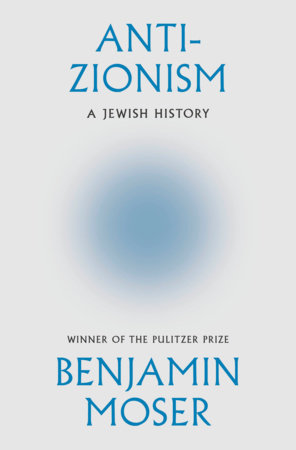
Courtesy of Doubleday.
INTERVIEWER
What did you know before you started this book?
BENJAMIN MOSER
Before I started it, I knew that anti-Zionism existed as a tradition, but I hadn’t heard of half these people. For me, one of the lessons of the past few years has been that Zionism affects everything, far beyond what you would think if you just looked at the absolute numbers of Jews in the world. Zionism sums up so much of what the West has done, including to the Jews, but also to nonwhite peoples—you can see how often India or South Africa come up in the book, for example. Palestinians often talk about “the centrality of Palestine,” and it’s because what happens in Palestine has a weird knock-on effect on so much else.
INTERVIEWER
What’s the function of repetition in this book? There are a number of refrains—the apostle Paul saying it’s time to put away childish things, other biblical epithets like “the stiff-necked people” (the disobedient Israelites), and the detail that the most dangerous country for Jews today is Israel.
MOSER
Well, you know whom I got that from?
INTERVIEWER
Sontag? Clarice Lispector?
MOSER
No—V.S. Naipaul.
INTERVIEWER
Can you elaborate?
MOSER
When I was younger, he told me that people don’t remember anything they read in nonfiction books. You put all this detail in to make something feel real, but then people read forward, and they forget. So you have to keep recalling things, whether it’s through a physical characteristic—so-and-so with red hair—or a Homeric epithet, like “rosy-fingered dawn.” The fact that Israel has been the most dangerous place in the world for Jews since 1945 is not just a fact that you want to mention in passing. Israel’s national argument is based on the idea that Israel keeps Jews safe—that we can exist in Sweden or in Holland or in New Jersey only because we have this plan B. But it turns out that the plan B is extremely dangerous.
INTERVIEWER
You open with two pages of epigraphs from the Old Testament, and a lot of them are from lesser-known prophets—at least, lesser-known to me. What were you hoping to achieve with these dozen quotations?
MOSER
There were forty-eight prophets and seven prophetesses—anybody through whom God speaks is considered a prophet, even if they don’t get a full chapter of the Bible. And their message is pretty unanimous, namely that you must keep to the laws and the commandments or you will be punished. The way you get punished is that God withdraws his favor and punishes all the Jews. Not just the bad Jews—all of them. So there’s a sense of responsibility for the whole people. Moreover, the punishment, per many of the prophets, is that you’ll be expelled from your land, which happens in the Old Testament—more than once.
INTERVIEWER
Your sweeping, global narrative opens with a concrete, personal image—your grandfather’s copy of Theodor Herzl’s Zionist Writings, which traveled with him from Nazi Germany to Texas. How did you land on that?
MOSER
I wrote that part last, actually. My grandfather left Germany in 1938, and the only thing he took with him was this big, blue Herzl book, which I have right downstairs. But instead of going to that promised land, he went to another promised land—America. That book was one of his few possessions that survived through to my childhood, and to me, it was just a symbol of our Jewish story. We were persecuted, almost everybody was killed, and then, luckily, we got Israel—that’s what I was told as a kid. A very simple story.
But then I finally read the book, and I was utterly stunned by it. It is the weirdest book that you can imagine. In the first chapter, Herzl even says that when he showed his work to a friend, the friend started crying. And Herzl goes, “Oh, I was so moved when I was writing it, too.” But the friend is like, “No, no, I’m not crying because I’m moved by it—I’m crying because you’re nuts.” And that was exactly the feeling I had. It’s such an important book, which has affected the lives of so many millions of people—but none of your literary training equips you to read Herzl.
INTERVIEWER
Why was it important for you to preserve your subjective response to the book, rather than try to persuade through some sort of dispassionate or “objective” criticism?
MOSER
That’s really a principle in all my work. I start with an explicit acknowledgment of what I think, because I’ve always hated the pretense of objectivity. You write about anything from a certain perspective. You are asking me questions that you’re interested in, because of your interests and your experience, and then you’ll edit this in a way that will show what you thought I said that was good, or, if you don’t like me, you’ll try to put in all the stuff that makes me sound stupid.
I got some criticism for Sontag for emphasizing the gay aspects of her life. Well, it so happens that I’m gay and I’m interested in gay people’s lives. I can’t pretend to write about Jews or gay people or Americans or really any of these “identities” from a total remove. So I like to get that out of the way—who I am, where I’m coming from, what my family background is. In the case of Zionism, I think my background is pretty similar to that of a lot of American Jews. We didn’t grow up with fanatical Israelism, and we didn’t really have Birthright. Zionism was just hanging in the air, rather than being shoved down our throats. It really was a different time. There was a consensus on Israel in this country, and not only among Jews.
INTERVIEWER
I’d love to discuss your selection of subjects—perhaps taking the German Israeli lawyer Felicia Langer, who defended Palestinian political prisoners, as an example. The legal element of the occupation is obviously essential, but there are so many individuals who could potentially illuminate that. How did you land on Langer?
MOSER
Honestly, I had never heard of her beforehand, but I kept coming across her name in different left-leaning publications and human rights reports. So I googled her, and I found that she’d written a lot. It’s always helpful when people do that, because there’s more material. I’ll sketch her story in brief. She was born in Poland in 1930, and in 1939, when the Nazis invaded Poland, her family fled to the Soviet Union. She had this unbelievably horrific childhood—her father died in exile, and she and her mother survived, but then they discovered that their entire family had been killed. To make a long story short, they end up going to Israel, and Langer becomes one of Israel’s early female lawyers.
I think she was the only woman in her graduating class, which included the future Israeli prime minister Ariel Sharon. She was a communist and a leftist, and so was her husband, so they joined the Communist Party, which was the only party in Israel at the time with both Jewish and Palestinian members. Through that, she started getting to know some Palestinians, and to see the similarities between what she’d experienced as a European refugee and what they were experiencing.
Soon she became the most prominent Israeli lawyer for Palestinians. In her own writing, she posits that her contribution to the cause was to show how Israel used law and used the appearance of democracy to create this absolutely ruthless, inhumane, racist system to colonize and expropriate the Palestinian people. She’s also an incredible person to spend time with, on the page—she died in 2018. You feel strengthened by reading her memoirs. I went to Germany to meet her son and spend time with her family there. I think the best part about this book, for me, has been getting to know anti-Zionists from all over the world, because they’re always the best people.
INTERVIEWER
Your chapter about your grandfather’s Herzl book is structured like a detective story, while your section on the gay Dutch poet Jacob Israël de Haan has a three-act arc, with a tragic conclusion. How did you think about narrative tension, which is generated in different ways in each chapter?
MOSER
A lot of it happened in editing, because I was trying to do a big panorama of a huge story, and I wanted to do it economically. The book is only four hundred pages, including notes, but it could be much longer. There’s so much more to say. But I do think each of the lives in the book has a certain arc. De Haan’s reads like a thriller—it’s a jaw-dropping, tragic story ending in heartbreak, with him trying to get back to Europe from Mandatory Palestine, having been informed by anonymous political enemies that they were going to kill him. De Haan’s 1924 assassination was the first political killing of a Jew in Mandatory Palestine.
But the night before he was scheduled to be killed, he writes, “How wondrous is the 23rd, when one is going to be shot on the 24th!” He had a real flair for the dramatic. But narrative propulsion does become harder to achieve when you have to tell a new story in every chapter while also advancing the broader arc. I wanted to sketch out the whole story of anti-Zionism, so that by the time you’re about halfway through, you understand the basic outline of the ideology and can then spend time with specific case studies. But the book is designed to become more narratively propulsive the further you read.
INTERVIEWER
How much prior knowledge do you tend to assume in your readers?
MOSER
I learned about this when I was writing my first book. Since I was writing in English about Lispector, a Brazilian writer who was basically unknown in the U.S., I couldn’t assume prior knowledge about anything. I would say, “Rio de Janeiro, famous for its beaches and mountains,” and so forth.
The funny thing is, when it eventually came out in Brazil, I told the publisher they could edit all that stuff out in the translation. But they were like, “No, no, no, we have to leave it in, because nobody knows those basic things in Brazil either.” They probably know that Rio has beaches, but they don’t know why the National Congress was dissolved in 1937, or whatever. People forget.
So you can’t assume prior knowledge. But you also don’t have to assume ignorance—saying something like, “The Jews are an ancient religious sect that believe in something called the Torah.” You don’t have to go that deep. You can give people a subordinate clause. So I say, “Zionism, the belief that there should be a Jewish state in Palestine …” You can go deeper into that, and I do, later in the book—but you don’t have to beat people over the head.
INTERVIEWER
What did your research and reporting notebooks look like, and how do you use technology?
MOSER
Well, I had about eight hundred pages of notes from Egypt and about Ahmad Sadiq Saad—a Jewish Egyptian Communist—for chapter four. I do a lot of recording, and I like voice notes that you can transcribe and edit directly in Apple’s Notes.
The worst thing that can happen to you while working on a book like this is that feeling of, Where the hell is that quote? Something else I do is take a lot of pictures of book pages. I underline things and then take a picture, and I also annotate the transcriptions. That way, when I need to write about a certain subject, everything is searchable. I can look up a word, like pariah, which comes up in relation to Hannah Arendt, and find everything about that subject.
INTERVIEWER
One of the only Tamil loanwords, by the way—pariah.
MOSER
Oh, congratulations. Well, that concept comes up again and again in the Arendt material. So then you’re looking for connections. The twinned concepts of the conscious “pariah,” one who rejects assimilation, choosing to be an outsider, and the “parvenu,” the arriviste, essentially, who’s said to embody negative materialistic stereotypes, become really important in the history of Zionism, because Zionism embraces the parvenu—the individual who wants to live with power and money and armies.
INTERVIEWER
How did you think about fact-checking, expansively construed? On a basic level, there is a lot of source material, in several languages. But, more broadly, were you stress-testing your claims and assertions as you went along?
MOSER
I was writing this book with real anxiety about getting the facts right. As I say in the book, Zionism has the effect of installing a little Zionist censor in your head. If I write a fact about Vermeer that’s wrong, an academic might tweet about it, but it’s not really going to go past that. Whereas with Zionism, you’re always very afraid. That’s why one of the themes of the book is tone policing. The chapter about Hannah Arendt, for instance—am I really suggesting that Zionists worked with Nazis? First of all, yes—that’s on the record and has been for eighty years. But it does make you very paranoid.
Even after I turned in the book, I kept going over it and going over it, and in every pass I found mistakes, because it’s so broad. It covers a hundred and fifty years and five continents, so there’s not really one person to whom you can hand it and say, “Fact-check this.” The people who were still alive, like Nan Goldin and Ronnie Kasrils, read their chapters and gave comments, which was really useful.
This is, in general, a hard subject to write about, because you know you’re going to be attacked for certain things long before you even write one word. So I think the question is, does that make you timid or does that make you more bold?
Zionists will never argue about the substance, which is, was it right or wrong for these European Jews to take over Palestine and ethnically cleanse the native population? We don’t want to talk about that, so instead we’ll talk about this semicolon or this footnote. You can see it in the book—they would rather kill de Haan than argue with him. They do it to every single one of us. That can give you a sort of freedom, but you still need the facts to be right. It’s been very hard, I have to say, more so than any book I’ve ever done.
INTERVIEWER
You once told me, and I’ve never forgotten, that as you get older and keep on writing, some books will just come more easily, because you’ve been thinking about them for such a long time. Could you elaborate on that?
MOSER
Knowing who you are is such a hard part of becoming a writer. But you have to have a sense of who you are before you can write about certain things. At fifty, I finally have that. By midlife, there are themes or questions that you’ve been thinking about for years or decades, and all of that counts as writing, or perhaps research.
You also develop a muscle memory for reporting and interviewing people, even if it’s in a new setting. And I don’t think that can really be taught, because it’s so subjective. It’s about the kind of person you are in a room. I used to wish someone had told me that, but it wouldn’t have worked. I could tell you my tricks for interviewing people, too, but you wouldn’t remember them. What you do remember is your own experiences.
Despite everything I just said, right before I started this book, I was at a low point. I had written in my journal, “I’ve had a good run … but I have to just accept that it’s over.” Then, a week later, I had the idea for this book. And what’s more—I’m once again in that phase, and it feels quite inconceivable that I’ll ever write anything again. But I guess the good thing about getting older is that you’re like, Okay, we’ve been here before.
Krithika Varagur is the author of The Call: Inside the Global Saudi Religious Project and an editor of The Drift and Equator.




















 English (US) ·
  French (CA) ·
  French (FR) ·