

 2 months ago
66
2 months ago
66
PROTECT YOURSELF with Orgo-Life® QUANTUM TECHNOLOGY
Orgo-Life the new way to the future Advertising by AdpathwayOn April 19, North Korea fired ballistic missiles toward its east coast. The latest test salvo came just 11 days after the previous missile launch on April 8.
According to the Korean Central News Agency (KCNA), one of the North’s main state-controlled media, the missiles tested on Sunday were “surface-to-surface tactical ballistic missiles” in what Pyongyang described as a warhead performance evaluation of its upgraded Hwasongpho-11 Ra missile system.
“Five tactical ballistic missiles, launched towards the target area around an island about 136 km away, struck the area of 12.5~13 hectares with the very high density, fully displaying their combat might,” KCNA reported.
North Korean leader Kim Jong Un guided the missile test. According to KCNA, Kim touted the results, which could “boost the high-density striking capability to quell a specific target area as well as the high-precision striking capability.”
On April 19, South Korea’s Joint Chiefs of Staff (JCS) initially assessed the possibility that some or all of the projectiles may have been submarine-launched ballistic missiles (SLBMs), citing the launch location near Sinpo, South Hamgyong Province – home to a key North Korean submarine base. The JCS said South Korean and U.S. intelligence authorities had been tracking the launch and were conducting detailed analysis of the missiles’ specifications in coordination with Japan.
Hours after the North’s missile launches, the South’s Office of National Security held an emergency meeting and condemned the North’s missile test by calling it a clear violation of the United Nations Security Council resolutions.
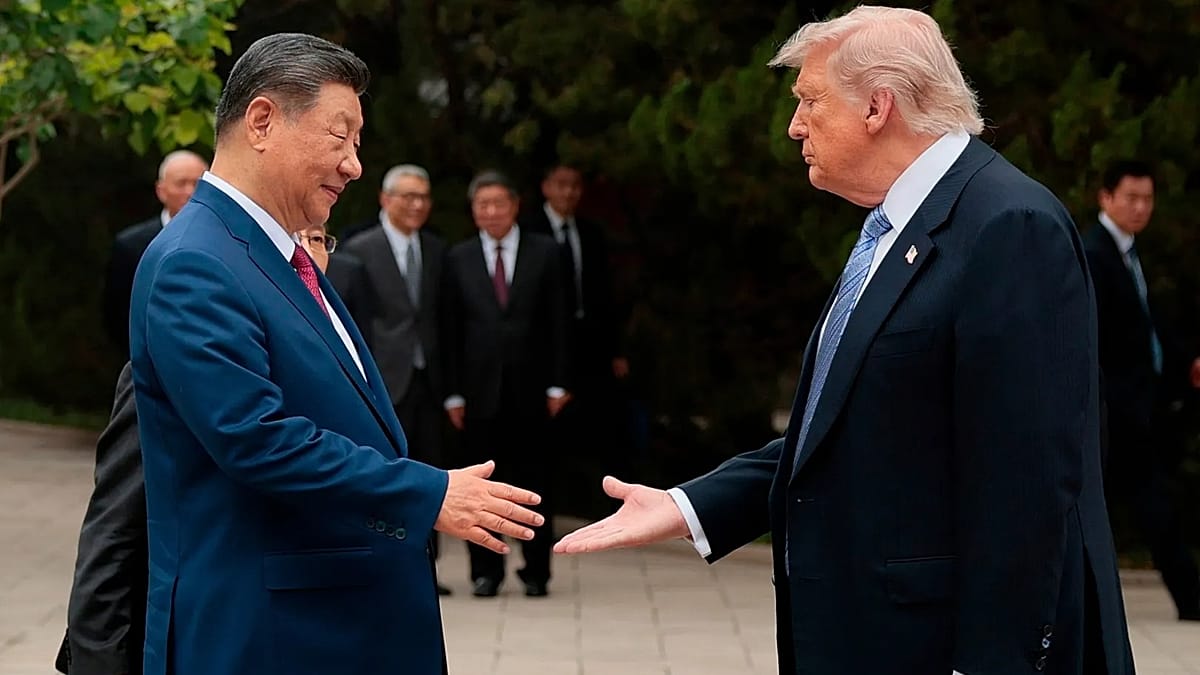
The timing carries significant diplomatic weight. The launches come approximately one month before U.S. President Donald Trump is scheduled to visit Beijing. Speculation has mounted that Trump may seek room to hold a direct meeting with Kim on the sidelines of his summit with Chinese leader Xi Jinping. Trump visiting the Demilitarized Zone of the two Korean Peninsula, or Kim traveling to Beijing for a summit, are two possible scenarios. As yet, however, it seems there have not been any working-level talks between the two countries to arrange such a meeting.
Last month, Pyongyang enshrined nuclear weapons as tools for the safety of its future generations during the sessions of the 15th Supreme People’s Assembly. In the past years since the end of the 2019 Hanoi Summit between Trump and Kim, Pyongyang has explicitly made moves – including the stipulation of its nuclear building policy in its Constitution – to clearly send messages toward Washington that it would never use its nuclear weapons as a bargaining chip anymore.
As Trump walked out of the summit in Hanoi without reaching an agreement, Pyongyang has demanded that Washington make concessions first in order to renew the stalled negotiations between the United States and North Korea. Without seeking any goals or preconditions to be settled in advance, however, Kim may consider having talks with Trump as Washington has little bandwidth to deal with Pyongyang’s nuclear weapons given the current circumstances. Although Pyongyang has explicitly shown its antagonism against Seoul, North Korea has not used its traditional hawkish rhetoric toward Trump directly this year.
In light of North Korea’s traditional strategy in testing its missiles to make its presence felt while the U.S. president grapples with other diplomatic or security issues, the bromance between Trump and Kim could be ignited suddenly, even just days before Trump’s summit with Xi. Trump and Kim’s last meeting, a summit at the DMZ in June 2019, was a last-minute addition to Trump’s itinerary, with very little advance preparation.
In this context, Seoul needs to make sure to closely coordinate with Washington for the possibility of a North Korea-U.S. bilateral summit next month so as to not be sidelined. However, cooperation between the U.S. and South Korea may be impacted by current diplomatic conflicts in the intelligence-sharing relationship between the two sides.
According to local media reports, the United States has partially restricted its sharing of North Korea-related satellite imagery with Seoul since last week, following remarks made last month by South Korean Unification Minister Chung Dong-young. At a National Assembly Foreign Affairs Committee hearing on March 6, Chung publicly identified Kusong, North Pyongan Province, as a site of North Korean uranium enrichment activity – the first time a senior South Korean government official had done so in a public setting. Washington subsequently conveyed its complaints through multiple diplomatic channels, expressing concern that the disclosure could allow Pyongyang to identify and shield the intelligence assets used to monitor the site.
Chung pushed back on April 20, saying his remarks were based solely on publicly available information, including a 2016 report by the U.S.-based Institute for Science and International Security that raised – though did not confirm – the possibility of uranium enrichment activity near Kusong. Noting that he had referenced Kusong in the same context during his confirmation hearing last year, Chung publicly expressed his regret over the accusations that he has disclosed confidential information.
Also on April 20, President Lee Jae-myung defended Chung in a post on X. Lee retweeted a news article that framed the controversy as an attempt to force Chung from office. The South Korean president called it “an indisputable fact” that the existence of the Kusong nuclear facility was already widely known before Chung’s comments. “Every claim and action premised on the assumption that Minister Chung ‘leaked classified information provided by the United States’ is wrong,” Lee said, adding, “I intend to look closely into why such an absurd situation is occurring.”
The intelligence sharing issue adds to a string of recent frictions in the alliance. For instance, South Korean Defense Minister Ahn Gyu-back complained about a confrontation between U.S. and Chinese fighter jets in February, when U.S. Forces Korea fighters patrolled an area where Air Defense Identification Zones (ADIZ). South Korea said that it has not received advance notice of the unusual patrol, forcing the USFK commander to apologize. The fracas was heavily covered by South Korean domestic media. The United States may also be displeased by the pending DMZ Act, which is an attempt by the Unification Ministry to carve out partial rights to control civilian entries to the DMZ – which is now the exclusive remit of the United Nations Command. Chung is leading the push to reduce UNC control over the DMZ.












 English (US) ·
  French (CA) ·
  French (FR) ·