

.png) 3 hours ago
5
3 hours ago
5
PROTECT YOURSELF with Orgo-Life® QUANTUM TECHNOLOGY
Orgo-Life the new way to the future Advertising by Adpathway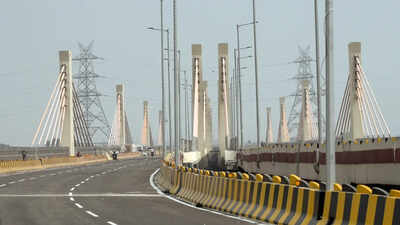
A view of the Barapullah Phase-3 elevated corridor that is scheduled to be inaugurated on September 29, 2026, in New Delhi on Saturday. (ANI Photo)
NEW DELHI: New access-controlled high-speed national highway corridors will have no median (divider) openings and no at-grade (surface level) intersections, a move that aims at eliminating conflict points and reducing crashes.It has also been mandated under new NHAI guidelines issued on Monday that these corridors won’t have raised concrete dividers but flush medians — painted centre lanes with thick wire ropes or crash barriers. These will also have advance exit signage at 5 km, 2 km, 1 km and 500 metres to help motorists prepare for lane changes well in advance.The design provisions are aimed at improving safety on access-controlled corridors where cars are allowed to travel at speeds of up to 100 kmph.
Delhi-Dehradun Expressway, Ambala-Kotputli corridor and Trans-Haryana corridor are among such highways.NHAI said the guidelines seek to bring uniformity in the planning and design of access-controlled high-speed corridors and ensure consistency in technical standards across projects.“The guidelines will apply to all upcoming four-lane and six-lane greenfield and brownfield access-controlled high-speed national highways,” an NHAI spokesperson said.
Officials said eliminating median cuts and surface intersections will prevent dangerous cross movements and wrong-side driving, while standardised signage and geometric design will improve traffic flow and reduce the risk of high-speed crashes on the new generation of national highway corridors.
The move is significant as govt has set a target of developing 50,000 km of access-controlled high-speed corridors over the coming years.At present, there are no separate standards governing the planning and design of access-controlled high-speed national highways, except for expressways. The new document fills that gap by laying down dedicated norms for highways that are access-controlled but not classified as expressways.The guidelines also specify lane configuration based on detailed traffic assessment and future traffic projections. Depending on the expected traffic volume and the number of structures such as bridges, flyovers and interchanges, these corridors will have a right of way of 60 metres or 70 metres.























 English (US) ·
  French (CA) ·
  French (FR) ·