

 2 months ago
22
2 months ago
22
PROTECT YOURSELF with Orgo-Life® QUANTUM TECHNOLOGY
Orgo-Life the new way to the future Advertising by Adpathway
By the end of the week, 17 bank branches in South Africa will enable South Africans to apply for Smart IDs on their premises through the new digital partnership model developed with Home Affairs. Applications will be paperless, and take approximately five to ten minutes, according to Home Affairs Minister Leon Schreiber. (Lubabalo Lesolle/ Gallo Images)
Lubabalo Lesolle/ Gallo Images
- By the end of the week, 17 bank branches in South Africa will enable their clients to apply for a Smart ID in minutes.
- Home Affairs, together with Capitec and Standard Bank, has gone live with their massive digital partnership model.
- The launch this week is just the beginning. More banks and services are expected to come online soon.
- For more financial news, visit News24 Business.
By the end of the week, new machines will be operational in 17 bank branches in South Africa, enabling clients of two of South Africa’s biggest banks to apply for a smart ID in 5 to 10 minutes.
On Monday, the Department of Home Affairs, together with Capitec and Standard Bank, announced the go-live of their new digital partnership model.
Through the partnership, the banks have connected directly to Home Affairs systems via an API-based digital gateway, a control hub that enables different digital systems to securely connect and exchange information.
For customers of these banks, this means they can apply for a Smart ID at a bank branch without any other documents and without touching a piece of paper. According to Home Affairs Minister Leon Schreiber, the process should take 5 to 10 minutes.
“Today signifies by far the biggest milestone to date on our reform drive to deliver Home Affairs @ home. By embracing digital transformation, we are redefining what public service delivery looks like in the modern age,” Schreiber said in his speech on the go-live.
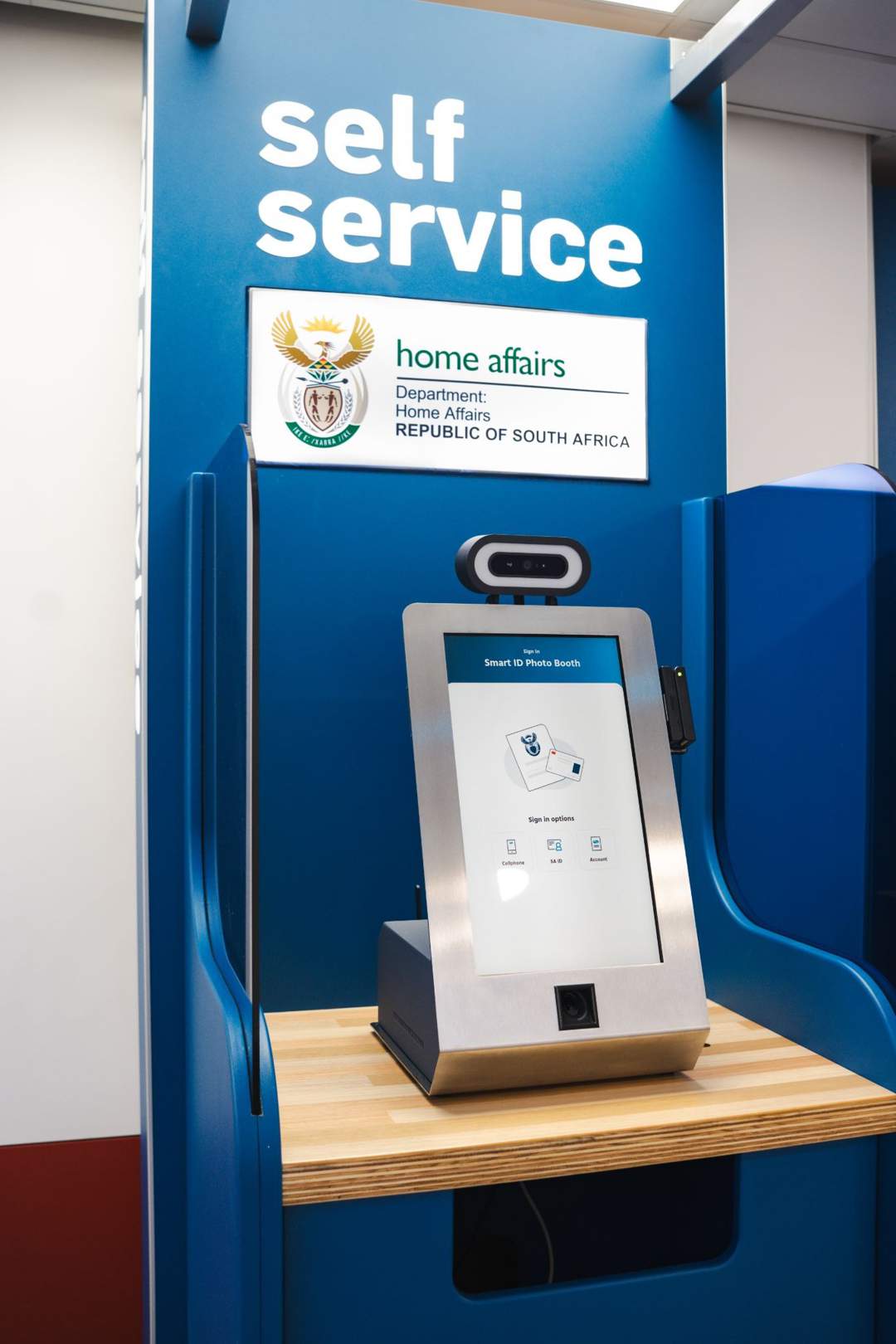
The new self-service machines that are being used for the partnership.
The intervention aims to reduce the need for people to travel long distances to apply for documents by radically increasing the number of locations where applications can be made. Having more locations should also cut the long queues at Home Affairs branches.
Who can make an application at a branch?
At this stage, the only people who should consider using the bank branch service are citizens and qualifying permanent residents who still hold a green ID book and want to convert it to a Smart ID card, and people who want to have a Smart ID card reissued.
It is important to note that, at this stage, people applying for a Smart ID for the first time must still apply at a Home Affairs branch.
While the intention is also to make passport applications possible through the partnership at a later stage, that is not currently possible.
Home Affairs has published an information page with a long list of frequently asked questions that people should review before heading to a branch to make an application.
Going forward, Home Affairs and the banks have expressed an intention to enable home delivery of documents.
READ | Home Affairs big bang: What’s next in massive push to banks?
However, for now, collections will be done at the bank branch where the application was made.
Where can applications be made?
By the end of this week, the new application system will be available through two banks at 17 branches across the country. As per Schreiber’s speech, these are:
Capitec
• Orange Farm, Eyethu Mall (Live)
• Howick (Live)
• Swellendam (Live)
• Sandton City (Live)
• Kathu Village Mall (Live)
• Matoks (Live)
• Hermanus (Live)
• Jeffreys Bay, Fountains Mall (Friday, 13 March)
• Pietermaritzburg (Friday, 13 March)
• Tygervalley (Friday, 13 March)
• Stellenbosch (Friday, 13 March)
• Vredenburg (Friday, 13 March)
• Cape Town V&A (Friday, 13 March)
Standard Bank
• Soweto, Maponya Mall (Live)
• Rosebank (Live)
• Westgate Mall (Thursday, 12 March)
• Parow (Thursday, 12 March)
Standard Bank and Capitec are the first banks to go live with the new offering. Schreiber said that FNB was in the final phase of testing the service.
Absa, Discovery Bank, Nedbank, African Bank, and GoTyme Bank are among the other banks that agreed to join the partnership with Home Affairs.
The new service is only available to clients of the banks where the service is live, Home Affairs spokesperson Carli van Wyk told News24. She noted that the new service helps everyone accessing Home Affairs services, as having more access points will shorten queues at Home Affairs branches.
Home Affairs wants to radically scale the number of branches that are live on the new service, but is rolling it out in phases to ensure system stability and operational readiness.
“To ensure a responsible rollout, the Department and its banking partners will start small, test thoroughly, and stabilise the system before rapidly expanding the rollout across the country throughout this calendar year,” Schreiber said.
He said that Home Affairs wants to scale the digital partnership model to 1 000 participating bank branches across South Africa by 2029.
Capitec CEO Graham Lee said that its network of 860 branches will serve as a hub that brings “critical services under one roof”.
“An ID is a catalyst for economic participation. We serve close to half of South Africa’s adult population, and we know that time is our clients’ most valuable asset. By integrating Home Affairs services into our branches, we are using our scale and technology to shorten long journeys and help fill a real gap in underserved communities,” said Lee.
Funeka Montjane, the CEO of Standard Bank Personal & Private Banking, said the partnership shows how collaboration between the public and private sectors can improve access to essential services.
“By working with the Department of Home Affairs, we are bringing these services closer to where people live and work, using infrastructure that communities already trust,” Montjane said.
Home Affairs previously had a partnership with some banks, in which it hosted miniature Home Affairs offices in their branches. This solution was, however, less scalable, as Home Affairs staff and hardware were needed in bank branches.
Van Wyk confirmed that this old model is still live in the branches where it has been rolled out. She said that the intention is to transition these branches to the digital model once it has been expanded to include passport applications.
The image credit in this article was corrected after publication. The image was supplied by Capitec.
























 English (US) ·
  French (CA) ·
  French (FR) ·