

 2 months ago
30
2 months ago
30
PROTECT YOURSELF with Orgo-Life® QUANTUM TECHNOLOGY
Orgo-Life the new way to the future Advertising by Adpathway- Iran is betting that it can survive the war with the US and Israel.
- The Islamic Revolutionary Guards Corps is firmly in control, dictating strategy and targets in the war.
- Iranian planners assumed confrontation with the US and Israel was inevitable.
Iran is wagering it can outlast the US and Israel - not militarily - but by grinding the war into a brutal contest of endurance.
Its strategy is stark: Unleash drones and missiles, cut vital energy routes and jolt global markets hard enough to force Washington to blink first.
AFP reported that Iran’s security chief Ali Larijani dismissed on Tuesday threats by US President Donald Trump to hit the country harder if the flow of oil stops through the strategic Strait of Hormuz.
“Iran is not afraid of your empty threats. Even those greater than you could not eliminate the Iranian nation. Take care of yourself not to be eliminated!” said Larijani in a post on X.
Despite the shock of the US-Israeli strikes and the loss of key figures, the Islamic Revolutionary Guards Corps (IRGC) - long the ultimate guardian of the Islamic Republic - is firmly in control, directing the battlefield, executing pre-planned contingencies and dictating strategy and targets in the war.
READ | ‘They have nothing left’: Trump hints at end to Iran war, and oil prices fall, stocks jump
The IRGC also played the decisive role in elevating Mojtaba Khamenei as supreme leader after Ayatollah Ali Khamenei was killed in the opening US-Israeli strikes.
“For them, they are waging an existential fight. This is an all-out war,” said Fawaz Gerges of the London School of Economics.
“They believe their very survival is at stake. They’re willing to bring the temple down on everyone’s heads.”
Alex Vatanka, a senior fellow at the Middle East Institute and expert on Iranian politics, added: “They’re like a bleeding animal - wounded, but therefore more dangerous than ever.”
The Iranian regime can try to hide their missile launchers, but U.S. forces won’t stop looking. When we find them, we’re taking them out. pic.twitter.com/urq3LWwARC
— U.S. Central Command (@CENTCOM) March 10, 2026That all-out war mindset is behind Iran’s escalating strikes across the Gulf, targeting energy hubs from Qatar to Saudi Arabia to maximise economic disruption in a calculated attempt to drive up costs for its neighbours, Europe and the United States and test Washington’s political will.
US President Donald Trump told Republican lawmakers on Monday the war would continue until Iran is “totally and decisively defeated”, but predicted it would be over soon.
He added that once the US is done with the military operation against Iran, Tehran will not have any weapons against the US, Israel and US allies for a long time.
Iranian insiders say this escalation was anticipated long before the war began 11 days ago.
Iranian planners assumed confrontation with Washington and Israel was inevitable, and prepared a layered strategy coordinated across the Guards’ sprawling military networks and proxy forces.

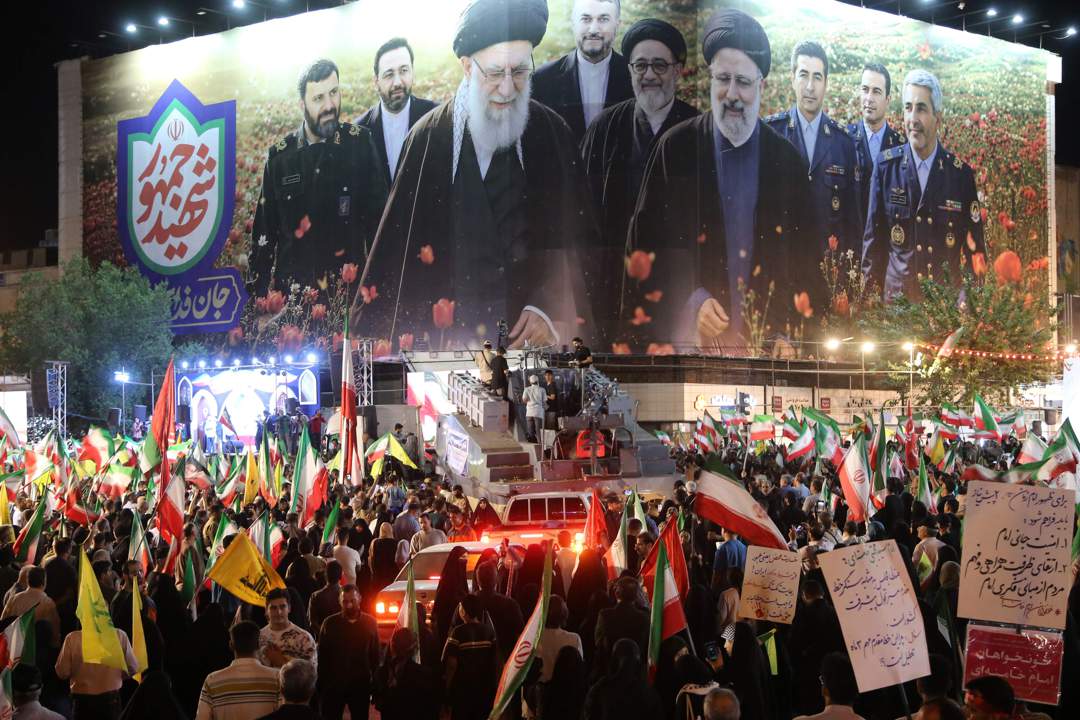
Iranians gather at Palestine Square carrying Iranian flags, chanting anti-US and anti-Israel slogans to protest the attacks by the United States and Israel in Tehran.
Fatemeh Bahrami/Anadolu via Getty Images
Now, with little left to lose, Iran is executing that plan and turning the conflict into a grinding war of attrition aimed at exhausting its adversaries politically and economically.
The consequences are already visible at home.
Mojtaba’s selection as supreme leader, insiders say, proves the Guards’ dominance as kingmakers.
They say the balance of power has shifted.
The supreme leader holds the title, but the future of the Islamic Republic, and the authority of the clerical establishment itself, now depends on whether the Guards can weather the storm unleashed by the US-Israeli campaign.
Former Trump National Security Adviser John Bolton says President Trump "could be manipulating the markets" by saying the Iran war could be over “very soon.” Bolton told Anderson that "if there's anything the president is obsessed about, it's markets" and gas prices. pic.twitter.com/HosGMVRlH3
— Anderson Cooper 360° (@AC360) March 10, 2026But a critical unknown in the war, says Mohannad Hage Ali, a senior fellow at the Carnegie Middle East Center, is how long the Guards can sustain its missile campaign, the backbone of its strategy against its adversaries.
US officials say a large share of Iran’s arsenal has already been destroyed, but regional sources say Tehran may still retain more than half its pre-war stockpile.
If that estimate holds, Iran could keep launching missiles for several more weeks, a timeframe that could prove significant for Washington as economic pressure mounts at home and abroad.
The Guards’ reach also extends far beyond the battlefield as it reshapes daily life.
An Iranian observer said goods that once sat for weeks at ports are now cleared immediately. Paperwork comes later.

In this handout image, an Arleigh Burke-class guided-missile destroyer USS Thomas Hudner (DDG 116) fires a Tomahawk land attack missile in support of Operation Epic Fury.
Officials described that as preparation for a war economy, ensuring supply lines keep moving under pressure, while also consolidating the IRGC’s control over the state and asserting continuity of governance.
Equally critical is internal stability.
So far, there are no signs of protests, elite defections or fractures within the establishment, according to observers and contacts inside Iran.
An insider in Tehran described a city under bombardment, but still functioning.
“The windows shake day and night,” the person said. “But life goes on.”
There’s never enough money for schools or healthcare or veterans.
But there’s always enough money to bomb people on the other side of the world.
We can support the democracy movement in Iran without bombing innocent schoolchildren and sending our American troops off to die. pic.twitter.com/OtX9Z1SFUe
Shops and banks remain open, supplies are available, and most residents have not fled the capital.
The attacks, however, may be producing an effect opposite to what Washington and Israel intended, he noted.
Despite long-standing grievances with the government, a surge of national solidarity is taking hold as strikes hit infrastructure and the possibility of internal insurgencies is openly discussed.
“People are not prepared for Iran to disintegrate,” the source said.
For now, that sentiment may be buying the leadership time.
“I don’t know if the regime will survive in the long term,” he added.
“But for the next couple of weeks, it will not collapse.”

A missile launched from Iran is pictured in the sky from the Bureij camp for Palestinian refugees in the central Gaza Strip.
For strategists on both sides, the war is increasingly defined by two parallel tests of endurance: Whether Iran can keep firing missiles and whether the US and Israel can sustain the economic, military and political costs of stopping them.
“The big question is who blinks first in this all‑out war - Donald Trump or Iran’s leaders?” Gerges said.
By driving up energy prices and spreading financial pain across Western economies, Tehran hopes the pressure will force a US retreat.
Early signs are that the effects are already biting. Oil prices are spiking, gas costs are rising and political unease is growing in Washington as the economic fallout collides with November midterm elections.
Under that pressure, Trump, Gerges said, could eventually seek an exit by declaring victory, citing the killing of Iran’s supreme leader, the destruction of Iran’s nuclear and missile capabilities and key military infrastructure.
PRESIDENT TRUMP on Iran's new supreme leader Mojtaba Khamenei: "I was disappointed because we think it's gonna lead to just more of the same problem for the country. So I was disappointed to see their choice." pic.twitter.com/3ELoP8e69b
— Fox News (@FoxNews) March 9, 2026For Tehran, however, survival alone would be enough.
Even if much of its strategic infrastructure is destroyed, Iran’s leadership can claim triumph and survival against one of the greatest military armadas in history.
What emerges may be a wounded Iran, but a bleeding Iran could prove just as dangerous - and perhaps more unpredictable - than the establishment that entered this conflict.

















 English (US) ·
  French (CA) ·
  French (FR) ·