

 3 months ago
49
3 months ago
49
PROTECT YOURSELF with Orgo-Life® QUANTUM TECHNOLOGY
Orgo-Life the new way to the future Advertising by AdpathwayThe day so far
If you are just logging on, here is a roundup of today’s news in the Middle East conflict. It has just gone 6pm in Tehran, and 4.30pm in Tel Aviv. It’s mid-morning in Washington DC, with the time having passed 10.30am.
-
Iran fired missiles at the US/UK Diego Garcia military base in the Indian Ocean, the UK Ministry of Defence has confirmed. The MoD said the strikes were unsuccessful, and took place before the UK said the US could use its bases for “specific and limited defence operations”.
-
Israel’s defence minister Israel Katz said strikes on Iran will “intensify” next week. In a statement Katz said there would be a “significant” rise in the attacks.
-
Israel and the US targeted an Iranian nuclear enrichment plant overnight. The head of the International Atomic Energy Agency has called for restraint. Iran said there had not been any radioactive leakage, and no residents were in danger.
-
The Israel Defence Force claimed it had “significantly degraded” ballistic missile production at a factory in Tehran with airstrikes. It said “dozens” of targets were attacked, including those used to produce critical parts for missiles.
-
Meanwhile the US military said Iran’s ability to threaten ships in the strait of Hormuz has been reduced after it attacked an underground facility that stored cruise missiles. The commander of the US central command said US forces had destroyed intelligence support sites and radar relays.
-
Donald Trump has said he is considering “winding down” military operations against Iran. “We are getting very close to meeting our objectives,” the US president posted on Friday on his Truth Social platform in the strongest indication yet that he may be prepared to soon end the hostilities that began three weeks ago.
-
More than twenty countries now say they are “ready to contribute” to the safe passage of ships going through the strait of Hormuz. It said they were ready to contribute “appropriate efforts” to ensure safe passage through the waterway, which is critical to global oil markets.
-
An officer was killed in a drone attack on Iraq’s intelligence headquarters in Baghdad. The intelligence service blamed “outlaw groups” and said a second officer was wounded. It took place at about 10am local time.
-
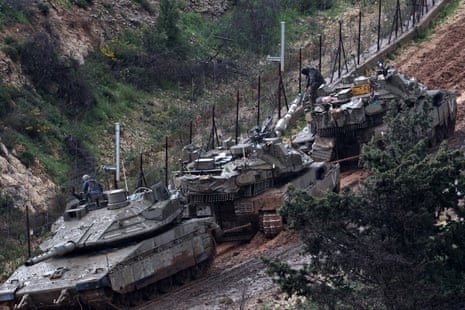
The Israel Defence Force killed four Hezbollah members in southern Lebanon overnight, the military has said. The IDF posted on Telegram that a combination of ground troops and the Israeli air force killed one – and tanks killed three more.
-
European diplomats have criticised increasing “settler terror” in the West Bank, with six Palestinians shot dead in settler attacks in the area this month. Representatives of 13 European countries including the UK and France issued a joint statement alongside Canada.
-
In the UK two people have been charged, one of them Iranian, after they allegedly tried to enter a naval base in Scotland which houses the UK’s nuclear Trident submarines. They were arrested on Thursday.
Key events Show key events only Please turn on JavaScript to use this feature
The International Atomic Energy Agency said on Saturday it was aware of reports that a projectile had struck the city of Dimona in Israel but had received no indication of damage to the Negev nuclear research center.
The agency said regional authorities reported no abnormal radiation levels following the incident and that it was closely monitoring the situation and would continue to seek further information, Reuters reports.
The foreign ministers of the Group of Seven (G7) countries said on Saturday they stood ready to take necessary measures to support global energy supplies and reaffirmed the importance of safeguarding maritime routes, including in the strait of Hormuz.
“We ... express support to our partners in the region in the face of the unjustifiable attacks by the Islamic Republic of Iran and its proxies,” the ministers of Canada, France, Germany, Italy, Japan, the UK and the US, as well as the top EU diplomat, said in a statement.
“We condemn in the strongest terms the regime’s reckless attacks against civilians and civilian infrastructure, including energy infrastructure,” they said.
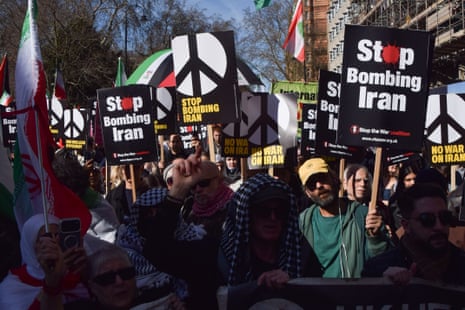
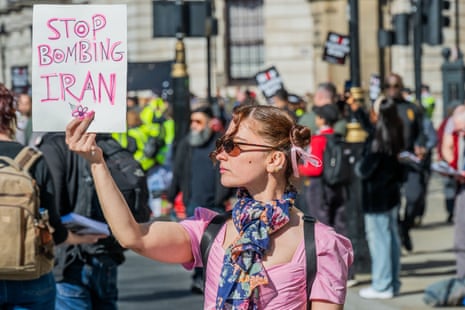
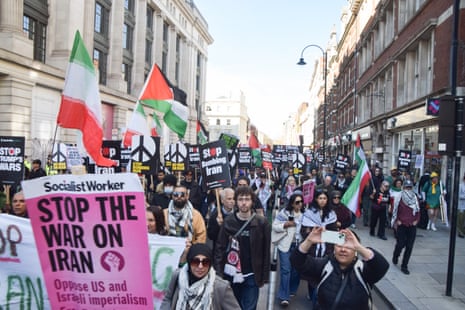
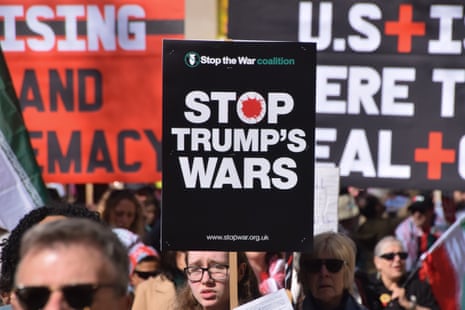
Thousands gathered on Saturday in central London for a Stop the War demonstration to protest against the war in Iran. Here are some photos of the protests:
Iran has claimed it attacked Dimona “after the US and Israel attacked the Bushehr power plant and the Natanz facilities.”
The Iranian Tasnim news agency wrote: “The enemy has once again received an unforgettable lesson. The missile attack on the Dimona area has once again sent a clear message: No area is safe from Iranian missiles. The enemy must surrender before it is too late.”
The Shimon Peres Negev Nuclear Research Center, commonly known as the Dimona nuclear reactor, is a nuclear installation located in the Negev Desert in southern Israel, approximately 13 kilometers (8 miles) southeast of the city of Dimona.
Republican House Speaker Mike Johnson told reporters this week that he believes the military operation in Iran is “all but done.”
“I do think the original mission is virtually accomplished now,” Johnson said, speaking at the Capitol. “We were trying to take out the ballistic missiles, and their means of production, and neuter the navy, and those objectives have been met.”
Johnson acknowledged that Iran’s ability to threaten ships in the strait of Hormuz is “dragging it out a little bit,” especially as the US allies have mostly ignored Trump’s requests for help, but he added: “As soon as we bring some calm to the situation, I think it’s all but done.”
The Lebanese Health Ministry said Saturday that three deaths were reported over the past 24 hours, and 99 people were wounded, raising the total number of injured individuals to 2,740.
The latest Israel-Hezbollah war began on March 2, when the Iran-backed militia fired rockets into northern Israel two days after the US and Israeli attacks on Iran triggered a widening war in the Middle East.
Israel has since ordered evacuations from large parts of southern and eastern Lebanon as well as Beirut’s southern suburbs, and more than 1 million people have been displaced.

Hooman Majd
When Israeli and American missiles first started falling on Tehran, and as news of the death of Iran’s supreme leader, Ayatollah Ali Khamenei, leaked out, Nasser, a sixtysomething Iranian American dad from Boston who regularly travels to Iran, briefly experienced something akin to optimism. He “felt a flash of hope”, he told me, “or maybe vengeance, when Khamenei and his circle were hit”.
It was a common sentiment among the millions of Iranians in the North American diaspora who have, for multiple reasons, come to reject the rule of the velayat-e-faqih, or the “guardianship of the Islamic jurist”, the Islamic Republic’s governing doctrine. Many Iranians inside and outside the country had just recently held Khamenei directly responsible for the horrific bloodshed during the mass protests in January. If the top leadership of the Islamic republic was decapitated, perhaps, many believed, Iran could forge a different future.
But now, after three weeks of all-out war on his homeland and with thousands of dead Iranians, damage to cultural heritage sites, and seeming randomness of missile attacks in cities, that hope has disappeared. “Now,” he tells me, “I feel sick about it.”
Read more:
A Patriot air defence system was involved in the interception of an Iranian drone over a residential area of Bahrain on March 9, Bahrain’s government said on Saturday according to Reuters. The incident was characterized by the US military as a direct Iranian drone strike.
At the time, Bahrain said 32 civilians had been injured, including children who required medical treatment, and the US military said an Iranian drone had struck a residential neighborhood.
On Saturday, a government spokesperson said the Kingdom had been subjected to multiple Iranian drone attacks that day, and that the interception over the Sitra district had prevented a drone strike and saved lives.
“During this incident, the Patriot air defense system intercepted an Iranian drone aerially,” they said. “Had the Iranian drone impacted the residential area, it would have resulted in significant loss of life.”
US Central Command at the time denied reports from Russian and Iranian media that a US Patriot missile had failed to intercept an Iranian missile or drone and instead inadvertently struck a residential area.
Britain will not be using its bases in Cyprus for any offensive action in the Iran crisis, a Cypriot government spokesperson said on Saturday, citing a phone call between British prime minister Keir Starmer and Cypriot president Nikos Christodoulides, according to Reuters.
“The British Prime Minister reiterated ... that the security of the Republic of Cyprus is fundamental to the United Kingdom and, to that end, a decision has been taken to enhance the means contributing to the preventive measures already in place,” the spokesperson said in a statement. “Finally, the Prime Minister reiterated that the British Bases in Cyprus will not be used for any offensive military operations.”
An Iranian-type Shahed drone caused slight damage when it hit facilities at Britain’s Akrotiri airbase in southern Cyprus on March 2, with two others later intercepted. There have been no further known security incidents.
Iranian president Masoud Pezeshkian expressed that an “immediate cessation of aggressions by the US and Israel, along with guarantees against their recurrence in the future,” is the only path to ending the current war and preventing a broader regional catastrophe.
In a telephone conversation with Indian prime minister Narendra Modi on Saturday, Pezeshkian said that any resolution must include firm guarantees to prevent future military strikes against Iran, according to a post from Iran’s embassy in India.
During the conversation, Pezeshkian also called on the BRICS bloc of major emerging economies to play an independent role in halting aggression against Iran. He also reiterated Iran’s stance that the US is responsible for the military strike on an Iranian elementary school that killed an estimated 168 schoolchildren.
Both Egyptian president Abdel-Fattah el-Sissi and Saudi crown prince Mohammed bin Salman warned on Saturday that Iranian escalation against Gulf nations poses a grave threat to regional security and stability.
According to the state-run Saudi Press Agency, president el-Sissi formally rejected the ongoing Iranian strikes on Gulf states and reaffirmed Egypt’s unwavering solidarity with the Kingdom in the face of these threats.
Arab league chief Ahmed Aboul Gheit also praised the recent high-level visits by both el-Sissi and King Abdullah II of Jordan to several Gulf nations. Aboul Gheit said that these diplomatic missions “reflect full Arab solidarity” during the current crisis.
In an operational update video posted Saturday, the head of the US military’s Central Command, Adm Brad Cooper, said that in the US military has struck more than 8,000 military targets, including 130 Iranian vessels.
“Their Navy is not sailing. Their tactical fighters are not flying, and they’ve lost the ability to launch missiles and drones at the high rates seen at the beginning of the conflict,” he said in the video.
Intelligence agencies were monitoring Nowruz celebrations in Iran on Friday to see whether Iran’s new supreme leader Mojtaba Khamenei would be seen for the first time since his father’s death, Axios reports.
His father, Ayatollah Ali Khamenei previously gave a new year’s address, and it was thought Mojtaba could do the same. However he only issued a written statement.
It comes as it is three weeks without him being seen, since he became supreme leader.
“We have no evidence that he is really the one giving orders,” a senior Israeli official told Axios.
Hezbollah has said its fighters have clashed with Israeli forces in two borders towns on Saturday.
AFP reported a Hezbollah statement which said the group had engaged in a four-hour confrontation with Israeli forces in the town of Khiam.
The statement said here had been “direct clashes with forces from the Israeli enemy army in the town of Khiam with light and medium weapons” and rockets.
Israel has killed more than 1,000 people in Lebanon since Hezbollah launched strikes on 2 March in response to the killing of Iranian supreme leader Ayatollah Ali Khamenei.
The day so far
If you are just logging on, here is a roundup of today’s news in the Middle East conflict. It has just gone 6pm in Tehran, and 4.30pm in Tel Aviv. It’s mid-morning in Washington DC, with the time having passed 10.30am.
-
Iran fired missiles at the US/UK Diego Garcia military base in the Indian Ocean, the UK Ministry of Defence has confirmed. The MoD said the strikes were unsuccessful, and took place before the UK said the US could use its bases for “specific and limited defence operations”.
-
Israel’s defence minister Israel Katz said strikes on Iran will “intensify” next week. In a statement Katz said there would be a “significant” rise in the attacks.
-
Israel and the US targeted an Iranian nuclear enrichment plant overnight. The head of the International Atomic Energy Agency has called for restraint. Iran said there had not been any radioactive leakage, and no residents were in danger.
-
The Israel Defence Force claimed it had “significantly degraded” ballistic missile production at a factory in Tehran with airstrikes. It said “dozens” of targets were attacked, including those used to produce critical parts for missiles.
-
Meanwhile the US military said Iran’s ability to threaten ships in the strait of Hormuz has been reduced after it attacked an underground facility that stored cruise missiles. The commander of the US central command said US forces had destroyed intelligence support sites and radar relays.
-
Donald Trump has said he is considering “winding down” military operations against Iran. “We are getting very close to meeting our objectives,” the US president posted on Friday on his Truth Social platform in the strongest indication yet that he may be prepared to soon end the hostilities that began three weeks ago.
-
More than twenty countries now say they are “ready to contribute” to the safe passage of ships going through the strait of Hormuz. It said they were ready to contribute “appropriate efforts” to ensure safe passage through the waterway, which is critical to global oil markets.
-
An officer was killed in a drone attack on Iraq’s intelligence headquarters in Baghdad. The intelligence service blamed “outlaw groups” and said a second officer was wounded. It took place at about 10am local time.
-
The Israel Defence Force killed four Hezbollah members in southern Lebanon overnight, the military has said. The IDF posted on Telegram that a combination of ground troops and the Israeli air force killed one – and tanks killed three more.
-
European diplomats have criticised increasing “settler terror” in the West Bank, with six Palestinians shot dead in settler attacks in the area this month. Representatives of 13 European countries including the UK and France issued a joint statement alongside Canada.
-
In the UK two people have been charged, one of them Iranian, after they allegedly tried to enter a naval base in Scotland which houses the UK’s nuclear Trident submarines. They were arrested on Thursday.
European diplomats have criticised increasing “settler terror” in the West Bank, with six Palestinians shot dead in settler attacks in the area this month.
Representatives of 13 European countries including the UK and France issued a joint statement alongside Canada.
It called for Israeli authorities to prosecute those responsible.
It said: “We strongly condemn increasing settler terror and violence by the Israeli security forces inflicted upon Palestinian communities.
“We are especially appalled by the killings of Palestinians over these past weeks. This violence by settler militias, aimed at taking over land and creating a coercive environment, forcing Palestinians to leave their homes, must end.”
Israel’s military chief Lieutenant General Eyal Zamir on Wednesday criticised the increase in settler attacks in the West Bank, calling it “morally and ethically unacceptable”.
Israel has claimed it has “significantly degraded” ballistic missile production at a factory in Tehran after it carried out airstrikes overnight.
The Israel Defence Force said it carried out attacks in Tehran and hit “dozens” of targets. It said the facilities were used to produce critical parts for the development of missiles.
Among the facilities hit were a components storage facility, a missile fuel plant and a production site.
The post by the IDF on Telegram said: “The IDF will continue to expand its strikes against the regime’s weapons production facilities in order to degrade its capabilities to advance its ballistic missile program, which poses a direct threat to the State of Israel.”
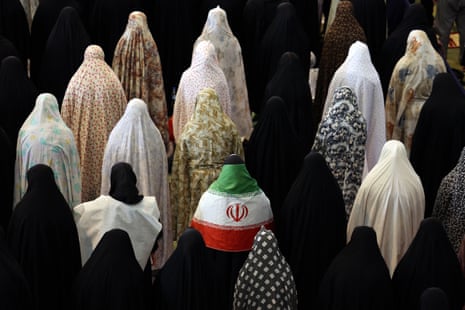
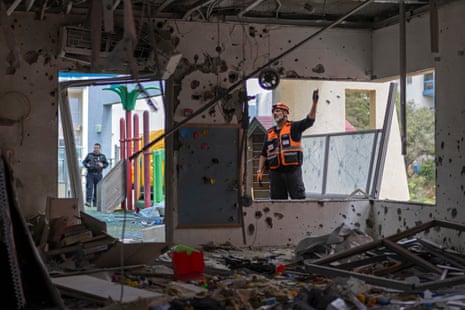
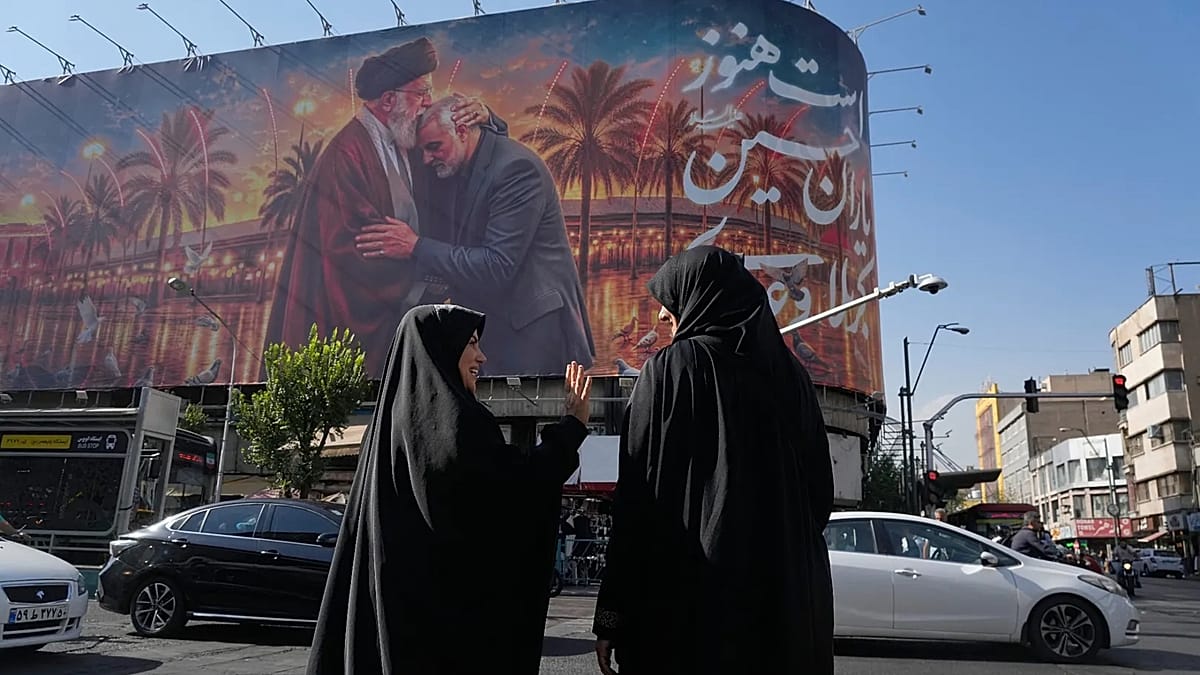
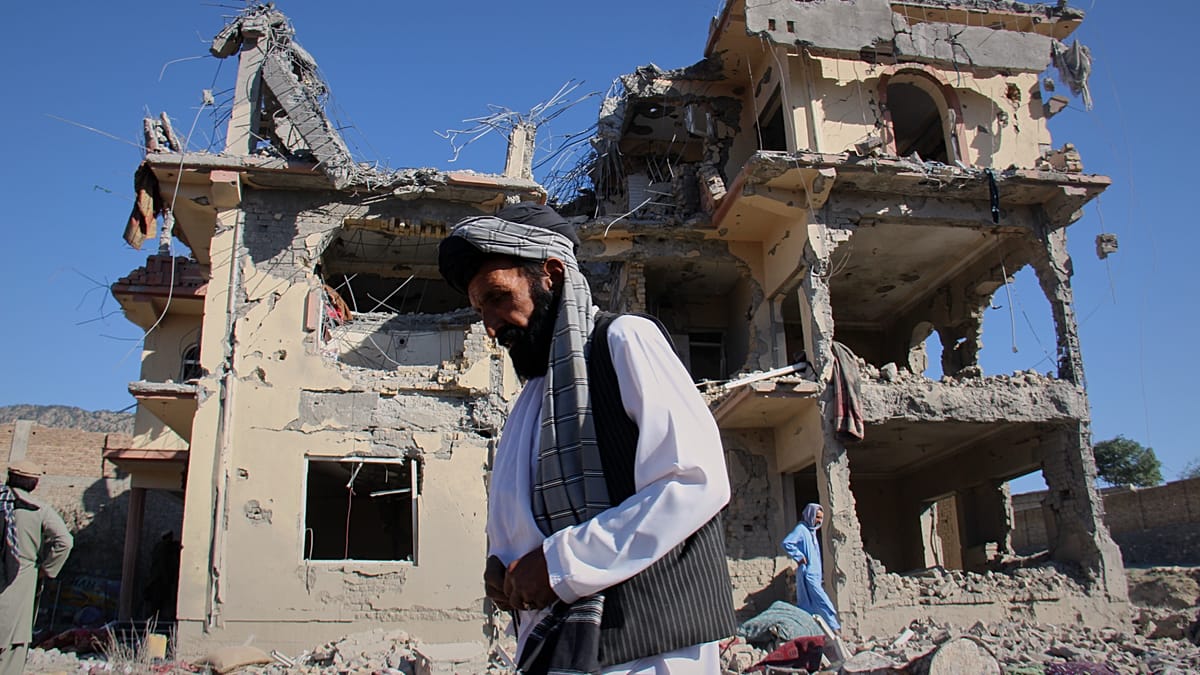
Here are some of the latest images from photographers around the Middle East:



















 English (US) ·
  French (CA) ·
  French (FR) ·