

 1 month ago
33
1 month ago
33
PROTECT YOURSELF with Orgo-Life® QUANTUM TECHNOLOGY
Orgo-Life the new way to the future Advertising by Adpathway
Soon after having their first child, Kornelia Thörn and Robin Lyne sold nearly everything and traded the typical path for a nomadic life on two wheels. With their young daughter in tow, they first traveled to the ruggedly beautiful Azores, where they got a crash course in parenthood and family bikepacking. Read their story of adapting to a new rhythm here…
Additional photos by Robin Lyne
I wake to the wind. For a moment, I can’t recall where we are. I only remember the black Atlantic beneath and the feeling that the ground might start to shake. Then it comes back: it’s the last night in the highlands on our family bike journey across the Azores. I must have fallen asleep while putting our baby, Ess, to bed.
Now, with the sun long gone behind the mountains and grassy meadows, the calculations begin: Isn’t our tent pitched just metres from a cliff? How solid is this soil if an earthquake hits? Out in the dark waters, tremors are common, and the jagged mountain silhouettes make nature feel unsettled. “Wouldn’t it be typical,” I whisper to my partner Robin, “for our first family trip to end in disaster?” Soon, both the wind and my worries pick up. I strap the baby carrier around my body and go back to sleep that way, no matter how bulky it gets in the sleeping bag. The carrier is my lifeline, I tell myself, in case I need to grab Ess and run.
* * *I close my eyes, trying to reach back to who I was seven months into parenthood. Now, with a four-year-old and several long bikepacking trips behind us, that time is hard to grasp. Planning a first family trip back then had felt almost absurd. How could we anticipate the needs of a baby who seemed to change with every sunrise? In addition, my body seemed different after giving birth, as if my center of gravity had shifted.
Yet we planned it, and between naps and nursing, we packed our bikes, a trailer, and a big bag of tiny clothes. Once we arrived in the Azores, the reality of what we’d planned began to sink in. Water surrounded us. Roads hung from the mountainsides like ropes, and in the highlands, where we’d mapped most of our route, an ever-present layer of fog cut the scenery in two.
For years, the less-visited central group of Azorean islands had intrigued me. In summertime, it’s possible to travel between them by boat, making it easy to get around with the bikes. Still, the tiny size and steep interior had never seemed ideal for cycling. Not until we had our daughter, that is. Suddenly, we told ourselves that a pocket-sized archipelago would make a perfect testing ground for a longer bikepacking adventure.
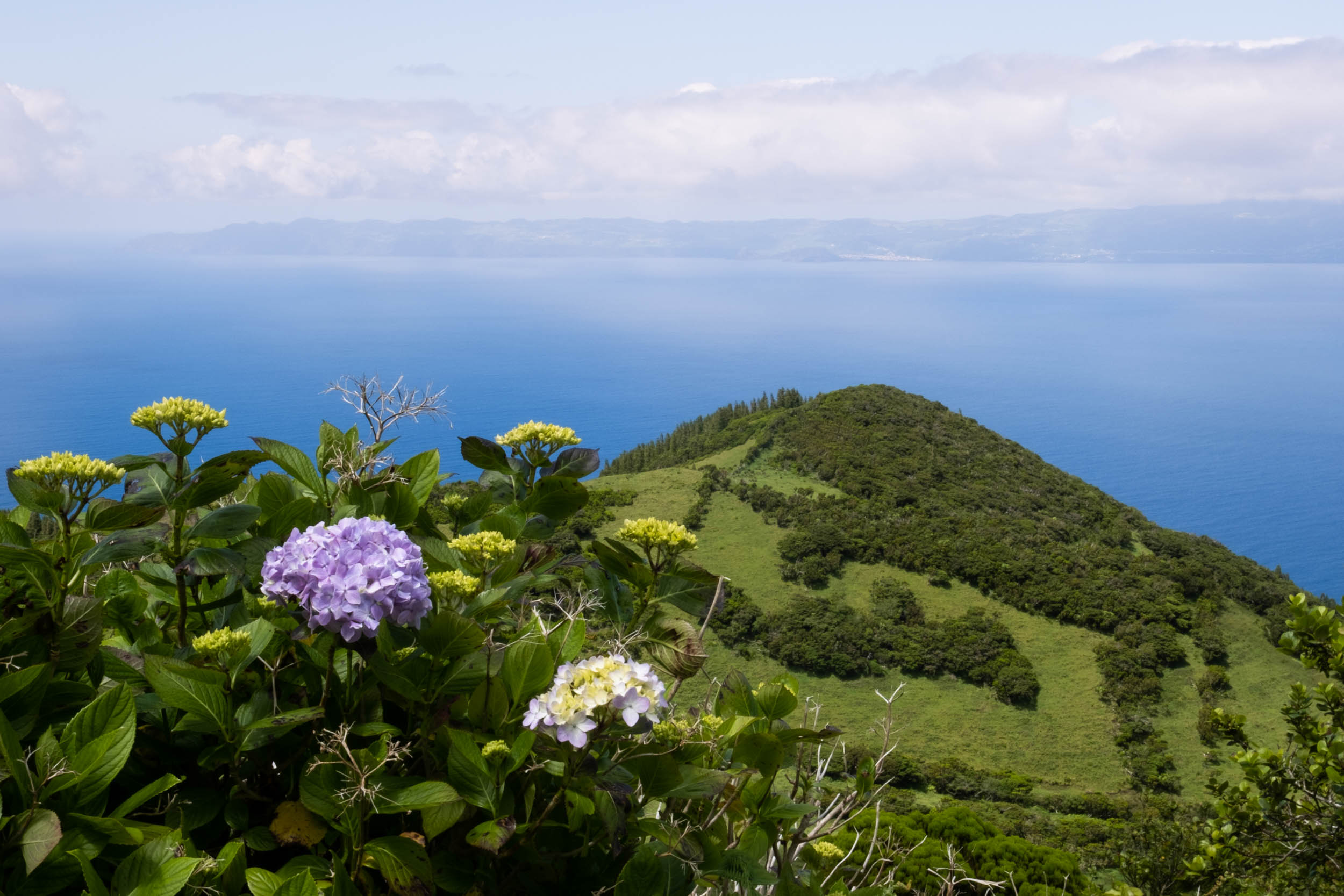
* * *After assembling the bikes and already leaving half of the baby clothing behind, we started our journey across the first island, Terceria. Just as the coastal weather had us believing in eternally clear skies, the gradient’s first slow rise made the route seem doable. Cobbled streets gave way to farm roads. Owing to the islands’ subtropical climate, crops and blossoms grow quickly year-round, and volcanic greenery surrounded us, dotted with cows and divided by fluffy hydrangeas. Slowly, my worries began to fade.

Being in motion, it all felt right again. “Maybe bikepacking with a baby isn’t so complicated,” I said to my partner Robin. At last, all we could hear was nature, soon to be accompanied by a promising snoring from the trailer.
Just a few pickups and tractors passed us the whole day, honking at the sight of our odd trio zigzagging between cow pies and potholes. Like on all the other islands, towns and villages sit along the coast, and aside from a handful of tourist sites and dairy factories, we had a lonesome piece of land ahead of us, inhabited only by fog and cattle.
As we progressed, it got steeper. Soon, more vertical than horizontal, with 1,000 metres of elevation in less than 10 kilometres. My bike was heavier than usual, and Robin pulled the trailer. Even though I could tell it was weighty, it felt fair, as I’d already carried Ess for nine months. In addition, I was hungrier and thirstier than on any other trip. Ess had started to nibble at fresh fish and potatoes, but she was still nursing. My body turned into something absurdly efficient—transforming food into both strength for the hills and the essentials for another human being.
Surprisingly, though, the hardest part wasn’t the physical demand for either of us. Instead, it was grappling with how much time we spent off the bikes. Babies like motion, and our new pace of two kilometres an hour didn’t appeal to Ess. The trailer stopped lulling her, and instead of naps, she demanded breaks. Every time we spread out the picnic blanket to nurse, play, or change diapers, we felt torn. As much as we cherished the pauses, our doubts returned.
Had we been stupid after all? According to the schedule, we should already be riding in the mountains. In reality, we sat in the grass a few hundred metres from the coast, watching today’s window of riding and tomorrow’s ration of Azorean cinnamon cookies growing smaller. It wasn’t until we put on our baby carrier and simply pushed that things changed. Now, instead of dragging an unhappy passenger or taking yet another break, we gradually made progress, with Ess happily hanging from our belly or back. Sure, it was heavier, but as with other obstacles on a bikepacking trip, we adapted. To remain sane, we just stopped keeping track of our daily kilometers.
As Ess bobbed up and down, she started to sing to the beat of our footsteps, creating what was soon going to be the heartbeat of our entire trip: aah-aah-ahh. When the terrain allowed us to ride again, she started chanting in the trailer, too. The last farms shrank, and sheets of mist clung to the hillsides. The rougher the terrain, the louder she sang. AAH-AAH-AHH, and our wheels steered into red dirt.
* * *We entered a subtropical cloud forest, locally named so for its constant mist. Greenery towered above us, and the wind contained billions of tiny water droplets. As serene as it was, the unrivaled greenness of the Azores always comes at a cost. Better days would later leave us with saddle sores or moldy cornbread. This day, darkness rolled in.
In seconds, the rainstorm’s first drops pricked my face. Thankfully, Ess was already in the trailer when the torrential rain hit. Robin and I looked at each other, knowing it was our first real test. We had prepared for this, knowing that pushing limits wasn’t ideal with a baby. Even if it was tempting, there was no chance that we could reach the plateau before nightfall.

We couldn’t stop, either. We were in the midst of a climb, and the forest floor was both too steep and too dense to pitch in. Backtracking was our only option, but before losing hundreds of vertical metres, I took a look around the corner. I kept climbing, as the rain remodeled the packed surface into a muddy mess. My wheels spun, and I was about to return when light gleamed through the trunks: it was an overgrown path winding upwards. At the end, a flat, abandoned viewpoint covered in bushes appeared, and I returned to Robin and Ess with a smile on my dripping face.

An hour later, we’d dragged everything up the hilltop and squeezed our tent between ferns and Azorean juniper. The storm seemed to bring out a warmth in me. In the vestibule, a pot of ramen simmered, and in my lap, Ess giggled at raindrops running down the canvas. Robin took my hand and squeezed it. It all filled me with confidence. Here we were, sore and soaked, yet together, free to stop whenever Ess needed. I was no longer giving up.
* * *Before the trip, I worried our nomadic lifestyle would be stressful to Ess, as people like to point out that kids love routines. Up in the highlands, we learnt that routines can take various forms. Here, she fell asleep on her own air mattress to the familiar sound of nature each night, with no check-ins or new hotels. In just a few days, she knew the tent inside-out. It even outnumbered her toys, as zips and flaps were her biggest hobby at the time.

Looking back, time has put a little mist on the memories too. But it’s fair to say that not everything was effortless. The fact that the daily tasks of cooking, cleaning, or setting up camp had become a one-person job initially irritated us. Naturally, though, we soon came to see that packing up a soaked camp and playing peekaboo were equally valuable.
Day by day, we settled into a new rhythm. At our usual pace, we could have covered the plateau in a day, but instead we slowly explored trails, caves, and landmarks, guided by Ess’s needs and the weather. Occasionally, we encountered a bigger road, and once, even a tourada à corda, a traditional bull festival. By the time we rolled our bikes onto the first ferry, it felt like we had our new pace set. But the thing with both the Azorean islands and babies is that they constantly change.
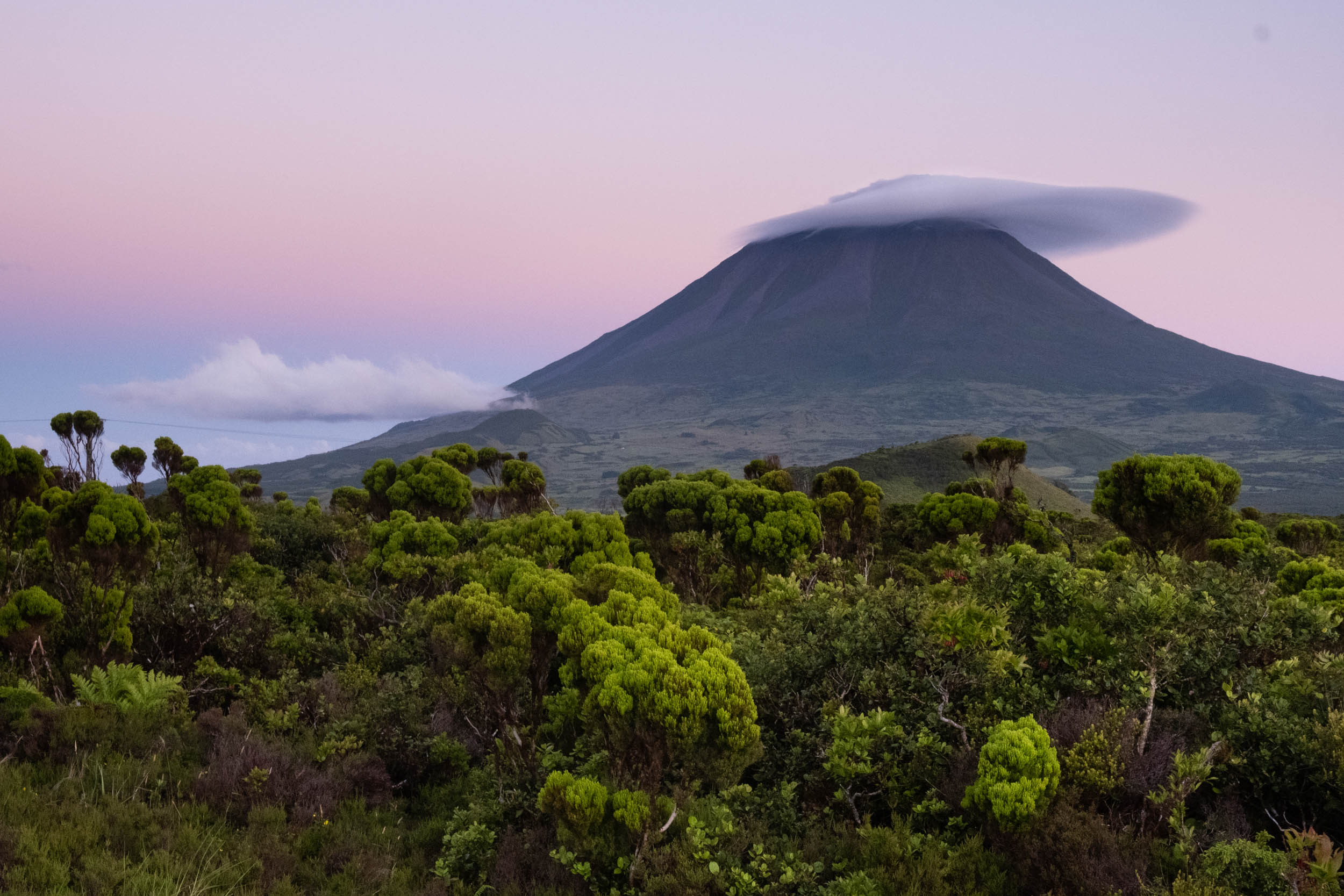
* * *Ess celebrated our arrival on the island of Pico by learning to crawl. From one minute to another, she was able to move her body deliberately over the ground—meaning she could also roll down a nearby cliff or choke on the tiny, brownie-like stones covering the dirt roads. These stones were locally called biscoitos (cookies), and they were sharp enough to threaten not only Ess but also our tent and tires. It was as if the whole island was made of pointy edges. Everything seemed dark and black, and Portugal’s highest mountain, Montanha do Pico, loomed in the distance.
Days passed, allowing us not only to admire Montanha do Pico, but also to climb it–one by one, as Ess couldn’t go. Going as a family, I realized, would in some aspects also mean going solo. At the top, I could distinguish the small villages we’d passed while riding. They were places we stocked up on food, but also on unexpected acts of hospitality. Farmers stopped their tractors to wave, older women leaned out of windows to blow kisses, and strangers put sacred bread in Ess’s tiny hands during the traditional celebrations of the Holy Spirit. Cycling had always been a way to connect with local communities, but travelling with a child seemed to create even more moments for connection.
I have always believed that everything contains its opposite. As I sat there above the clouds, in stillness, with no one needing me, I still had physical reminders of Ess. My breasts ached from not nursing all day. The feeling wasn’t only joyful. Part of me missed the freedom of travelling alone. I had assumed that as long as I kept bikepacking, that freedom would remain. Instead, I began to realize that while parenthood gives access to new things, it also marks the end of total freedom. Perhaps I was a little cynical, thinking those thoughts.
Days later, a car pulled up beside us. A woman rolled down her window. She smiled and said that we were the bravest on the island for riding these hills with a baby. In her youth, she’d travelled widely by bike herself, but never with her children. She said it was her one regret in life. When she drove off, disappearing behind a switchback, the road fell quiet again. It was as if she had been conjured for that very moment, only to remind me of how lucky I was to be out here.
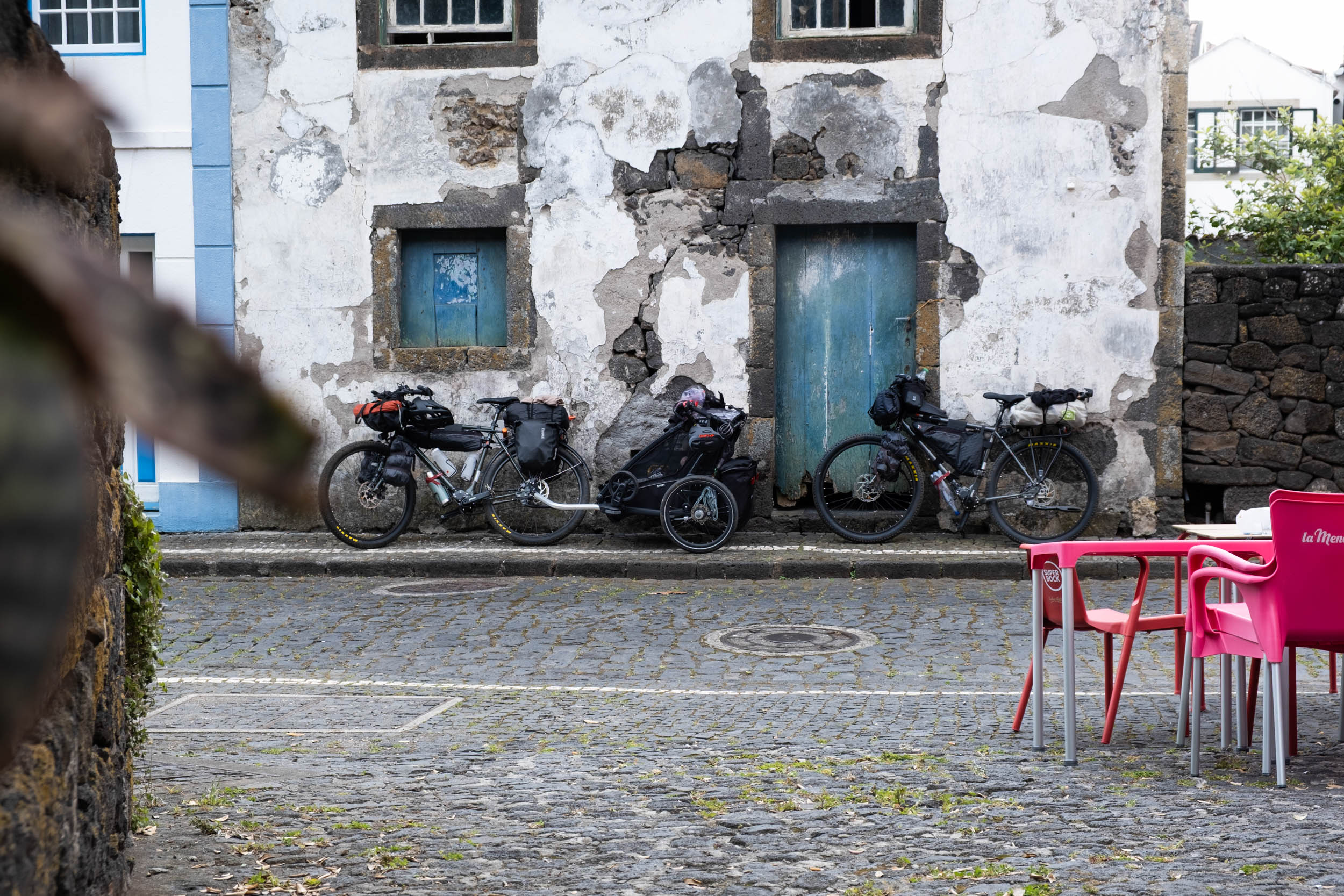
* * *Little by little, the Azores grew on us. We couldn’t help but wonder what a permanent life here might be like as we passed house ruins overgrown with moss and vegetation, seemingly longing to be restored and inhabited once more. The same thing must have happened to the couple running a guesthouse amid a banana plantation, as well as the French chef who served us fresh limpets from his little restaurant.
Some other travellers had come by sea rather than by air. On the island of Faial, rows of sailboats were anchored in the harbor, with their crews taking a respite from Atlantic crossings. Behind them, the marina’s walls were covered in weathered sketches, painted by countless sailors. According to legend, failing to leave your mark here brings bad luck on the journey.
It wasn’t just sailors who revered the ocean. Locals told us stories about how the ocean’s power governed everything from boat schedules and flights to the daily rhythm of life. Maybe that was what drew young people to leave for the Portuguese mainland, but pulled others in, like a current.
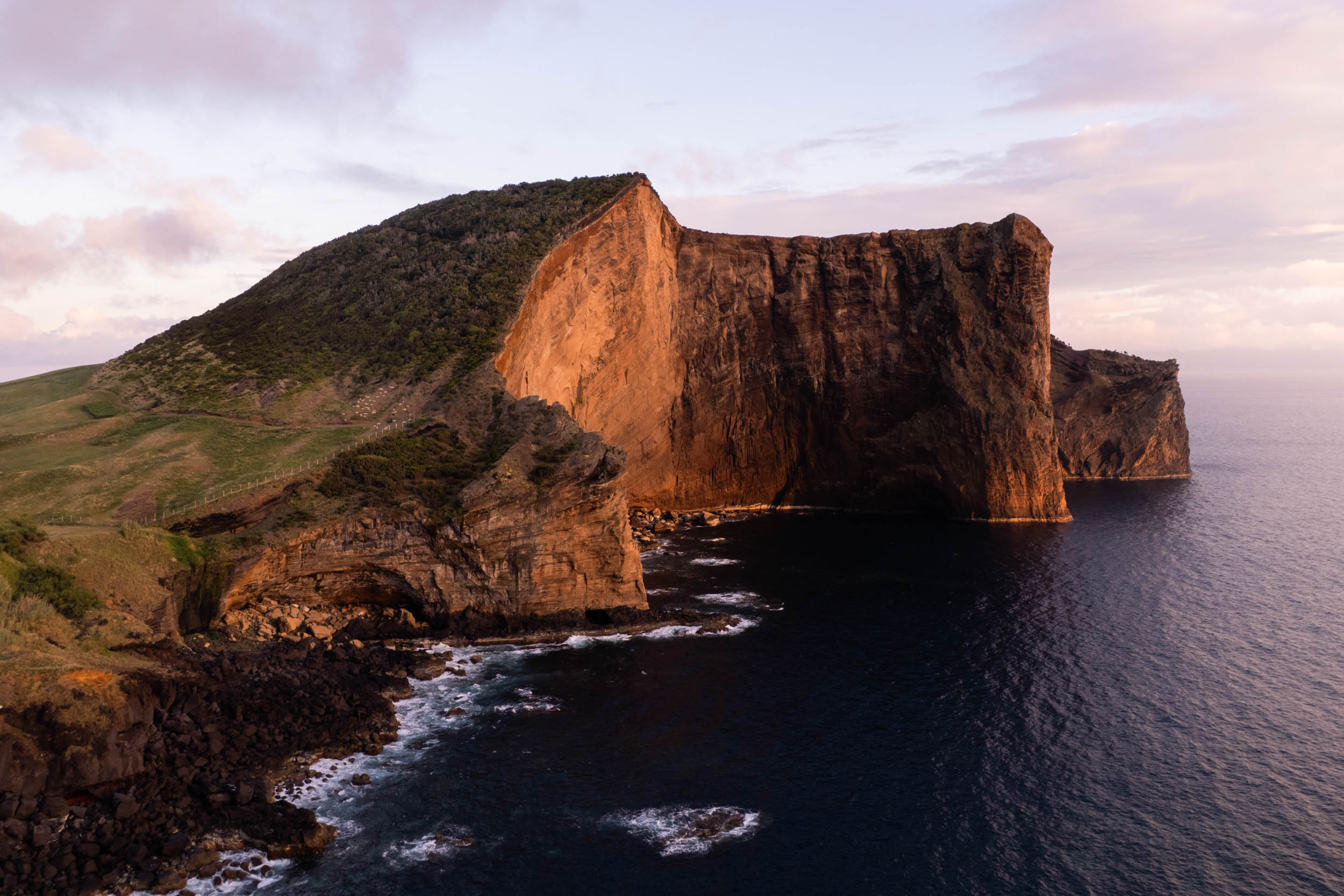
People pointed across the sea to the island of São Jorge, where seismic activity rules the waters. Just months ago, the residents had been evacuated there after a series of quakes. It was considered safe again, but people still widened their eyes when we mentioned we were going there. Their worry, though, was never about earthquakes. It was about the brutal incline.
* * *The first glimpse of São Jorge from the ferry already proved them right. To save weight, we stocked up with enough supplies for the mountains at a sparse hilltop supermarket. Watching a weathered container being unloaded outside of it, it became clear that limited supplies weren’t just a bikepacking challenge.

Some days later, sweaty and tired, we asked a couple of farmers if we could pitch our tent in one of the pastures. They kindly showed us a place close to hundreds of blue hydrangeas but far enough from the bulls. It was there that I spent the windy night, with the baby carrier tightly strapped around my body. And it was also there, surrounded by the stars and the mightiness, that a new thought hit me, as claustrophobic as relieving: this new kind of worry would never go away. Whether it’s back home or out on those slopes, it was a part of parenthood. I just had to find out how to carry it, how to strap it somewhere, somehow. It was going to be heavy, but I already understood it was worth it.
No earthquake hit São Jorge that night, or the day after. Instead, our time unfolded much as it had on the other islands: we pushed our way up to the plateau, only for the grand views to dissolve into fog. On the GPS, I could see us moving along São Jorge’s spine, with the slopes plunging into the Atlantic Ocean on all sides. In reality, I could barely make out Robin’s back or the trailer.
Then, as if on repeat, when we descended, the clouds drifted. The sun dried the rain off us, and the sea drew a blue line through the air. We put Ess in the carrier to hike down the steepest part, and, as always, she started her little chant.
* * *Fast-forwarding to today, years later, I often think about returning. Yet I don’t know if the same portal would still be open. Perhaps it was reserved for our new eyes—a time that changed us and shaped how we continue to cycle as a family today. Suddenly, the joy of bikepacking wasn’t as tied to kilometres or performance. The goal of the day became subordinate to the impulsiveness of the moment. Tiny, chubby hands touching the grass. The inside of a soft, pink potato. In a way, we all learnt how to crawl.
Further Reading
Make sure to dig into these related articles for more info...
Please keep the conversation civil, constructive, and inclusive, or your comment will be removed.












 English (US) ·
  French (CA) ·
  French (FR) ·