

 3 months ago
26
3 months ago
26
PROTECT YOURSELF with Orgo-Life® QUANTUM TECHNOLOGY
Orgo-Life the new way to the future Advertising by AdpathwayIsrael killed two senior Iranian security officials in a major blow to the country's leadership as it faces its greatest test in decades, and Iran responded Wednesday with renewed missile and drone attacks on its Gulf Arab neighbours and Israel.
Ali Larijani, secretary of Iran's Supreme National Security Council, was considered one of the most powerful figures in the country since Supreme Leader Ayatollah Ali Khamenei was killed in an airstrike on the first day of the war. Gen. Gholam Reza Soleimani was the head of the Revolutionary Guard's all-volunteer Basij.
Iran confirmed the killings of both men, who were key to Iran's violent crackdown on protests in January that challenged the theocracy's 47-year rule.
Israel's military said Iran launched another round of missiles toward Israel on Wednesday. Sirens sounded across central Israel and loud booms were heard in Tel Aviv as the war showed no signs of abating.
With concerns growing about a global energy crisis, an Iranian official said Tehran had no intention of relinquishing its tight grip on shipping through the Strait of Hormuz, a crucial waterway for the global oil supply.
U.S. President Donald Trump said NATO and most other allies have rejected his calls to help secure the strait.
WATCH | Trump's timeline for the war keeps changing: Why Trump’s war timeline keeps changing
The Israeli military said it had begun a "wide-scale wave of strikes" across Iran's capital and was stepping up strikes on Iran-backed Hezbollah militants in Lebanon.
Israeli Defence Minister Israel Katz said Larijani and Soleimani were "eliminated" in strikes overnight Tuesday. The Israeli military said it also struck more than 10 Basij posts across Tehran.
Israeli Prime Minister Benjamin Netanyahu said the killings were aimed at "undermining this regime to give the Iranian people the opportunity to remove it." There have been no signs of anti-government protests since the war began, as many Iranians are sheltering from the U.S. and Israeli strikes.
The Iranian judiciary's news agency, Mizan, quoted the Revolutionary Guard as confirming the killing of Soleimani. Other Iranian state media confirmed Larijani's death.
Larijani, a former parliamentary speaker and senior policy adviser, advised the late Khamenei on strategy in nuclear talks with the Trump administration. He was sanctioned by the U.S. Treasury in January for his work "co-ordinating" Iran's violent suppression of nationwide protests.
Soleimani was also sanctioned by the U.S., the European Union and other nations, over his role in suppressing dissent for years through the Basij.
The killings came on the eve of "Chaharshanbe Souri," or the Festival of Fire, shortly before the Persian new year. Authorities have sent threatening text messages telling the public not to celebrate the festival, warning the rowdy celebrations could be used by "rioters."
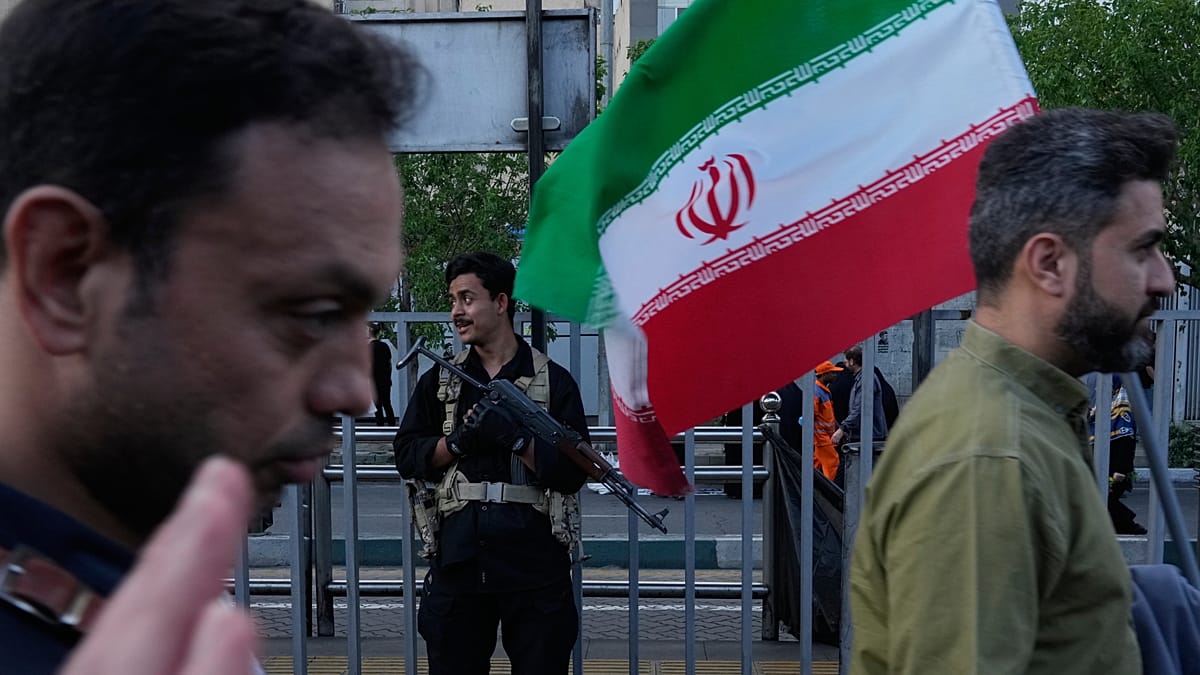
State media aired footage Tuesday of pro-government demonstrations, including images of men in plainclothes brandishing assault rifles and shotguns on the back of motorcycles.
State television showed crowds of women wrapped in black and older men waving flags and portraits of the late Khamenei.
Pressure on oil markets
In Iraq, two drones were shot down by the U.S. Embassy's defence system in Baghdad, while a third drone crashed inside the compound, according to two Iraqi security officials who spoke on condition of anonymity because they were not authorized to comment.
An Associated Press journalist saw a massive fire that appeared to be engulfing a structure in the compound. There was no immediate comment from the embassy.
WATCH | Multiple dangers to vessels in the Strait of Hormuz: The Strait of Hormuz kill box | About That
In the United Arab Emirates, explosions rang out early Wednesday morning in Dubai, followed by a missile alert. The government's Dubai Media Office said "the sounds heard across parts of the city" were successful interceptions by air defence operations.
Earlier Dubai, a major transit hub for international travel, briefly shut its airspace, the second disruption to flights in the city in as many days.
Also an oil facility in Fujairah was hit, and a man was killed in Abu Dhabi by debris from an intercepted missile — the eighth person to die in the U.A.E. since the start of the war, authorities said.
Saudi Arabia said it intercepted drones, while air defences could be heard targeting incoming fire over Qatar's capital, Doha.
WATCH | McGuinty won’t rule out defensive role: Canadian defence minister won’t rule out role in Middle East war
Iran's grip on the Strait of Hormuz, through which a fifth of the world's oil is transported, is sparking concerns about tightening energy supplies — unnerving the world economy.
A handful of ships have crossed through the strait, and Iran has said the waterway technically remains open — just not for the United States, Israel and their allies. About 20 vessels have been struck.
With oil prices rising, Trump said he had demanded that roughly a half-dozen countries send warships to ensure ships can pass through the strait.
Trump fumed Tuesday that the U.S. is not getting support "despite the fact that almost every country strongly agreed with what we are doing," and that Iran cannot be allowed to secure a nuclear weapon.
The European Union's top diplomat says the 27-nation bloc does not want to be dragged into the conflict with Iran. "This is not Europe's war," Kaja Kallas told EU lawmakers. "We were not consulted."
French President Emmanuel Macron earlier reaffirmed that France is ready to help secure the strait, but only after heavy bombing has stopped.
Israel launches fresh attacks on Iran
The Israeli military said it hit Iran command centres, missile launch sites and air defence systems. There was no immediate confirmation from Iran, where little information has been getting through due to internet outages, round-the-clock airstrikes and tight restrictions on journalists.
WATCH | The challenges the U.S. faces in attempting to secure vital sea passage: Is the U.S. strong enough to secure the Strait of Hormuz alone?
More than 1,300 people have been killed in Iran since the conflict started on Feb. 28, according to the Iranian Red Crescent.
The Lebanese army said that three soldiers were killed in Israeli strikes and Lebanon's Health Ministry said an airstrike near Beirut's international airport killed one person and wounded nine.
Israel's strikes have displaced more than one million Lebanese — roughly 20 per cent of the population — according to the Lebanese government, which says 912 people have been killed.
In Israel, officials said 12 people have been killed by Iranian missile fire. The U.S. military says 13 U.S. service members have been killed and about 200 wounded.













 English (US) ·
  French (CA) ·
  French (FR) ·