

 2 months ago
28
2 months ago
28
PROTECT YOURSELF with Orgo-Life® QUANTUM TECHNOLOGY
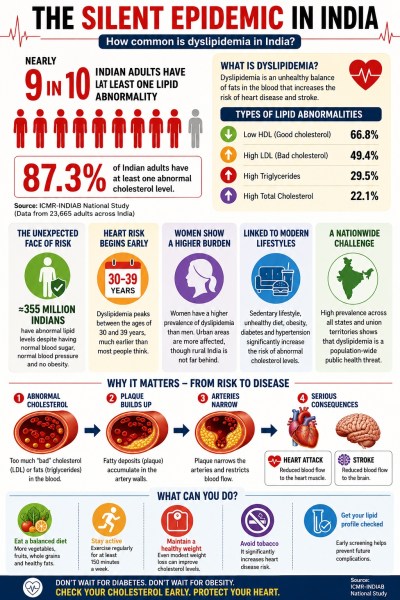
Orgo-Life the new way to the future Advertising by AdpathwayMost people associate high cholesterol with middle age, obesity or diabetes. But what if the greatest threat is hidden among people who look perfectly healthy? A landmark national study by the Indian Council of Medical Research (ICMR) has delivered a sobering answer. According to researchers, 87.3% of Indian adults have at least one abnormal lipid level, making dyslipidemia — an unhealthy balance of fats in the blood — one of the country’s most widespread health problems. The findings, based on the nationally representative ICMR-INDIAB study, paint a picture of a silent epidemic unfolding across India. More importantly, they challenge long-held assumptions about who is at risk.
“These findings reinforce decades of evidence that cardiovascular health depends not only on genetics but also on daily habits — healthy eating, regular exercise, maintaining an appropriate body weight and avoiding tobacco. They also point to an early screening of cholesterol,” says Dr V Mohan, one of the authors and chairman, Dr Mohan’s Diabetes Specialities Centre, Chennai.
“A lot of dyslipidemia is driven by low HDL or high-density lipoprotein, which we call the good cholesterol. Of course, Indians are genetically predisposed but lifestyle is equally to blame. In that diet plays a crucial role. Our diet continues to be carbohydrate-heavy and we know excess carbs push up triglycerides, which push down HDL. This factor alone drives up dyslipidemia in Indians by 90 per cent we found,” he says. The plate concept of one quarter carbs, one quarter protein and half a plate of fibres coming from vegetables and fruits needs to be followed, he suggests.
A problem you cannot feel
The study analysed lipid profiles from 23,665 adults, selected from the larger ICMR-INDIAB survey covering every state and Union Territory. The results suggest that abnormal cholesterol levels are no longer confined to cities or affluent populations —they have become a nationwide public health concern.
Unlike fever or pain, dyslipidemia has no warning signs. People often feel healthy while unhealthy fats slowly accumulate inside blood vessels over many years. This process eventually narrows the arteries, increasing the risk of heart attack, stroke and other cardiovascular diseases.
The good cholesterol is running low
Among the different types of lipid abnormalities, one stood out. Nearly two out of every three adults had low HDL cholesterol, often called the “good cholesterol” because it helps remove excess cholesterol from the bloodstream.
Researchers found that low HDL cholesterol was the most common abnormality, followed by elevated LDL (“bad”) cholesterol, high triglycerides and high total cholesterol.
Story continues below this ad
While many people focus on total cholesterol, the study reminds us that cardiovascular risk is influenced by the balance between different blood fats, not just a single number.
South Asians have long been recognised as having a unique metabolic profile. Many Indians develop low HDL cholesterol and elevated triglycerides even when their body weight appears normal. This combination is closely linked to insulin resistance and contributes to the disproportionately high rates of premature heart disease seen in South Asian populations.
Although scientists continue to debate the role of isolated low HDL cholesterol, its extremely high prevalence in India makes it an important marker of overall cardiometabolic health.
The unexpected face of risk
Perhaps the most surprising finding was not how common dyslipidemia is but who has it. The researchers estimate that roughly 355 million Indians have abnormal lipid levels despite having normal blood sugar, normal blood pressure and no obesity. In other words, millions of people who would generally be considered “healthy” could still be carrying a significant risk for future heart disease.
Story continues below this ad
This challenges the traditional approach of testing cholesterol only in people who already have diabetes, hypertension or excess weight.
 India’s bad cholesterol crisis
Heart risk begins earlier than we think
Another important message from the study is that cardiovascular risk starts much earlier than many Indians realise. Instead of rising only in old age, dyslipidemia was found to peak between 30 and 39 years of age. This suggests that unhealthy changes in metabolism are beginning during the most productive years of adult life.
For a country with one of the world’s youngest populations, the implications are profound. Early onset of abnormal lipid levels means longer lifetime exposure to cholesterol-related damage, increasing the likelihood of premature cardiovascular disease.
Women showed a higher burden
The study also reported notable differences between men and women. Overall, women had a higher prevalence of dyslipidemia than men. Urban residents were also more affected than those living in rural areas, although rural India was far from protected. The relatively small urban-rural gap indicates that lifestyle changes, changing diets and reduced physical activity have spread well beyond metropolitan centres.
Story continues below this ad
The findings reflect India’s rapid social and economic transition, where processed foods, sedentary occupations and declining physical activity are becoming common across the country.
The weight of modern lifestyles
As expected, abnormal lipid levels became increasingly common among people with diabetes, hypertension and obesity.
Individuals with higher body mass index and worsening blood glucose status showed substantially higher rates of dyslipidemia. Sedentary lifestyles further increased the likelihood of unhealthy lipid profiles.
Cardiovascular disease remains India’s leading killer, and dyslipidemia is one of its most important but also most manageable risk factors.
Story continues below this ad
The authors argue that the country’s screening strategies need to evolve. Waiting until someone develops diabetes, hypertension or obesity before recommending cholesterol testing may leave millions of high-risk individuals undetected.
Instead, broader lipid screening, earlier identification of risk and timely lifestyle interventions could substantially reduce the future burden of heart attacks and strokes.
Simple lifestyle measures, including regular physical activity, reducing intake of ultra-processed foods and trans fats, eating more fruits, vegetables and whole grains, maintaining a healthy weight, and following prescribed medications when necessary, can significantly lower cardiovascular risk. Most importantly, people should not assume they are protected simply because they are young, slim or free from diabetes.
If India hopes to curb the rising tide of heart disease, screening must begin earlier, prevention must become a priority and awareness must reach every household. Because when nearly nine out of ten adults have an abnormal lipid profile, the question is no longer who is at risk—it is how soon we act.












 English (US) ·
  French (CA) ·
  French (FR) ·