

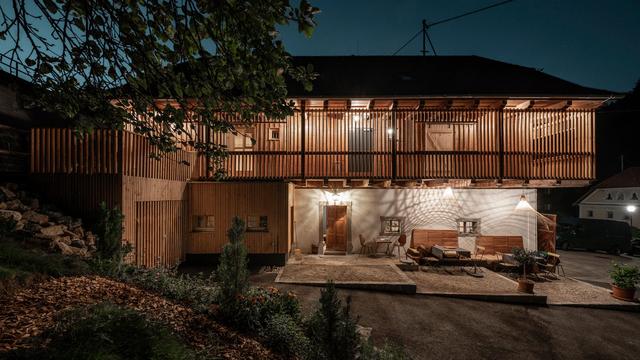
 Installation view: Augustas Serapinas, Barn from Saltria, 2026. Disassembled structure, wood, metal. Dimensions variable. Commissioned by Biennale Gherdëina 10 with the support of Lithuanian Culture Institute and the Embassy of Lithuania in Italy. ©Tiberio Sorvillo
The names Val Gardena, Gröden, Gherdëina—which refer to an alpine valley in the Dolomites of South Tyrol, in the languages of Italian, German and Ladin, respectively—originate from the Latin word “gredine,” meaning “fence” or “fenced-in area.” The garden is thus a fitting inspiration for the 10th edition of the region’s eponymous biennale, which was founded by Doris Ghetta in 2008. Observer spoke with Samuel Leuenberger, curator of “(Future) Paradise Gardens,” about these spaces of care, coexistence and imagination, and some of the 28 contemporary artists participating in this anniversary edition.
In your Introduction to “(Future) Paradise Gardens,” you refer to “the politics embedded in botanical ordering and cultivated space; the violence hidden within ideals of beauty, harmony and care.” Both clauses bring to mind the paintings of Evelyn Taocheng Wang, concurrently exhibiting at Museion in Bolzano. In Urtijëi (Ortisei), Taocheng Wang’s paintings are presented in conversation with Lydia Ourahmane (who also participated in Azad Raza’s “Plot” at Museion in 2023, and is presenting a solo exhibition at the Nicoletta Fiorucci Foundation in Venice, coinciding with the Venice Biennale), at Hotel Ladinia. Where did you encounter both artists’ works, and how have you placed them in relation in this space?
I have been following both artists’ work for some time, although I had not previously worked with Evelyn. Lydia, on the other hand, I have had the pleasure of collaborating with on several occasions since 2014. Her striking approach to the spaces we inhabit is profoundly moving. She invites us into experiences that may have already taken place, yet through the careful re-staging of a setting, she encourages us to see the history of a place or an object with fresh eyes.
This is precisely what happened when Lydia visited the abandoned Hotel Ladinia. She was immediately drawn to the lobby and bar as sites of encounter. After interviewing and speaking with former staff members and guests, she felt compelled to create a scenario in which visitors are invited to gather, use the tables provided—some equipped with chess boards—and engage with one another.
 Curator Samuel Leuenberger. Courtesy Biennale Gherdëina
Evelyn’s exhibition at Museion was both serene and humorous in its observations of multicultural identities and the movement between Chinese and Western traditions. Her Frog Princess series of paintings offered a perfect meta-commentary on everyday situations, depicting hipsters, tourists and other travelers with wit and sensitivity. It therefore felt like a natural conceptual pairing for the two artists to share the same space.
Alongside the importance of collaborations with local institutions, at the opening of the biennale, you acknowledged the “groundwork” of its previous curators. In his review of the 2024 edition, writer Will Jennings remarked on the deliberate decision by its curator, Lorenzo Giusti, to consider the region’s ancient cultural and natural connections with Southwest Asia and North Africa (visualized in, for instance, the geometric murals of Nassim Azarzar). Indeed, the ancient Achaemenid Persian concept of the paradise garden—a walled, square enclosure, divided into four symmetrical parts—was much later reproduced in early modern botanic gardens, representing both the start of scientific botany in western/Europe, and long histories of cultivation. Could you talk about this edition’s particular and ongoing exchange with Lithuania?
The exchange between Biennale Gherdëina and Lithuania emerged from a shared desire to foster meaningful international dialogue and long-term cultural exchange. Creating connections with artists, institutions and cultural partners beyond Italy has always been central to the biennale’s mission, and Lithuania became a particularly inspiring counterpart.
The collaboration began with an invitation for Biennale Gherdëina to contribute to the 2025 Kaunas Biennial, presenting works from the previous edition curated by Lorenzo Giusti. At the same time, I was already in conversation with several Lithuanian artists, including Eglė Kulbokaitė & Dorota Gawęda, and Augustas Serapinas, whose practices resonated strongly with many of the themes we were exploring for this edition.
Through a series of studio visits in Vilnius and Kaunas, the exchange deepened organically. In addition to these artists, I invited Andrius Arutiunian, whose work fascinates me through its playful yet profound engagement with sound, time, memory and the ways cultures intersect and influence one another. Together, these artists bring distinct perspectives while sharing a sensitivity to questions of landscape, history, mythology and collective experience.
The Lithuanian presence in this edition is therefore not the result of a thematic quota or national focus, but rather the outcome of genuine conversations, mutual curiosity and sustained engagement. It stands as an example of how cultural exchange can move beyond institutional partnerships and become a meaningful artistic dialogue. In a time when borders often dominate political discourse, collaborations such as these demonstrate how art can create spaces of connection, trust and shared imagination across geographies.
The interpretation is given in English, Italian, German and Ladin, a “minority” language spoken by around 30,000 speakers. This multilingual context was one subject of Lucia Petriousti and Filipa Ramos’ edition (2022, 8), reflected in its full working title “Persons Persone Personen.” Language is also considered in some of the artworks here, such as Dorota Gawęda & Eglė Kulbokaitė’s sound installation, Brood (Scene 5: and her hair parted on the left side) (2026), developed with the polyphonic vocal group Isokratisses in Epirus, a geographical and historical region in southeastern Europe, which spans present-day Greece and Albania, and contemporary musician OXHY. Elsewhere, Ana Prvački’s paintings, sculptures and performances reflect on the artist’s personal history, as the great-great-great-grandchild of a family of beekeepers (and a budding interest in cross-border relations between the former Yugoslavia and Romania). Does the garden offer a unique space for contemporary artistic engagements with history and heritage, one that transcends present-day borders?
Yes, I believe the garden offers precisely such a space. What makes the garden so compelling is that it is never confined to a single moment in time. Every garden carries traces of different temporalities: memories of past cultivation, inherited knowledge, seasonal cycles, future growth and the constant negotiation between human intention and natural processes. In that sense, the garden becomes a living archive where history is not preserved as something fixed, but continuously reactivated and transformed.
 Gabriela Oberkofler, DER LETZTE ACKER – THE LAST FIELD, 2026. Installation of 12 drawings, Barley and various cooperation partners, above and below ground (each 30 x 40 cm, ink pen on paper), wall painting and table with glasses, with growing moss and barley, petri dishes with drawings and forest finds from Val Gardena, plant lamps. Dimensions variable. Commissioned by Biennale Gherdëina 10. ©Tiberio Sorvillo
For contemporary artists, the garden provides a framework through which questions of history and heritage can be approached in a way that is less concerned with national narratives or political borders and more attentive to processes of exchange, migration, care and coexistence. Plants, seeds, soils and cultivation techniques have always traveled across regions and continents, often revealing complex histories of trade, colonialism, displacement and cultural transmission. The garden reminds us that cultures, like ecosystems, are rarely isolated entities.
Within the context of Biennale Gherdëina, this perspective felt particularly relevant. The Dolomites themselves are a landscape shaped by overlapping histories, languages and traditions. Rather than treating heritage as something static or nostalgic, many of the artists approached it as a living and evolving condition—one that can be questioned, reimagined and expanded. The garden thus became less a physical site than a conceptual space through which we could think about belonging, stewardship, memory and our shared responsibility toward the future.
Essays in the accompanying publication introduce some of the tensions and contradictions—or coexistences, to borrow from the title of Walter Niedermayr’s photographic installation Coexistences—in thinking about gardens, beyond that which can be articulated in a curatorial statement. The very first work of the biennale, Álvaro Urbano’s Zwischenzeit (2025), is also a play on words (meaning “between times”), and comprises a conversation between two lightbulbs, representing two different positions in time and space. The work comprises 92 metal leaves, painted in the four colors of spring, summer, autumn and winter, carefully laid beneath a lamppost from the DDR (Deutsche Demokratische Republik, 1949-1990), found in Berlin, where the artist is presently based. This impossible situation—of four seasons, simultaneously—also hints at how concepts of paradise can differ between social and political contexts. How/have your understandings of “paradise” shifted through your own migrations, and through the curatorial process?
My understanding of paradise has shifted considerably over time. As a child, paradise appeared to me as a destination—a place of harmony, abundance and permanence. Later, through travel, curatorial work and encounters with different cultures and landscapes, I began to understand paradise less as a fixed location and more as a projection: a deeply human desire that reveals as much about our fears and longings as it does about any actual place.
Working on Biennale Gherdëina further complicated this notion. The original title, “(Future) Paradise Gardens,” was intentionally hopeful, but throughout the curatorial process I became increasingly interested in the tensions hidden beneath the idea of paradise itself. Every paradise seems to imply an outside; every garden requires some form of boundary, selection, cultivation or exclusion. At the same time, gardens can also become places of encounter, care, experimentation and coexistence. They embody both hospitality and control, freedom and regulation.
Living and working between different contexts has reinforced this understanding. Coming from Switzerland, a country often imagined as a kind of paradise—stable, prosperous, orderly—I have become aware that such ideals are always partial and dependent on perspective. What appears idyllic from one position may feel restrictive from another. Likewise, many of the artists in the biennale approached paradise not as an achieved state but as something unfinished, fragile and continuously negotiated.
 Alice Bucknell, Ground Truthing, 2026. Installation with single-channel 4K video, 4 CNC-milled wooden log stools, green window gels 17′. Commissioned by Biennale Gherdëina 10 with additional support from The MUNCH Triennale, Art Explora and Creative Capital. ©Tiberio Sorvillo
Álvaro Urbano’s Zwischenzeit captures this beautifully. The coexistence of four seasons beneath a single street lamp creates an impossible temporal condition, where multiple realities occupy the same space. For me, paradise increasingly resembles this image. It is not a perfect future waiting to be reached, nor a lost past to be recovered. Rather, it exists in moments of overlap—in the ability to hold contradictions, different histories and multiple ways of being together at once.
If there is a paradise that emerged through this exhibition, it is perhaps not one of perfection but of coexistence: a space where differences do not need to be resolved, where uncertainty is embraced, and where humans, plants, animals, stories and memories can inhabit the same garden without necessarily belonging to the same world.
Almost all of the participating artists made a site visits, which informed not only their works, but the course of the biennale overall, becoming “less an argument imposed on a place than a field of responses shaped by artists listening intently to the valley.” The biennale is loosely structured around six themes or prompts, one of which, “Violent Garden,” addresses the “urgent need to decolonize the garden.” Could you talk about some of the works made in response to this prompt, and the meanings of decolonization in and for this particular context?
The chapter “Violent Garden” emerged from a desire to complicate the seemingly innocent image of the garden. While gardens are often associated with beauty, care and cultivation, they have also historically been spaces of control, classification and exclusion. Many are linked to colonial histories through the movement of plants, resources and knowledge across territories. To speak of decolonizing the garden is therefore to ask who decides what belongs, what is valued and what remains invisible.
In the context of Biennale Gherdëina, this question extends beyond colonial history alone. The Dolomites are shaped by overlapping languages, contested histories, tourism and changing relationships between humans and the environment. Decolonization here also means questioning established hierarchies between cultivation and wilderness, ownership and stewardship, humans and nature.
Several artists approached these themes from different angles. Alice Bucknell examines how technologies of observation shape our understanding of environmental futures, revealing new forms of control over landscapes. Leonardo Bürgi Tenorio’s work reflects on our desire to contain and domesticate nature, often under the guise of care.
Rather than offering solutions, these works expose the tensions embedded within the garden itself. For me, decolonizing the garden is less about arriving at a new model than about opening space for multiple histories, perspectives and ways of relating to the world. It asks whether we can imagine forms of coexistence that move beyond domination and extraction, and embrace a more reciprocal relationship with our surroundings.
Challenging the conventional format of a paradise garden, you suggest gardens as “unfinished worlds,” temporary spaces in which people can gather, in a “shared terrain of questions.” An emphasis is placed on interdisciplinary collaboration, for instance, between artist Pedro Abu Wirz and philosopher Michael Marder. I noticed that very few works made reference to particular contexts, or conflicts. Was this important in the selection of artists and works?
Yes and no. Many of the works are deeply rooted in particular contexts, histories and places, but they tend to approach them indirectly rather than through explicit representation. I was less interested in artworks that illustrate a specific conflict and more interested in practices that create space for reflection, ambiguity and multiple readings.
One of the guiding ideas of the biennale was the notion of the garden as an unfinished world—a place that is constantly evolving and never fully resolved. In that sense, I was drawn to artists whose work could hold complexity without reducing it to a clear message. Rather than responding to a single political event or local issue, many of the artists address broader questions of coexistence, ecology, spirituality, care, memory and our relationship to the more-than-human world.
The collaboration between Pedro Abu Wirz and Michael Marder is a good example. Their exchange is not tied to one specific geography or conflict, but opens a wider conversation about how we understand growth, interdependence and the intelligence of living systems. Similar approaches can be found throughout the exhibition, where artworks often move between the local and the universal, the personal and the collective.
 Walter Niedermayr, Koexistenzen, 2015-2017. Digital prints, Alu-Dibond, solid maple frames. Various dimensions. Courtesy the artist ©Tiberio Sorvillo
This was indeed important in the selection process. Rather than imposing a singular narrative onto the valley, I wanted to create a field of responses that could resonate across different contexts and experiences. The artists listened carefully to the region, but many transformed those encounters into questions that extend far beyond the Dolomites themselves. In a time when public discourse often demands immediate positions and definitive answers, I felt it was equally valuable to create a space where uncertainty, imagination and contemplation could coexist.
The process of artist selection included an open call, with local artists—including those with a diasporic relation to the Dolomites, such as Judith Neunhäuserer—constituting almost one-third of the participants in the biennale. There are also many migrants to the region, including Yokohama-born Masatoshi Noguchi, who has lived in the South Tyrol region for four years. Could you talk about two specific references in the works of these respective artists, Laura and Enrico Fermi (Neunhäuserer), and Leo Lionni (Noguchi)?
One of the aspects I found most rewarding about this edition was the opportunity to bring together artists with very different relationships to the region. Some were born in the Dolomites and maintain a strong connection to the area despite living elsewhere, while others arrived more recently and encountered the landscape from a different perspective. Both positions can offer valuable insights into how a place is remembered, imagined and transformed.
Judith Neunhäuserer’s work engages with the remarkable yet often overlooked figure of Laura Capon Fermi, who spent significant periods in the Dolomites with her husband, the physicist Enrico Fermi. Rather than approaching the story through a purely historical lens, Neunhäuserer is interested in the intersections between science, memory, landscape and personal biography. Her work reactivates a lesser-known narrative embedded within the region, inviting us to consider how histories are preserved, forgotten and retold over time, 100 years after the couple visited the very region we exhibit in.
One of Masatoshi Noguchi’s contributions centers on Leo Lionni, the celebrated writer and illustrator whose stories continue to resonate across generations. What attracted Noguchi to Lionni was not only his connection to the region but also the way his books explore themes of community, difference, cooperation and belonging. As someone who arrived in South Tyrol from elsewhere, Noguchi brings a unique perspective to these questions. Through Lionni’s work, he reflects on how identity is shaped through movement, adaptation and encounters with others, play and educational tools.
Although the two projects are very different, both engage with figures who moved between places, disciplines and cultures. In doing so, they challenge fixed notions of local identity and remind us that the history of the Dolomites has always been shaped by exchange, migration and the circulation of ideas.
As curator of Parcours, the public art sector of Art Basel, you encourage international visitors to walk beyond the fair, and around the city. Likewise, in Gherdëina, you acknowledged that “before international guests arrive, the path has been shaped accordingly.” This includes your own as curator, having visited the biennale a number of times independently, and as part of an invited group of curators, prior to your selection for the 10th edition, perhaps introducing another “contradiction,” in the long-term relations that constitute the foundation of this particular, though still temporary and transitory, event of a Biennale. Could you trace the journey of the work of Jacopo Belloni, both before and after the biennale, to consider this approach with respect to the artists?
One of the things I have always appreciated about Biennale Gherdëina is that it is built on long-term relationships rather than spectacle alone. While the exhibition itself is temporary, many of the conversations, collaborations and encounters that make it possible unfold over years. My own relationship with the biennale developed in a similar way, first as a visitor, then as an invited curator, and eventually as curator of this 10th edition.
Jacopo Belloni’s project reflects this understanding particularly well. His work did not simply arrive in the valley fully formed; it emerged through a process of research, dialogue and repeated engagement with the region. During his visits, Belloni became interested in the intersections between mythology, spirituality, local histories and the natural environment—elements that have long shaped the cultural imagination of the Dolomites. The work grew from these encounters rather than being imposed upon them.
At the same time, the biennale is not conceived as the final destination of an artwork. Like many projects in this edition, Belloni’s contribution exists within a longer trajectory. The research undertaken here will continue to inform his practice beyond the exhibition, while the work itself enters new conversations as it travels elsewhere and finally ends up in the collection of GAMEC in Bergamo, while some of the sleepers, the seed bags, will be buried in the region for many decades to come. In this sense, the biennale functions less as a conclusion than as a moment within a larger process of exchange.
This approach was important to me throughout the exhibition. Rather than commissioning works that merely respond to a site, I was interested in creating conditions for meaningful encounters between artists and the valley. The resulting projects carry traces of these relationships, but they also remain open, continuing to evolve long after the exhibition has ended.
Many of the artists in this edition are relatively young (and established). To return to the beginning of our conversation, in Bolzano, Leonie Radine, curator of Museion, suggested that the present generation of artists often have a “big say” in all of the elements of an exhibition, approaching them as gesamtkunstwerks, a German loanword meaning “total work of art.” What do you hope will remain rooted from this edition of the biennale, and what may grow for the many Basel and Switzerland-based artists included?
One of the things that excites me most about this generation of artists is precisely their willingness to think beyond the individual artwork. Many approach exhibitions as holistic environments in which architecture, display, sound, graphic design, publishing, performance and social interaction become part of a larger ecosystem. This creates a richer and often more collaborative way of working, one that felt particularly suited to the spirit of Biennale Gherdëina. What I hope remains from this edition is not a particular object or image, but a network of relationships: between artists and the valley, between local communities and international visitors, and among the artists themselves.
For the many Basel- and Switzerland-based artists participating, I hope the experience offered an opportunity to work outside familiar institutional frameworks and engage with a landscape that demands a different pace of attention. The Dolomites invite a certain humility; they remind us that we are part of a much larger ecological, geological and cultural continuum. Several artists responded to this by taking risks, experimenting with new materials, scales or ways of working.
More in art fairs, biennials and triennials
-
What the Venice Biennale Reveals About the West’s Cultural Confidence
-
Why the Destination Art Fair Is Here to Stay
-
Faig Ahmed Weaves Azerbaijan’s Past Into Its Future in Venice
-
The Biennale of Contemporary Keramics Finds in Rhodes Its Most Resonant Stage Yet
-
In the Polish Pavilion, “Liquid Tongues” Rewrites Our Hierarchy of the Senses










 English (US) ·
  French (CA) ·
  French (FR) ·