

 12 hours ago
1
PROTECT YOURSELF with Orgo-Life® QUANTUM TECHNOLOGY
Orgo-Life the new way to the future Advertising by AdpathwayBracken and heather ripple across the plateau. I exhale into the chill autumn air and my breath mists a view that reaches all the way to Gower and the ochre peaks of Bannau Brycheiniog (formerly the Brecon Beacons). Far below, the Ogmore valley’s terrace houses look like tiny constellations but up here on Tarren y Fforch, it’s just me and a few sheep taking springy steps between tufts of bilberries. If this corner of the south Wales valleys feels a long way from its coal mining past, that is, partly, the point.
I’m hiking the new Llwybr Coedwig Cymru Trail, or Wales Forest Trail. Running from Porthkerry Park, near Barry, to Pont Walby, close to Glynneath, this 50-mile (80km) pilot route is the first section of what the National Forest for Wales hopes will eventually be a trail linking woodlands across the length and breadth of Wales: a sylvan counterpart to the Wales Coast Path.
My father grew up in one of the valleys’ mining villages and, when I visited relatives there as a child, the disconnection of those post-industrial communities from the wild hills that loomed above them was striking. Mountain bikers have long discovered the region’s potential, but walkers still tend to head for the more obvious trails that wind through the national parks or along the coast. This pilot trail seems a good excuse to explore untapped footpaths.
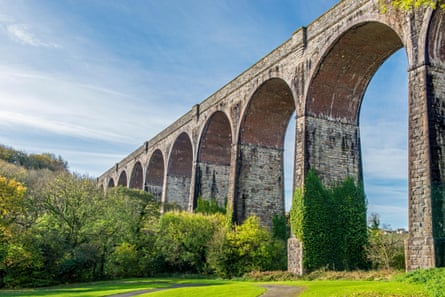
With the sea behind me, I set off from the oak leaf sculpture that marks the trail’s start. The viaduct ahead once carried coal to Barry docks, but today it stands over Caffe Matteo, busy with dog walkers sipping cappuccinos. Leaving them behind, I cross the park between the soft greens of birch and oak trees.
I swerve on to a fern-fringed path and follow a stream to the outskirts of Barry. The next section is less lovely – a long stretch of roadside pavement until I enter Hensol Forest. The sunshine splinters through ancient pine trees and their needles cushion the ground. Weaving in and out of forest and fields, I soak up all the calm this long-distance forest-bathing exercise can offer until the Vale Resort comes into sight.
This vast hotel is popular with golfers, but also holds two trump cards for walkers: a spa where weary hikers can swim, sauna and steam their muscles limber again, and a bar serving energy-boosting Welsh rarebit spiked with ale mustard, Dragon cheddar and charred leeks.
Restored, I rejoin the trail the next morning, dipping along leafy lanes and footpaths as the roar of the M4 gets louder. I cross beneath it to enter Coedwig Gellihir, a small broadleaf woodland, then continue north into Pontyclun, before clambering down to the river at Ynysmaerdy Forest to pick up an old railway path to Coedely.
The trail has been designed to offer stretches for cyclists, pushchair users and horse riders, with more pavement-pounding and, in Thomastown, a reminder of the challenges faced by post-industrial communities. Leaving the village behind, the trail opens out again on to a little rocky path with soaring views of Ogwr Fach Valley.
One of the National Forest for Wales’s aims is to help communities connect with nearby woodlands. In Blackmill, the next village I come to, the trail passes Coed Bach Dimbath, a small community woodland where local groups have come together to build an otter hide, outdoor classroom and accessible paths.
“The woodland there had been inaccessible for decades, and now people can access it,” says Rhodri Hewitt of Natural Resources Wales, the trail’s project lead. “The valleys can feel desperately poor in places, but the River Ogmore is another world entirely.”
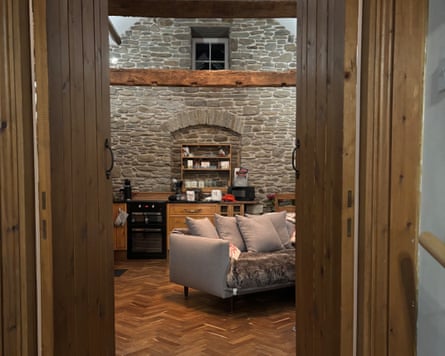
Continuing north to Nant-y-Moel, I come to Blaenogwr Farm, a Georgian farmstead marooned in the village, where I’m staying in a homely holiday cottage. I drop off my backpack and head across the road for fish with buttery potatoes and laverbread (made from edible seaweed) and cockle sauce at the Blaenogwr Hotel.
after newsletter promotion
My final day’s walking starts with a climb up to that extraordinary plateau on Tarren y Fforch. Hewitt tells me that parts of the trail follow the paths miners took across these hills to work in pits in neighbouring valleys. I’m glad they had this antidote to the darkness and danger underground. Today’s route feels uplifting. I slip through an ancient gate on to open moorland and pick my way up the escarpment, meadow pipits chirruping around me.
Crossing the plateau, I enter Afan Forest park, a large commercial woodland that’s also home to a forest of wind turbines, a peat restoration project and a network of mountain-biking trails. I have an urge to be inside the forest rather than tracing its edges and detour on to a footpath leading up to the trig point at Craig y Llyn, the highest point of the valleys at 600m.
Continuing beneath branches dripping velvety lichen, I come to another spectacular viewpoint, as the land drops away to the waters of Llyn Fach and Llyn Fawr, with the peaks of Corn Du and Pen y Fan shrouded in soft-focus drizzle behind them. Soon I dip into the loveliest stretch of forest along the whole trail.
The valley of Cwm Gwrelych is a designated geological site of special scientific interest because of the near complete 300m-year-old strata exposed here. But it’s also rainforest-like, cut through with waterfalls, a dark, glossy river and dense, broadleaf woodland. I feel completely enveloped in green as I hike the last couple of miles to the trail’s current end, the Isambard Kingdom Brunel-designed viaduct at Pont Walby. As I continue to Sgwd Gwladys pub with rooms in nearby Pontneddfechan, I remind myself that this is not a finished trail but the beginning of one.
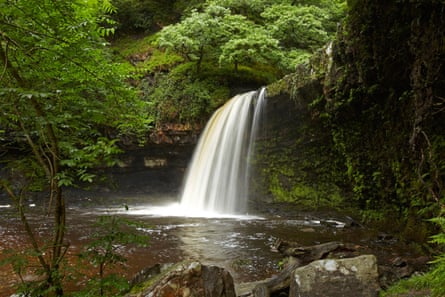
The next morning, I pull on my boots one last time and set out in search of the waterfall the pub is named after. Mist rises from the river, shafts of sunlight turn the leaves amber and a heron glides past in cinematic slow-mo. When we spoke about the trail, Hewitt mentioned an old Welsh proverb: Dod yn ôl at fy nghoed, meaning “To return to my trees”, or finding your way back to a balanced state of mind. As I sit and admire Sgwd Gwladys’ thundering cascade, I realise this leafy trail has delivered exactly that.
The trip was provided by the National Forest for Wales and Natural Resources Wales. Vale Resort has doubles from £104 room-only. The Airbnb cottage costs from £87 a night. Sgwd Gwladys has doubles from £65.55, room only. For trail information, visit gov.wales/llwybr-coedwig-cymru-trail and for region information Visitwales.com






















 English (US) ·
 French (CA) ·
 French (FR) ·