

 2 months ago
97
2 months ago
97
PROTECT YOURSELF with Orgo-Life® QUANTUM TECHNOLOGY
Orgo-Life the new way to the future Advertising by Adpathway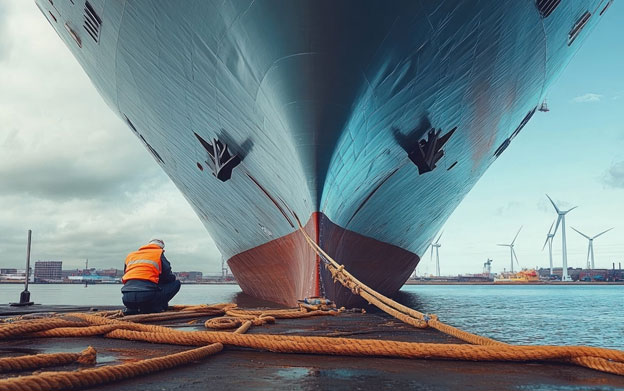 A cargo vessel docked at a port facility. Credit: UNCTAD
UNITED NATIONS, July 16 (IPS) - The full economic impact of the disruptions in the Strait of Hormuz may not become clear until the second half of 2026, warns the United Nations Conference on Trade and Development (UNCTAD).
Prior to the closure, an average of 129 maritime vessels transited daily through the strait, carrying approximately 34 percent of globally traded crude oil and 20 percent of the world’s liquefied natural gas (LNG). Asia is by far the largest importer of Gulf crude and oil products, receiving 91 percent of Gulf crude and petroleum products or roughly 16.5 million barrels per day.
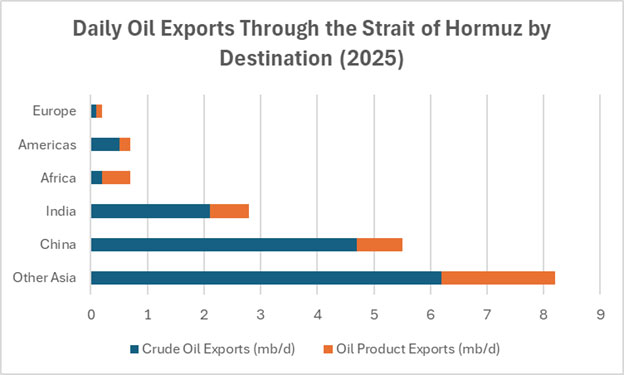
While much of the global economy appears to be absorbing the shock rather decently, UNCTAD warned that the broader consequences of the Strait of Hormuz disruption have yet to fully materialize.
“I should qualify that the full picture on Hormuz disruptions should become clearer in the second half of 2026, once the higher costs have been fully absorbed through value chains, the broader macroeconomy, and financial conditions.” UNCTADS’s Head of Macroeconomic and Development Policies, Anastasia Nesveailtova, told Inter Press Service.
Oil prices in recent months have reached an amount higher than USD 100 per barrel, up from roughly USD 60 per barrel last June. While the immediate effects have been largely visible in the energy markets, economists note that secondary shocks often take months to fully solidify through the broader global economy.
Higher fuel costs increase expenses for agricultural producers, shipping companies, and manufacturers, all which are heavily reliant on energy intensive operations. As businesses begin to absorb these costs, they are often felt later by the consumer as it takes time for the full supply chain costs to trickle down.
UNCTAD warned about these secondary effects as early as March this year, noting that “Freight rates for oil tankers and war risk insurance premiums are surging, while marine fuel costs are also rising, increasing shipping costs across supply chains.”
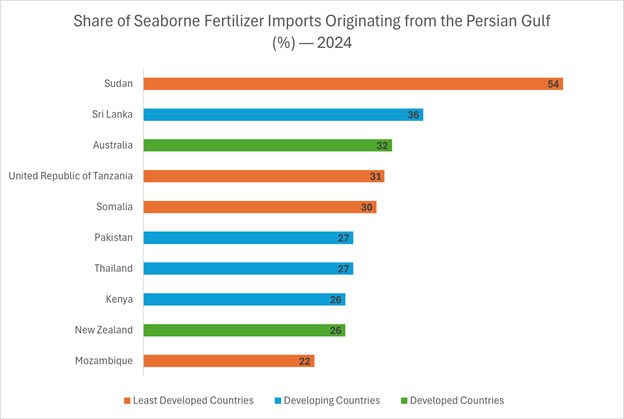
Beyond transport costs, the disruption also threatens global agricultural supply chains. UNCTAD notes that “Around one-third of global seaborne fertilizer trade (about 16 million tonnes) passes through the strait,” raising concerns that prolonged disruption of the strait could increase agricultural production costs by limiting access to fertilizer.
Several countries that rely heavily on fertilizer imports from the Persian Gulf are also major agricultural producers and exporters. According to UNCTAD, Australia for example sources 32 percent of its seaborne fertilizer imports from the Gulf. According to the World Trade Organization (WTO), Australia is among the world’s largest agricultural exporters, accounting for 12.8 percent of global agricultural exports, making it a top five exporter.
Likely as a result of fertilizer being a critical input to agricultural production, a decrease in supply of fertilizer signals an increase in price, meaning growing food becomes more costly. These effects also reach other exporters such as Pakistan, Thailand and New Zealand, but largely will affect them less than the secondary result of a supply constriction which raises regional food prices for vulnerable countries.
UNCTAD records that Sudan receives 54 percent of its fertilizer through seaborne imports from the Gulf, along with the United Republic of Tanzania, Somalia, and Mozambique also receiving large percentages from the region. Sudan and Somalia in particular are currently in a humanitarian food insecurity crisis, with parts of Mozambique also continuing to experience food security pressures.
The economic consequences of the Strait of Hormuz’s disruption may therefore extend far beyond just energy markets, reaching consumers worldwide through higher through higher transportation, agricultural and supply chain expenses.
IPS UN Bureau Report
© Inter Press Service (20260716043359) — All Rights Reserved. Original source: Inter Press Service
























 English (US) ·
  French (CA) ·
  French (FR) ·