

PROTECT YOURSELF with Orgo-Life® QUANTUM TECHNOLOGY
Orgo-Life the new way to the future Advertising by Adpathway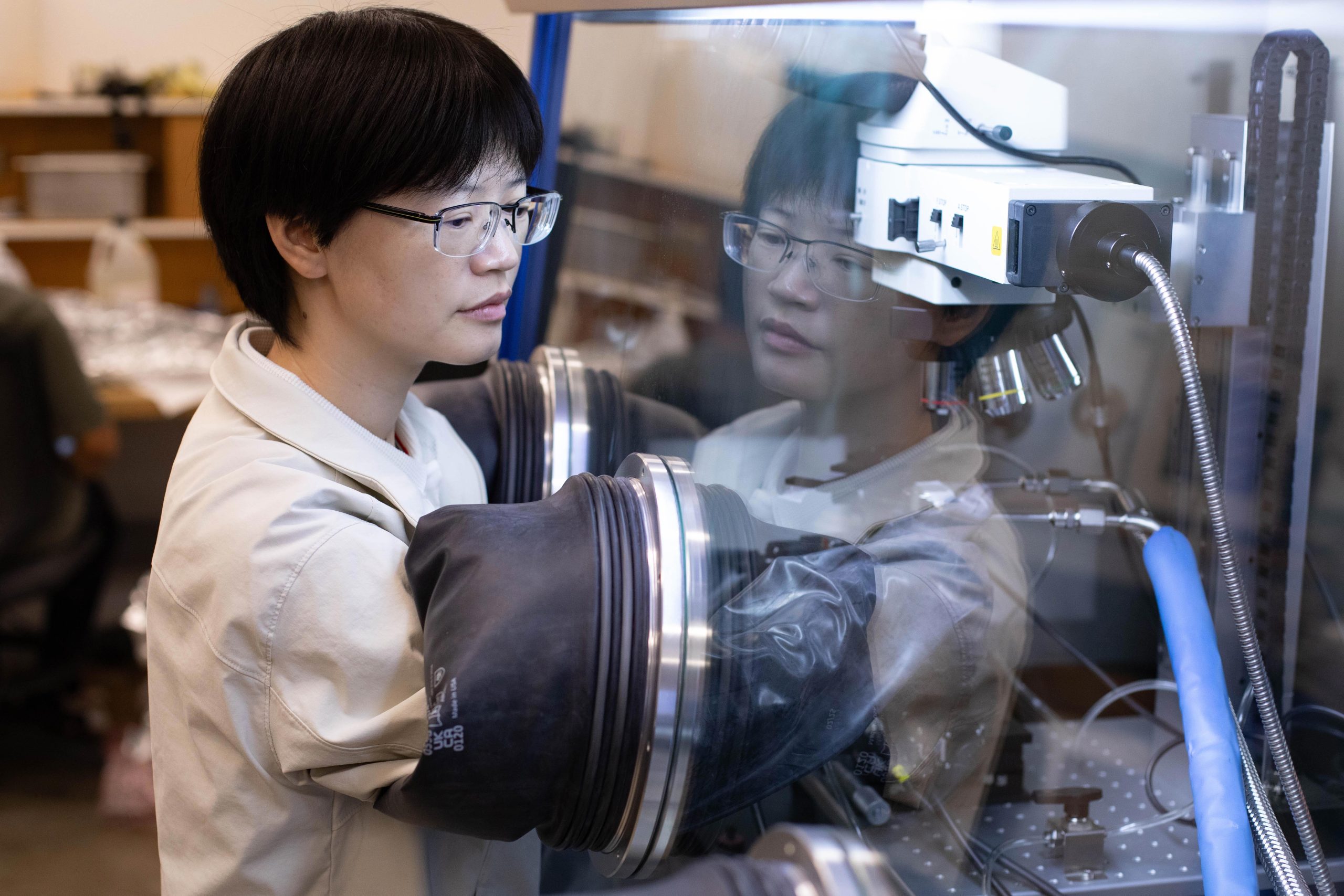 Dr. Mengke Liu, assistant professor of physics at The University of Texas at Dallas, operates a two-dimensional transfer stage inside a glove box to fabricate atomically thin quantum devices. She and her colleagues discovered an unusual atomic pattern in a uranium-based material that gives it a rare combination of magnetic properties, a finding that could open new pathways for designing advanced electronic and computer memory devices. Credit: University of Texas at Dallas
A long-overlooked material has revealed a hidden atomic pattern that challenges conventional expectations about magnetism.
A uranium compound that has received little scientific attention for decades has been found to contain a previously unknown atomic structure with unusual magnetic properties. The discovery could help researchers identify materials capable of supporting faster, more resilient computer memory.
Scientists discovered a repeating, twisted arrangement of atoms known as a chiral superlattice inside uranium oxytelluride (UOTe). The structure appears to play a central role in how electrons move through the crystal, which exhibits an uncommon combination of two different types of magnetism. The findings were published online October 7 in Nature.
A Hidden Atomic Pattern Revealed by Microscopy
Dr. Mengke Liu, an assistant professor of physics at the University of Texas at Dallas, discovered the structure while examining crystals synthesized by Dr. Sheng Ran, an associate professor of physics at Washington University in St. Louis. Liu began studying the material while working as a Harvard Quantum Initiative Postdoctoral Fellow, before joining UT Dallas in 2025. Using transmission electron microscopy and scanning tunneling microscopy, she investigated the crystal at atomic resolution.
“I was originally studying this material for an entirely different reason,” Liu said. “When I examined it with high-resolution microscopy, I found a naturally occurring superstructure no one had recognized before.”
The newly identified superlattice consists of a larger, repeating atomic arrangement with a predominantly left-handed or right-handed twist, a property known as chirality. The researchers found that this organization influences electron behavior and is associated with the material’s unusual magnetic characteristics.
Two Forms of Magnetism in One Material
The crystal displays characteristics of both ferromagnetism and antiferromagnetism. In ferromagnetic materials, atomic magnetic moments align to produce an overall magnetization. In antiferromagnetic materials, neighboring magnetic moments point in opposing directions, typically canceling one another so that the material has no net magnetization.
“Finding a single material that combines both of these properties is interesting fundamentally,” Liu said.
A research team at Harvard University, led by Dr. Suyang Xu, the John L. Loeb Associate Professor of the Natural Sciences and a corresponding author of the study, was independently investigating the same compound. The teams compared results from complementary experiments and conducted additional measurements, confirming that the unusual atomic superstructure is an important factor controlling how electrons travel through the material.
Potential for Faster and More Reliable Memory
Antiferromagnetic materials offer potential advantages for computer memory because they are generally less sensitive to external magnetic fields and can support faster operation than conventional ferromagnets. A material combining characteristics of both could provide new possibilities for magnetic memory technologies, although practical devices based on the discovery have not yet been demonstrated.
“If those advantages can be harnessed, memory devices could potentially become both faster and more robust,” Liu said.
Computational analyses also suggest that hundreds of related compounds might contain comparable superlattice structures. This expands the range of materials researchers can investigate for similar electronic and magnetic behavior.
“This study provides a new way of looking for materials with these unusual properties,” Liu said. “Instead of focusing only on the fundamental atomic arrangement, we can also now explore larger superstructures that might influence how electrons behave.”
A Material Known Since the 1960s Holds New Possibilities
Uranium oxytelluride was first known to scientists decades before the discovery of its unusual superlattice. Modern microscopy techniques have now made it possible to examine structural features that earlier investigations could not resolve.
“Uranium oxytelluride has been known since the 1960s, but it has been largely ignored in research since then. Now, with today’s techniques, we’re able to uncover and study properties that previously were hidden,” Liu said.
Reference: “A chiral superlattice route to spin-split topological antiferromagnetism” by Thao Dinh, Mengke Liu, Jian-Xiang Qiu, Sougata Mardanya, Suk Hyun Sung, Xuan Hoang Le, Christopher Broyles, Chengfeng Zhu, Qiaozhi Xu, Haotian Chen, Zack Rehfuss, Yu-Fei Liu, Xiaoyu Zeng, Houchen Li, Peng Guo, Jinchen Liu, Tianye Huang, Jingtian Shi, Michael Smith, Joanna M. Blawat, John Singleton, Ross McDonald, Iván E. Arvizo, Dongtao Cui, Shao-Liang Zheng, Kenji Watanabe, Takashi Taniguchi, Vineet Kumar Sharma, Sudip Ghorai, Barun Ghosh, Hsin Lin, Ting Yong Lim, Tay-Rong Chang, Arun Bansil, Ivar Martin, Ashvin Vishwanath, Weiwei Xie, Claudia Felser, Jairo Sinova, Anyuan Gao, Mikhail D. Lukin, Jennifer E. Hoffman, Sugata Chowdhury, Qiong Ma, Kai Sun, Ismail El Baggari, Sheng Ran, Talieh S. Ghiasi, Hongkun Park, Philip Kim and Su-Yang Xu, 7 October 2026, Nature.
DOI: 10.1038/s41586-026-11073-7
The research was funded in part by the U.S. Department of Energy, the Office of Naval Research, the National Science Foundation, the Air Force Office of Scientific Research and the Army Research Office.
Never miss a breakthrough: Join the SciTechDaily newsletter.
Follow us on Google and Google News.
















 English (US) ·
 French (CA) ·
 French (FR) ·