

 1 month ago
181
1 month ago
181
PROTECT YOURSELF with Orgo-Life® QUANTUM TECHNOLOGY
Orgo-Life the new way to the future Advertising by AdpathwayWith the European Union’s 20th package of sanctions against Russia, adopted on April 22, Kyrgyzstan has earned a dubious accolade as the first country to be targeted by the EU’s “anti-circumvention tool.”
On April 23, coincidentally, Kyrgyz President Sadyr Japarov stopped by Moscow for a working visit, including a meeting with Russian president Vladimir Putin.
Since Russia’s full-scale invasion of Ukraine in late February 2022, the EU has issued successive packages of sanctions in an effort to pressure Moscow toward peace, or at the very least make continued war increasingly painful.
In the EU’s 11th package of sanctions, adopted in June 2023, the European Commission introduced what it called an “anti-circumvention tool” designed to allow the EU to “restrict the sale, supply, transfer or export of specified sanctioned goods and technology to certain third countries” considered to be at high risk of providing pathways for the circumvention of sanctions.
“This new ‘anti-circumvention’ tool will be an exceptional and last resort measure when other individual measures and outreach by the EU to concerned third countries have been insufficient to prevent circumvention,” the European Commission stated.
In the just-approved 20th package of sanctions, the European Commission says it is activated the tool for the first time, citing the “systematic and persistent failure” of the Kyrgyz government “to prevent the sale, supply, transfer, or export to Russia of certain machine tools and certain telecommunication equipment imported from the EU and used for the manufacturing of drones and missiles in Russia.”
This decision is not necessarily a surprise.
In February, EU’s sanctions envoy, David O’Sullivan, laid out European concerns about Kyrgyzstan’s role in re-exporting sanctioned goods to Russia during a visit to Bishkek. O’Sullivan told reporters that trade flows suggest that some goods “are being imported into Kyrgyzstan with the sole purpose of being re-exported to Russia, in breach of our sanctions.” Specifically, he mentioned radio equipment and machine tools produced in Europe and imported into Kyrgyzstan with the exclusive purpose of re-export to Russia.
“What is disturbing for us is the fact that there has been a significant and very noticeable percentage, a big increase in the percentages of your imports and re-export of these products compared to the pre-war period,” O’Sullivan said.
“We are not asking Kyrgyzstan not to have trading relations with Russia. We only ask that that trading relationship does not involve the deliberate circumvention of our sanctions by the transmission through Kyrgyzstan of sanctioned EU goods to Russia,” he added.
At the time, Kyrgyz Deputy Prime Minister Daniyar Amangeldiev told POLITICO, “Our task is to prove that we are a reliable partner.”
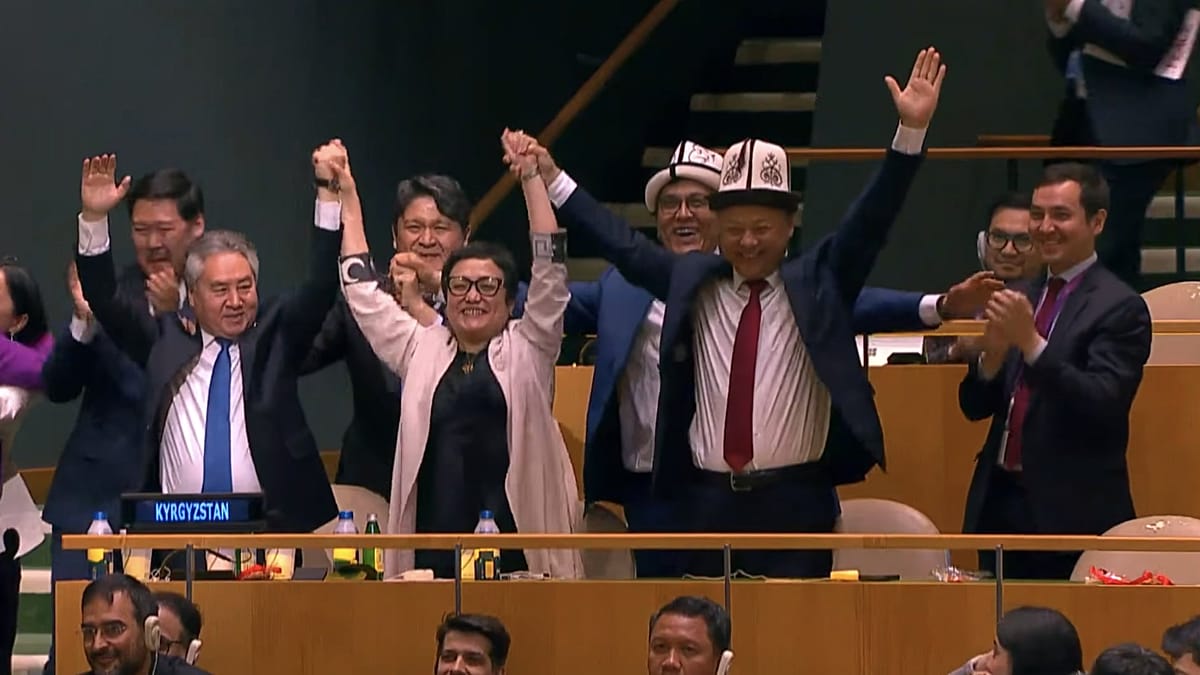
In other avenues, the Kyrgyz government has pushed back against sanctions. In his September 2025 speech before the United Nations General Assembly, Japarov fired broadsides specifically at the United Kingdom for new sanctions London had introduced in August against a pair of Kyrgyz banks, repeating allegations he’d made previously that “sanctions imposed on Kyrgyzstan are based on false information spread by certain non-governmental organizations and malicious citizens.”
What Japarov branded as fake news, the EU apparently takes more seriously.
Last year the EU, U.K., and U.S. all applied sanctions to a certain Kyrgyz banks, alleging that they – and the country’s new booming crypto scene – are abetting the movement of money to the benefit of Russian actors.
In October 2025, the European Union adopted its 19th package of sanctions against Russia, including sanctions against two Kyrgyz banks, three in Tajikistan, and one in Kazakhstan.
The 20th package sanctions adopted this week adds an additional four Kyrgyz banks, plus banks in Laos and Azerbaijan.
With the “anti-circumvention tool” the EU will restrict exports of some high-tech goods to Kyrgyzstan, namely metal-working machines, including equipment with computer numerical control (CNC), and communication equipment such as modems, routers, radio stations, and other data transmission devices.
“These high-risk items allow Russia to pursue its illegal military aggression against Ukraine and sustain its ability to wage war,” the European Commission argued in its announcement.












 English (US) ·
  French (CA) ·
  French (FR) ·