

 1 month ago
12
1 month ago
12
PROTECT YOUR DNA WITH QUANTUM TECHNOLOGY
Orgo-Life the new way to the future Advertising by Adpathway
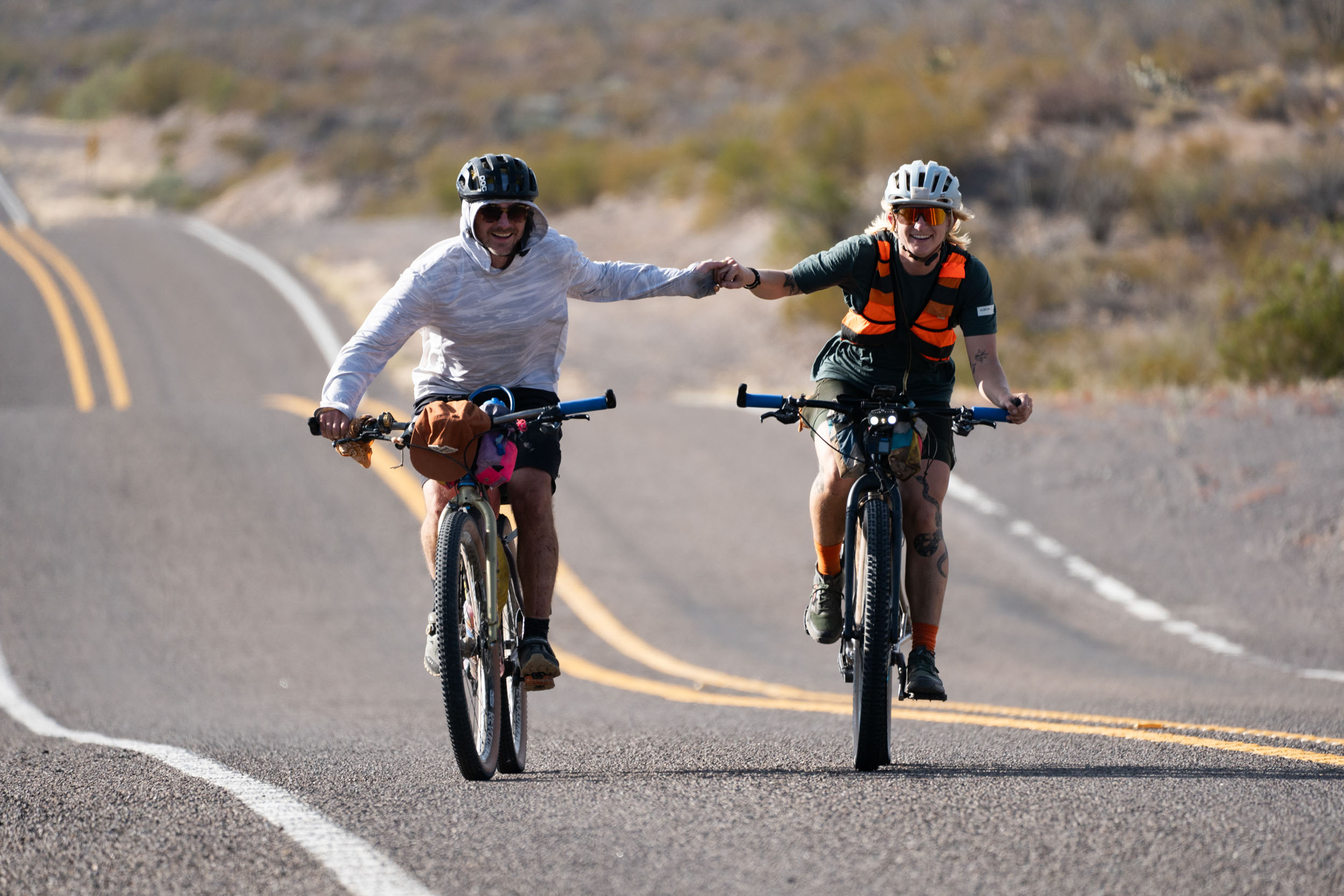
As the recipient of this year’s El Piri startline bursary, Zoë Hyatt found her way to the start of her first bikepacking race. Despite riding totally self-supported, what stood out was the amount of support she received in such an unexpected space. Read a reflection of her experience at the 2025 El Piri event in Spain here…
Photos by Lloyd Wright
Sitting on a plane headed towards Barcelona with my helmet as my primary carry-on felt surreal. I hadn’t flown with a bike before, and the impending rebuild would be a first. The 11 a.m. plane was full of jolly Glaswegians headed to a Festival in Barcelona; they were on a completely different trip. Squished on all sides by partygoers, I felt the humour in the juxtaposition with me riding a bike up and down hills for my holiday.
It so happened that amongst the festival crew, the person sitting beside me was a personal trainer. This resulted in me landing in Spain with a healthy understanding of what I should have been doing in preparation for the race and the hourly calorie intake I would need on the road. Whilst I was very grateful to the guardians above for this interaction, it highlighted that I had no idea what was to come, and my “learn by doing” approach was feeling a little naive. Although, as it turned out, this moment of support in an unexpected space would be added to a growing list of occasions in this “solo” adventure, where I would feel connected and held by others and the landscape.

The adventure was my first ultra bikepacking event, El Piri. This involved just under 800 kilometres of riding and 20,000 metres of climbing in the most spectacular loop across the Catalonian Pyrenees.
It feels contradictory to talk about support when speaking about a self-supported bike event. However, alongside pushing limits and testing my self-sufficiency, taking part in El Piri was, in fact, an exercise in accepting help and deeply appreciating the extent of support in my life and within this bike community.
Whilst I expected lack of sleep, beautiful views, and a sore butt, I didn’t expect to be carried up hills by a playlist created by friends or feel company from the butterflies or the red rock faces I cycled beside. Quick head dunks in the coolest of streams and tree canopy shade would feel like gifts on the road, and perhaps, most naively, I didn’t anticipate that by stepping into this world I would be joining an incredibly caring community of like-minded people from all over.

Accepting Help
A lot is required to make it to the start line of these events, and having money certainly helps. When embarking on an ultra for the first time, there is much self-doubt around capability and strength. The pressure from an increasingly capitalised and commercialised sport adds to this stress. You don’t need the lightest, newest, or best gear to do well, and what I have learned is that generally if you ask, folk are more than willing to help.
Back home in Glasgow, in the run-up to the event, friends offered their labour and mechanical knowledge, leading to head-torched evenings after work. My set-up involved borrowed handlebars, handmade bike bags, a water vest, my flatmate’s sleeping bag, a pal’s jersey, and all sorts of other bits and bobs lent by friends and strangers.

Invisible Barriers
Some of the hurdles, however, aren’t just having the gear. Applying for the El Piri Bursary felt like a revelatory moment, truly acknowledging how a male-dominated cycling world relates to the barriers of access, enjoyment, and achieving “success.” Whilst shifts are happening, I hadn’t fully acknowledged the accumulative impact of condescending interactions at bike shops, technical and expensive kit conversations within organised group rides, and being shouted at by predominantly male vehicle drivers on commutes.
Although these become easily absorbed in your everyday life, the effects can be alienating, particularly at times of challenge or insecurity. Add in a lack of tailored equipment for female/non-conforming body types, poor representation, and lack of support for female, trans, and non-binary riders, and you begin to build up a significant barrier to the thing that you love. I felt the poignancy of this when a fellow rider, Kerry, and I had a moment when chatting about this somewhere on the climb out of Sant Julià de Lòria. Heat, altitude, and tiredness might have been contributors to the tears.

Over the years, I have rain-checked bike events and gatherings out of fear of failing or not fitting in—a consequence of the internalized feeling that I must prove myself as deserving to be there. To be worthy, I must be great on a bike, and to achieve, I must do it all on my own, a horrible thought cycle that I believe is common in the cycling community and becomes a barrier to remarkable achievements.
Importance of the El Piri Startline Bursary
I can’t express enough how important support like El Piri’s Startline Bursary is for opening up self-supported events, which can feel intimidating and unreachable. The Bursary, in partnership with Tailfin, is designed to enable access to bikepacking events for more people from underrepresented backgrounds. It waives the entry fee and provides a free tracker, Tailfin bikepacking equipment, and a cash contribution towards travel and accommodation. The Bursary, along with the experience and knowledge gained from my first ultra bikepacking event, opened my world to wildly exciting new possibilities on the bike. Simply put, it felt like someone reaching out their hand and giving me a slight push off onto the road.
My first bike race was less than a month before El Piri, when I participated in the Medieval Cat, an utterly unserious alley cat in my home city, organised by friends. It had taken years to build up the courage to get myself to an alley cat, so getting to the start line of El Piri was in itself going to be a colossal achievement—anything beyond was a bonus. This feeling was echoed to me on the trail by a fellow female rider who was riding her first ultra at the age of 62!
When I pictured myself at the start line, I imagined I would stick out like a sore thumb beside lycra-clad cyclists with superior bikes to mine. The latter might have been true, but the first couldn’t have been further from the truth.
Perceptions Proved Wrong
In June, I found myself pedalling for five days behind, in front, and sometimes beside such a hugely welcoming group of people of varying ages, backgrounds, and experience on the bike. I quickly realised that “not fitting in” was, in fact, fitting in, and that those taking part in ultra-events were a wild bunch of people who felt the same immense joy of traveling far and hard through beautiful places.

During the event, I found myself in the back of the midpack, far from the solitude and isolation I had expected or associated with ultra-endurance events. I found myself propelled by the elation of meaningful encounters on the trail or at refuelling spots. In the days after finishing, I forged new relationships driven by sharing such a unique experience.
Never Alone
I have always thought of myself as an extrovert, but the more I ride solo, the more I enjoy the company of the landscape around me—moments on my own for long stretches rival joyous encounters with others. I feel engaged and notice more of the creatures that bear witness to me passing through (and are subjected to my singing!). I traipsed through the river El Segre, gasped at vivid wildflowers on Creu de l’Eixol, and marvelled at the butterflies that swirled on the climb from Cabo. All were reminders of how beautifully inhabited and precious these landscapes are.
Nights spent bivvying are reminders of this, too. You become a witness to the storms in the night or the condensation in the morning. You are eye level with the bugs that you usually tower over and don’t see. Animals tend not to take much notice of you, and you can spectate aspects of human life without being seen. As if for those hours, you become part of the fabric, whereas often, as a tourist, you stand out or barge through a place.

During El Piri, my bivvy spots weren’t special. They were chosen bleary-eyed, late at night, and out of necessity, but these insignificant places are still vivid in my mind and hold meaning. I was forced to notice the details: the temperature of different materials, the comfort of the bench under my back compared to the ground. I walked in bare feet when I needed to pee at night, and I looked around corners that I’d otherwise have ridden by.
I realised from my one night in a proper bed that it might be wiser to pay for a room. You wake dry and energised from a night on a mattress in a secure room. You might save time by not having to pack up your sleeping gear; however, bivvying often guarantees much more than five stars.
A Memorable Night
A friend recently said to me, “You are never alone in nature because everything is alive.” It is a simple statement, but it really summarises what I was feeling, particularly riding the last 80 kilometres of El Piri.
In the middle of the night, somewhere between Camprodon and Girona, my lights momentarily disturbed hundreds of spiders’ reflective backs, which appeared as stars in the grass. A snake crossed my path, its eyes shining and suspended in mid-air, and mice scuttled away, disturbed by the sound of my tires. The moon was an orange crescent. It was all mesmerising. It wasn’t until Falling by Julee Cruise and the theme tune to Twin Peaks suddenly played through what I thought were my turned-off headphones, and I felt my tire deflate, that snapped back into the reality of having cycled for nearly 24 hours.
This momentary pause in the dark was a space to absorb the beauty and the busyness of nature. I continued, feeling grateful for my time in Catalonia. It wasn’t until the sun began to rise over the hillside and urban life began to trickle into the landscape that a silent sadness crept over me. I rolled into the finish with adrenaline high and a genuine desire to keep going.
Looking Back
In the run-up to the event, I had been so focused on the start that I hadn’t thought about the finish. I was sad that it would never be my first race again, but I was excited to know that with each event, there are different approaches to take and attitudes to embody. There would be new things to get wrong and subsequently learn from.
Each day on the bike feels like a week’s worth of experience and learning. For me, bikepacking is when I most feel childlike wonder, truly present and open to the unknown. An ultra is an adult’s play and a reclamation of how we once experienced time.
Whilst I showed up to El Piri alone, I left with a newfound sense of community, tremendous encouragement to continue adventuring and testing my capabilities, and a desire to support others in doing the same.
Please keep the conversation civil, constructive, and inclusive, or your comment will be removed.




 English (US) ·
  French (CA) ·
  French (FR) ·