

PROTECT YOURSELF with Orgo-Life® QUANTUM TECHNOLOGY
Orgo-Life the new way to the future Advertising by AdpathwayHomemade gravy has to go in the fridge, and fast. An unopened shelf-stable jar or dry packet does not, but an opened jar does. Below: what to refrigerate, how long gravy can sit out, and how to cool, reheat and freeze it.
Does gravy need to be refrigerated?
The Short Answer
Yes. Homemade gravy, gravy prepared from a mix, and opened shelf-stable gravy need refrigeration, and USDA says to refrigerate leftovers within 2 hours of cooking. Unopened shelf-stable jarred gravy and dry packets don’t need the fridge, and gravy sold in the refrigerated case stays refrigerated. How long it keeps depends on the source, and the storage-time section below explains the difference.
For a complete pantry storage reference, see our Food Storage Guide. For the full shelf-life timeline, see our guide on whether gravy goes bad.
📋 Does Gravy Need to Be Refrigerated: At a Glance
| Unopened shelf-stable jar | No. Heinz lists the storage classification as ambient and prints a Best By date on the cap |
| Refrigerated-case gravy | Yes. Keep it cold and follow its label |
| Opened jar | Yes. Heinz says to use its jars within 5 days. For other brands, follow the label |
| Dry packet | No. Keep it cool and dry (McCormick, K-State) |
| Prepared or homemade | Yes. Refrigerate within 2 hours of cooking (USDA) |
| How long it keeps | FDA: 1 to 2 days. USDA’s Turkey Basics: 3 to 4. We suggest 1 to 2 when practical |
| Sitting out | Not over 2 hours, or 1 hour above 90°F (USDA) |
| Reheating | Rolling boil and 165°F, per USDA |
| Freezing | Shallow container. 2 to 3 months for best quality (FDA). Frozen at 0°F it stays safe indefinitely |
Key Takeaways
- Homemade gravy, gravy prepared from a mix and opened shelf-stable gravy all need the fridge. USDA’s leftovers page says to refrigerate leftovers within 2 hours of cooking, or of taking them off a warming appliance.
- Unopened shelf-stable jarred gravy and dry packets don’t need the fridge. Heinz lists its jars as ambient storage, and McCormick says to keep pouches cool and dry. Gravy sold in the refrigerated case stays refrigerated.
- An opened Heinz jar goes in the fridge, and Heinz says to use the unused portion within 5 days. For other brands, follow the label.
- Don’t leave gravy out more than 2 hours, or 1 hour above 90°F, per USDA. USDA’s Danger Zone page says bacteria can double in as little as 20 minutes between 40°F and 140°F, a general illustration rather than a prediction for any one gravy.
- Cool gravy in shallow containers. Hot food can go straight into the fridge, and an ice or cold-water bath also works, per USDA.
- Reheat gravy to a rolling boil and to 165°F, per USDA. We’d reheat only what you’ll serve.
- Keep warm gravy at 140°F or hotter, checked with a food thermometer. USDA doesn’t recommend reheating cold leftovers in a slow cooker.
Which Gravy Do You Have?
Jarred, canned, dry packet and homemade gravy have different answers. For shelf life and spoilage signs, see whether gravy goes bad. For a full leftovers chart, see how long leftovers last.
Which Gravy Needs the Fridge?
Start with the kind you have, because jarred, packet and homemade gravy have different answers. These are maker, FDA, USDA and extension recommendations, not guarantees.
| Unopened shelf-stable jar | No. Pantry storage until you open it | Heinz |
| Refrigerated-case gravy | Yes. Keep it cold and follow its label | Label |
| Opened Heinz jar | Yes. Use within 5 days | Heinz |
| Opened can or other brand | Yes. Follow the label. For best quality, move it to a covered container | USDA, NDSU |
| Unopened dry packet | No. Cool, dry cupboard | McCormick, K-State |
| Gravy made from a packet | Yes. Treat it as homemade gravy | USDA |
| Homemade gravy | Yes. Within 2 hours of cooking | USDA |
| Milk- or cream-based gravy | Yes. We found no separate guidance | USDA |
Does Jarred Gravy Need to Be Refrigerated?
An unopened shelf-stable jar doesn’t need the fridge. Heinz’s HomeStyle Turkey Gravy page lists the jar’s storage classification as ambient and prints a Best By date on the cap. Once the jar is open, Heinz says to refrigerate any unused portion and use it within 5 days. Its au jus and pork gravy pages say the same. Gravy sold in the refrigerated case is a different product, so keep it cold and follow its label.
Canned gravy follows the same rule once it’s open. USDA’s shelf-stable food page says unused portions of canned food must be refrigerated in clean containers. NDSU Extension’s canned and packaged food Q&A says that, for best quality, you should move the food to a covered container before refrigerating it. That is a quality tip, not a safety condition.
Heinz’s 5 days is Heinz’s instruction for its own jars. We found no maker figure for other brands or for canned gravy, so follow the label, and if it gives no timeline we’d use the homemade window below. Our guide on whether gravy goes bad has the full timeline.
Does Gravy Mix Need to Be Refrigerated?
A dry gravy packet doesn’t need the fridge. McCormick’s Brown Gravy Mix page says to keep the pouches in a cool, dry place away from heat, humidity, moisture and light. K-State Research and Extension’s cupboard storage guide says to keep sauce and gravy mixes cool and dry too.
The fridge matters once you add water or stock. We found no maker figure for gravy made from a packet, so we’d treat it as homemade gravy: refrigerate it within 2 hours and use it by the windows below.
Does Homemade Gravy Need to Be Refrigerated?
Yes, homemade gravy belongs in the fridge. USDA’s leftovers guidance says leftovers must be refrigerated within 2 hours of cooking, or of coming off an appliance that keeps them warm. It says to divide large amounts into shallow containers. USDA’s Turkey Basics: Handling Cooked Dinners page says gravy belongs in shallow containers in the fridge.
For milk- or cream-based gravy, such as sausage gravy, we found no separate guidance. We’d treat it like homemade gravy and use the shorter window below.
How Long Does Refrigerated Gravy Keep?
Federal guidance differs. FDA’s Refrigerator & Freezer Storage Chart lists gravy and meat broth at 1 to 2 days in the refrigerator. University of Minnesota Extension’s storage times chart and Texas A&M AgriLife Extension’s leftover storage limits agree. USDA’s Turkey Basics page lists cooked dishes and gravy at 3 to 4 days.
We recommend using gravy within 1 to 2 days when practical, and treating USDA’s 3 to 4 days as the outer limit. These windows assume the gravy was refrigerated promptly and the fridge is at 40°F or below. Our guide on whether gravy goes bad compares each source.
How Long Can Gravy Sit Out?
Not long. USDA’s Danger Zone page says bacteria multiply fastest between 40°F and 140°F, and can double in as little as 20 minutes. That is a general illustration, not a prediction for any one gravy. The page says never to leave food out of refrigeration over 2 hours, or over 1 hour if the temperature is above 90°F.
Gravy is a known problem food. North Dakota Health and Human Services’ Clostridium perfringens factsheet says gravies are common sources of Clostridium perfringens infections, and that the bacteria grow while food cools or is held between 40°F and 140°F. Symptoms begin 6 to 24 hours after eating and usually last less than a day.
Discard gravy left at room temperature overnight. USDA says to throw away perishable food left out more than 2 hours, and we wouldn’t try to rescue it by reheating. We don’t suggest tasting it to decide.
How Do You Cool Gravy Quickly?
Spread it out so it cools fast. USDA says to put gravy in shallow containers, and NDSU Extension’s freezer storage Q&A says shallow containers also help food freeze faster. USDA’s leftovers page adds that hot food can go straight into the refrigerator, and that an ice or cold-water bath can chill it quickly.
Keep the fridge at 40°F or below. UF/IFAS’s Clostridium perfringens publication says large portions of meat, broth and gravy need specific cooling guidelines, with rapid chilling to 41°F or less. North Dakota says to divide large pots into smaller quantities so they cool quicker. Don’t wait for a big pot to cool on the stove.
Can You Keep Gravy Warm?
If gravy stays on the table or on the stove, keep it hot. North Dakota says to keep cooked food at 140°F or hotter, or 40°F or colder, if it won’t be eaten right away. UF/IFAS gives 140°F or higher as the hot holding temperature. Check it with a food thermometer rather than by eye.
USDA’s Slow Cookers and Food Safety page says to hold food in a slow cooker at 140°F or hotter, measured with a food thermometer. It says hot food can go into a preheated slow cooker, and that reheating cold leftovers in one is not recommended. For cold gravy, reheat it on the stove or in the microwave first, then move it to a preheated slow cooker.
Refrigerate leftovers within 2 hours of cooking. A gravy boat on the table cools quickly, so we’d put out a small amount and refill it from the hot pot.
How Should You Reheat Gravy?
Bring it to a rolling boil and to 165°F. USDA’s leftovers page says sauces, soups and gravies should come to a rolling boil when reheated, and that leftovers should reach 165°F. USDA also says to bring gravy to a rolling boil.
Stir as it heats, and add a splash of water or stock if it has set up in the fridge. USDA’s 1965 bulletin Freezing Combination Main Dishes says stirring while reheating helps with separation. We’d reheat only the portion you’ll serve and keep the rest cold.
Can You Freeze Gravy?
Freezing is the best way to keep gravy past a few days. Frozen at 0°F, food stays safe indefinitely, and the freezer times are for quality. FDA’s chart gives gravy 2 to 3 months, and USDA’s Turkey Basics page gives 4 to 6. For best quality we’d aim for 2 to 3 months. Our guide on whether gravy goes bad has the full comparison and the texture notes.
For thawing, NDSU Extension says to use the refrigerator, cold water or a microwave, and not the counter. For cold water, use a leakproof bag and change the water every 30 minutes. Reheat the gravy right away after a cold-water or microwave thaw.
University of Nebraska-Lincoln’s refreezing page, quoting USDA, says food thawed in the refrigerator can be refrozen without cooking, with some quality loss. It says not to refreeze food left out more than 2 hours, or 1 hour above 90°F.
Gravy and Holiday Leftovers
Holiday leftovers are where gravy gets forgotten. Pack it in shallow containers with the other sides, and see how long leftovers last for the rest. Mashed potatoes have their own clocks in whether instant mashed potatoes go bad and whether potatoes go bad. For Thanksgiving sides, see whether Stove Top stuffing goes bad, whether cranberry sauce goes bad and whether cranberry sauce needs to be refrigerated.
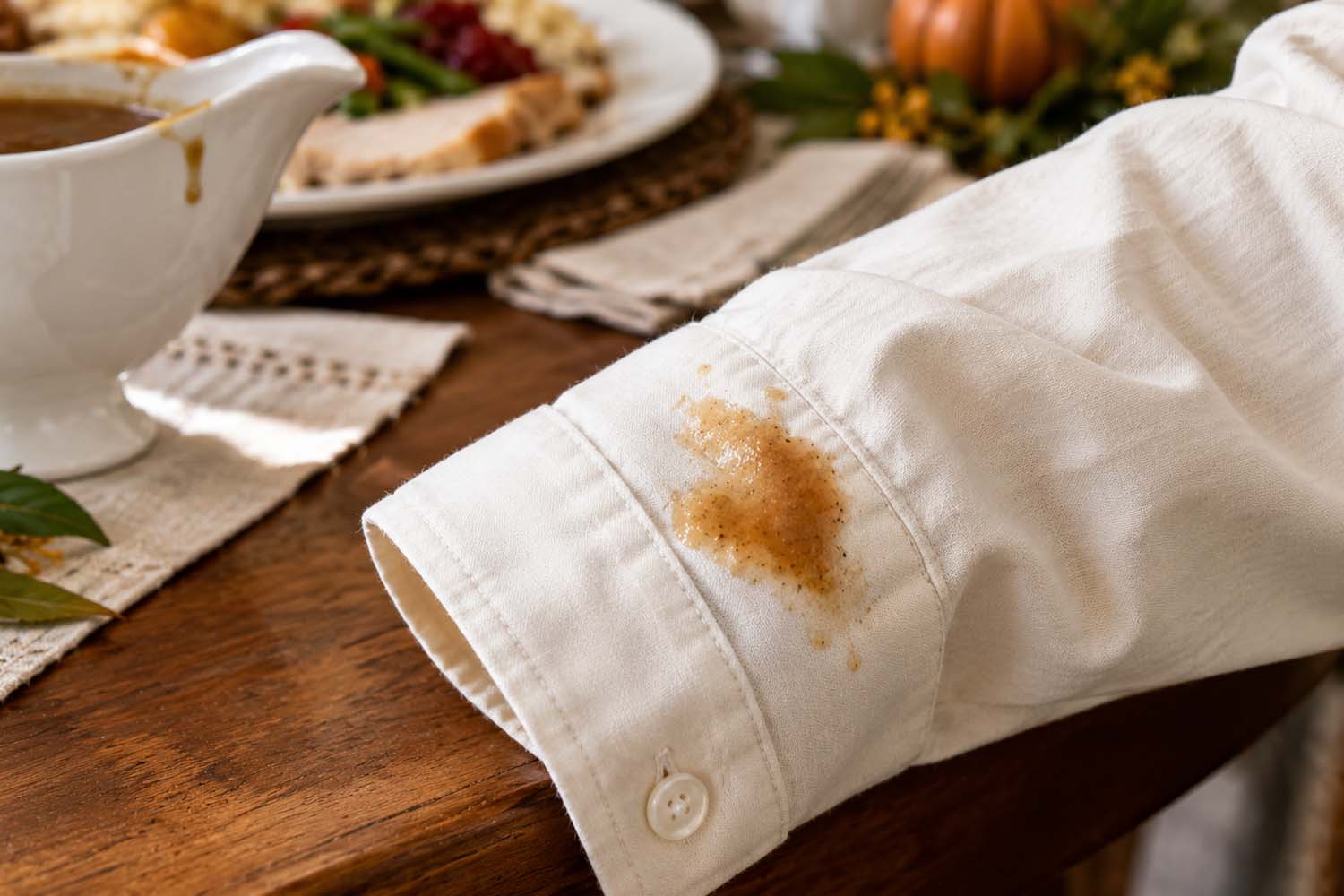
Cooking gravy for a dinner? Our classic meatloaf recipe and bourbon baked ham are two mains to try, whether roast beef goes bad covers leftover beef, and our Thanksgiving wine pairing guide covers what to pour. Making it from scratch? Check whether flour goes bad and whether cornstarch goes bad, with what to use instead of cornstarch if you’re out. If the gravy ends up on your shirt instead of your plate, see our guide on how to get gravy out of clothes.
Signs Something Is Wrong
- Gravy left out more than 2 hours, or more than 1 hour above 90°F, per USDA.
- Visible mold. USDA says to discard moldy cooked leftovers.
- A bulging lid or a raised button on a jar. Heinz and NDSU flag these.
- A sour or off smell, or a slimy texture. This is our checklist, not an agency list.
The first three items follow USDA, Heinz and NDSU, and the fourth is our checklist. A normal look doesn’t prove gravy is safe. We don’t suggest tasting to test.
Normal Things That Aren’t a Problem
- An unopened shelf-stable jar on the pantry shelf, or a dry packet in the cupboard.
- Gravy that sets up or thickens in the fridge. Add liquid and stir while reheating.
- A layer of fat on top of cold gravy.
These are texture and storage normals, and they don’t override the storage-time and handling rules above.
Quick Storage Reference
- Unopened shelf-stable jar or packet: Pantry, cool and dry.
- Opened Heinz jar: Fridge, 5 days. Other brands: follow the label.
- Homemade or prepared gravy: Fridge within 2 hours, in shallow containers.
- How long: FDA says 1 to 2 days, USDA says 3 to 4. We suggest 1 to 2.
- Sitting out: 2 hours at most, 1 hour above 90°F.
- Hot holding: 140°F or hotter, checked with a thermometer.
- Reheat: Rolling boil and 165°F.
See also

| Unopened shelf-stable jar in the pantry | Fine. Heinz lists it as ambient storage. |
| Refrigerated-case gravy, unopened | Keep it cold and follow the label. |
| Opened jar left on the counter overnight | Discard it. USDA says to throw away perishable food left out over 2 hours. |
| Gravy on the table for 90 minutes | Within the 2-hour limit if the room is below 90°F. Refrigerate it now in a shallow container, and reheat it to a rolling boil and 165°F. |
| Gravy on the table for 3 hours | Discard it. USDA says not to leave food out over 2 hours. |
| Gravy on a patio in 95°F heat for 90 minutes | Discard it. USDA’s limit is 1 hour above 90°F. |
| Hot gravy in a big pot, cooling on the stove | Divide it into shallow containers now. Don’t wait for the pot to cool. |
| Gravy that stayed at 140°F or hotter during the meal | If a food thermometer confirms it stayed at 140°F or hotter, it was hot-held within the guidance. Refrigerate leftovers promptly. |
| Cold gravy you want to warm in a slow cooker | Don’t reheat it in the slow cooker. USDA doesn’t recommend it. Bring it to a rolling boil and 165°F on the stove or in the microwave first, then hold it at 140°F or hotter. |
| Opened Heinz jar, in the fridge for 4 days | Within Heinz’s 5 days if it was kept at 40°F or below. Bring it to a rolling boil before serving. |
| Opened Heinz jar, in the fridge for 6 days | Past Heinz’s 5 days. Discard it. |
| Gravy from a packet, made and promptly refrigerated yesterday | Within both FDA’s and USDA’s windows if the fridge is at 40°F or below. Bring it to a rolling boil and 165°F. |
| Homemade gravy, promptly refrigerated 3 days ago | Probably fine under USDA’s 3 to 4 days but past FDA’s 1 to 2. We’d use it or freeze it now, and reheat it to a rolling boil and 165°F. |
| Homemade gravy, in the fridge for 5 days | Past USDA’s 3 to 4 days. Discard it. |
| Gravy that separated in the fridge | Separation can be a texture change rather than spoilage. It doesn’t override the storage-time and handling rules. Stir while reheating. |
How We Checked This
In October 2026 we read USDA’s leftovers, Turkey Basics, Danger Zone, slow cooker and shelf-stable food pages, two older USDA posts on Thanksgiving leftovers and its 1965 bulletin Freezing Combination Main Dishes. We read FDA’s Refrigerator & Freezer Storage Chart and the University of Minnesota Extension and Texas A&M AgriLife Extension storage charts. We read K-State’s cupboard guide, NDSU’s canned food and freezer Q&As and the University of Nebraska-Lincoln’s refreezing page. We read North Dakota Health and Human Services’ and UF/IFAS’s Clostridium perfringens publications. We read Heinz’s turkey, au jus and pork gravy pages and McCormick’s brown gravy mix page. We found no maker figure for canned gravy or prepared packet gravy, and no separate guidance for milk-based gravy. Our own suggestions say we’d or we suggest. This article is general information, not medical advice.
Does Gravy Need to Be Refrigerated FAQ
Does gravy need to be refrigerated?
Homemade gravy, gravy prepared from a mix and opened gravy, yes. USDA says to refrigerate leftovers within 2 hours. Unopened shelf-stable jars and dry packets don’t need the fridge.
Does jarred gravy need to be refrigerated?
Not until you open it. Heinz lists its jars as ambient storage, and says to refrigerate any unused portion after opening and use it within 5 days. Gravy sold in the refrigerated case stays cold.
Does gravy mix need to be refrigerated?
No. McCormick says to keep pouches cool and dry, and K-State says the same for sauce and gravy mixes.
Does homemade gravy need to be refrigerated after cooking?
Yes. USDA says to refrigerate leftovers within 2 hours of cooking, in shallow containers.
Does canned gravy need to be refrigerated?
After opening, yes. USDA says unused portions of canned food must be refrigerated in clean containers. For best quality, NDSU says to move the food to a covered container first. Follow the label for how long.
How long can gravy sit out?
No more than 2 hours, or 1 hour above 90°F, per USDA. Gravy left out overnight or for 4 hours should be discarded.
How long does gravy last in the fridge?
FDA’s chart says 1 to 2 days, and USDA’s Turkey Basics page says 3 to 4. We recommend 1 to 2 days when practical. See whether gravy goes bad.
Can you reheat gravy?
Yes. USDA says to bring sauces, soups and gravies to a rolling boil, and to reheat leftovers to 165°F. We’d reheat only what you’ll serve.
How do you cool gravy quickly?
Use shallow containers. USDA says hot food can go straight into the refrigerator, and an ice or cold-water bath also works. North Dakota says to divide large pots into smaller quantities.
Is it safe to keep gravy warm in a slow cooker?
Yes, if it stays at 140°F or hotter, checked with a food thermometer, per USDA. USDA doesn’t recommend reheating cold leftovers in a slow cooker, so reheat on the stove or in the microwave first.
Can gravy make you sick?
Yes. North Dakota Health and Human Services says gravies are common sources of Clostridium perfringens, which grows while food cools or is held between 40°F and 140°F.
Can you freeze gravy?
Yes. FDA’s chart gives 2 to 3 months for best quality, and USDA’s Turkey Basics page gives 4 to 6. Food kept at 0°F stays safe indefinitely, per FDA. See whether gravy goes bad for texture notes.
How do you thaw frozen gravy?
NDSU says to use the refrigerator, cold water or a microwave, not the counter. For cold water, change the water every 30 minutes. Reheat right away after a cold-water or microwave thaw.
Can you refreeze gravy?
USDA, quoted by the University of Nebraska-Lincoln, says food thawed in the refrigerator can be refrozen without cooking, with some quality loss. Don’t refreeze food left out more than 2 hours.
Does sausage gravy need to be refrigerated?
Yes. We found no separate guidance for milk- or cream-based gravy, so we’d treat it like homemade gravy and use it within 1 to 2 days.
Further Reading

Better Living may earn commissions through affiliate links and may occasionally feature sponsored or partner content. If you make a purchase through our links, we may receive a small commission at no cost to you.


















 English (US) ·
 French (CA) ·
 French (FR) ·