

 2 weeks ago
3
2 weeks ago
3
PROTECT YOURSELF with Orgo-Life® QUANTUM TECHNOLOGY
Orgo-Life the new way to the future Advertising by AdpathwayEarlier today I set you a puzzle that Isaac Newton posed in 1679 in a latter to Robert Hooke. I mentioned that the answer is counter-intuitive, and also gave you the hint that it might have something to do with figure skating. Here’s the problem again, with its solution.
The tower drop
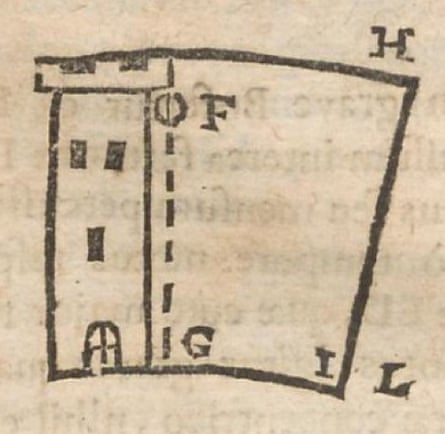
An object is dropped from a high tower. Bearing in mind the rotation of the Earth itself, where will the object land?
-
slightly to the west
-
slightly to the east
-
exactly at the bottom
Solution 2. slightly to the east.
The Earth rotates from west to east.
Our first thought might be that the object falls slightly to the west, on the grounds that as the object is falling the Earth will rotate slightly to the east.
But such an argument ignores the fact that the object is originally – like the tower itself – rotating with the Earth. Our second thought might be that it lands exactly at the bottom of the tower.
Again wrong! The object lands slightly to the east because as it falls it spins about its axis slightly faster, by essentially the same mechanism that makes a spinning ice-skater spin faster when they pull in their arms. It is in this way, then, that the object lands slightly to the east.
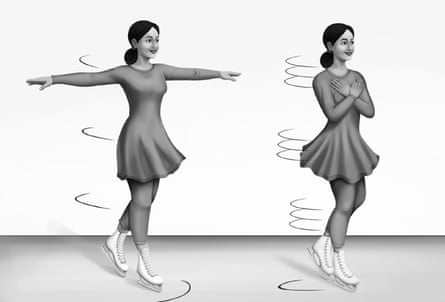
The effect is small, but not absurdly so. If the Eiffel tower were on the equator the deflection to the east would be about 11cm.
In more technical detail, the result follows from conservation of angular momentum, which is a measure of the momentum of an object rotating about an axis.
When an object is falling from a tower, gravity is pushing it towards the centre of mass of the Earth. Yet the object is also spinning in a circle around the centre of the Earth.
As the object falls its angular momentum stays the same. Which means that the expression wr2 – where w is the object’s angular velocity and r is its distance to the rotational axis (in this case, the centre of the Earth) – stays the same.
Since the value of r decreases during the fall, the value of w must increase, which means that the object spins faster. If it spins faster than the Earth is spinning it will land slightly to the east of the position directly underneath the tower.
Thanks to David Acheson for today’s puzzle. He is the author of a new book, Wonders in Motion, The Story of Dynamics, which among other things explains the background to Newton’s puzzle in more detail.
I hope you had fun. I’ll be back in two weeks.
Wonders of Motion by David Acheson is on sale at the Guardian Bookshop.
I’ve been setting a puzzle here on alternate Mondays since 2015. I’m always on the look-out for great puzzles. If you would like to suggest one, email me.






















 English (US) ·
  French (CA) ·
  French (FR) ·