

.png) 2 months ago
66
2 months ago
66
PROTECT YOURSELF with Orgo-Life® QUANTUM TECHNOLOGY
Orgo-Life the new way to the future Advertising by AdpathwayIn 1868, the government of Hong Kong gave eight axis deer to Hawaii’s King Kamehameha V. They were a beautiful gift, these creatures that hail from south Asia, with their honey-colored pelts marked by a smattering of white spots. But their incursion into Maui started much later, in the 1950s, when they were brought to the island for recreational hunters.
Now, more than a century after their introduction, an estimated 60,000 traverse the Hawaiian islands of Lanai, Maui and Molokai in herds that are reshaping the environment. Unlike the white-tailed deer common along the US east coast, whose breeding season lasts from October to January, axis deer breed year-round. Their herds are constantly reduplicating. They feast on native grasses and endangered plants, chewing them down to their roots, leaving wide swathes of lands fallow. They can leap 10ft over fencing or barrel through it, consuming farmers’ crops and the cattle feed needed for Maui’s small beef industry.
In February, looking for a specific blood sausage that reminded an aunt of the wild boar sausage her Portuguese mother once made, I found it was unavailable. Joy Enriques, owner of Uncle Louie’s Sausage Co, in Kahului, said: “We stopped making it. We couldn’t get the amount of green onions we needed for it. The deer ate all that the local farmers were growing.”
Axis deer are also uniquely destructive. Thankfully, they are also delicious. For one company, that overpopulation is an opportunity.
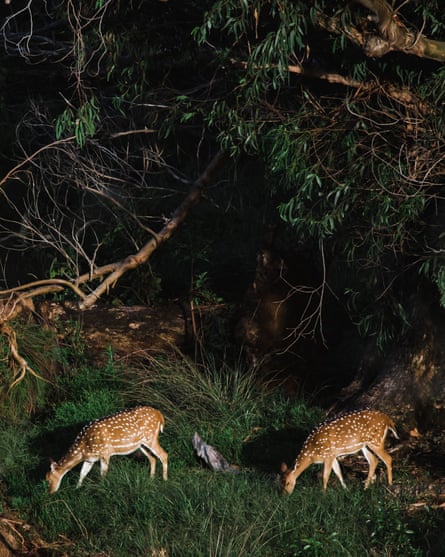
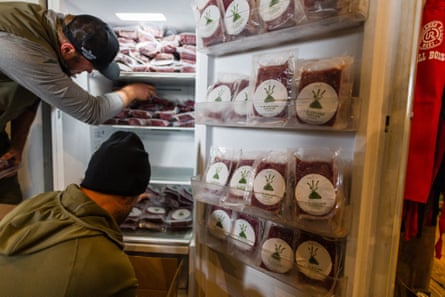
Maui Nui Venison harvests the deer from privately owned ranches, whose owners advise how many animals they want hunted. That culling is overseen by US Department of Agriculture (USDA) agents, who record every single kill and track the deer population with high-tech tools. The deer gets turned into steaks, ground meat, bone broth, jerky and even organ-based health supplements.
The company’s work might just be interspecies turnaround as fair play. A 2011 US interior department report said: “This deer species is a voracious grazer of forest understory plants, including seedlings of native trees that are critical to the survival of native Hawaiian forest birds.” In Hawaii, axis deer met no natural predators, allowing them to run rampant. In January, Josh Green, the state’s governor, declared a state of emergency due to drought conditions exacerbated by axis deer. It is the 25th such proclamation regarding the impact of axis deer on Hawaii.
Every night, a quasi-military operation
For almost a decade, Maui Nui Venison has led the charge to turn axis deer into food. Using night-vision technology, infrared drones, utility terrain vehicles and the same guns wielded by military special forces, Maui Nui’s hunters harvest deer every night, weather permitting. Usually, 40-55 deer are culled nightly, most of them a few years old. Each deer produces about 42lb of meat, but some bucks, weighing up to 200lb, can produce a lot more.
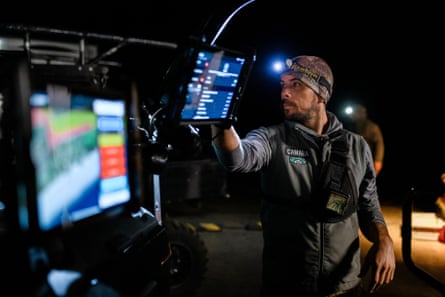
On an exceptionally clear and bright night in February, I followed Maui Nui’s shooters and spotters into the brush-covered landscape of central Maui. The hunters are all men, mostly in their early 20s, who work seven days on and seven days off. They nap during the day in converted, insulated shipping containers, sealed off from daylight with foil and duct tape.
Each night, they go off in different directions in two separate teams, each accompanied by a USDA inspector who looks at each animal and grants the shooter permission to shoot. Their convoy of off-road vehicles looped around thickets of kiawe mesquite trees filled with thorns (the kind “that will pop all your tires”, said the shooters repeatedly).
Sheldon Simeon, a chef and owner of the restaurant Tiffany’s in Wailuku, stuffs his wontons with Maui Nui’s venison rather than the traditional ground pork.
“We have a wild food source that has wrecked our ecosystem and has become a nuisance by running rampant. People can be intimidated by venison because it’s associated with tasting gamey,” said Simeon. “Hawaii’s people are very ‘go to Costco and buy ground pork or canned pork’ ever since being accustomed to WW2 rations. But Maui Nui’s venison is not so gamey because of what [the deer are] eating on Maui. It’s full of flavor and it also cooks really easily.”
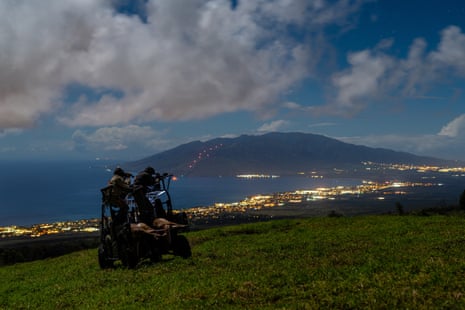
“And they’re clean!” said a beaming Keahi Camara, Maui Nui Venison’s harvest specialist, as he drove a UTV to the company’s base camp. Unlike wild boar, which also cause destruction, but on a much smaller scale, axis deer typically aren’t covered in dung or mud.
There are other benefits. “A pound of conventional ground beef costs $20 on Molokai,” said Camara, who is originally from another island overrun by axis deer. “Wouldn’t you rather pay $5 for high-quality local venison you can make into a burger?”
Whenever a deer is spotted, the harvesters sound an electronic call to get the deer’s attention, which sounds like a melodic duck quack. Then often a soundtrack: a crack, a soaring whistle and a thud.
“They make sure we’re not wounding animals and causing suffering,” said Camara. “The USDA makes sure we’re rending animals unconscious immediately.” There are many stipulations: they must be head shots (if a head shot does not immediately dispatch the deer, the shooter may approach the deer and execute it with one more shot). The deer must be a certain size (both baby deer and giant bucks throw off the metrics for their butchering team).
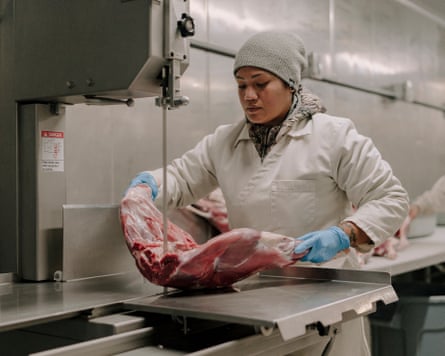
“You’re not following the animal all day and watching it,” said Camara. “The boys love to hunt during the day, but they’ll do it with bows. When it comes to harvesting deer, we’re just shooting. Tracking is replaced with technology.”
On one night every two weeks, they go out without inspectors and specifically shoot deer for Maui’s community. This deer gets turned into ground meat, frozen and distributed in community hubs across Maui – a program the company calls Holo ‘Ai. “Holo” means to flow and “ai” means food in Hawaiian. The meat is free for residents.
Hawaii imports somewhere between 85% to 90% of its food supply from the US mainland. But during the pandemic, the challenges weren’t about supply, but rather distribution of food. “We had excess food because all of the imported food was going to tourists, and during Covid, there were no tourists. But there was also no distribution,” said Camara. Recognizing that there was a bottleneck in getting food to Maui’s residents, Maui Nui expanded their Holo ‘Ai program across Maui.
In upcountry Maui, with its high-elevation slopes, ranching cleared native forests – and its history predates the arrival of any deer. “And yet we idolize paniolo (Hawaiian cowboy) culture,” said Camara, who drove me on the same UTV through Ulupalakua Ranch the following morning, above the same areas we had accompanied the shooters in darkness a few hours earlier. He gestured toward the land above us: highland areas used for raising cattle, lowland for sugar.
“You can see the fingerprints of everyone who has come through. With all these layers of destructive food production [in Hawaii], if there’s gonna be a new layer what is it going to look like?”
For all of the nuisances caused by axis deer, Maui Nui isn’t looking to completely eliminate them, but rather balance their population. “Some ranch owners would call them ‘spotted rats’,” said Camara. “But our first goal was to shift that mindset. This is a resource, not an invasive species.”
Camara pointed out all the reforested areas of Ulupalakua Ranch – still largely devoted to raising cattle, but with large swathes of land cordoned off to grow endangered koa trees. The patches of koa forest are loud with the tweets of native birds such as ‘apapane. I spotted the bright red and yellow bristly blossoms of the vulnerable ‘ōhi’a lehua tree, too. “Native birds follow the blooms,” said Camara. “But the deer don’t let the trees’ saplings survive. But some are surviving now.” Reforestation has also restored the area’s aquifer. As the sun rises, we hear but do not see the pueo, or Hawaiian short-eared owl, that lives in the bushes.
During February and March, a series of devastating storms swept through Maui and other islands. Low-pressure weather systems brought hurricane-force winds, heavy rainfall and flash floods to western Maui, Oahu’s north shore and Molokai, wiping out farms and illustrating how fragile Hawaii’s food system is. Maui Nui still focused its efforts on shooting for the community and filling local coolers and fridges with ground venison.















 English (US) ·
  French (CA) ·
  French (FR) ·