

 1 month ago
30
1 month ago
30
PROTECT YOURSELF with Orgo-Life® QUANTUM TECHNOLOGY
Orgo-Life the new way to the future Advertising by Adpathway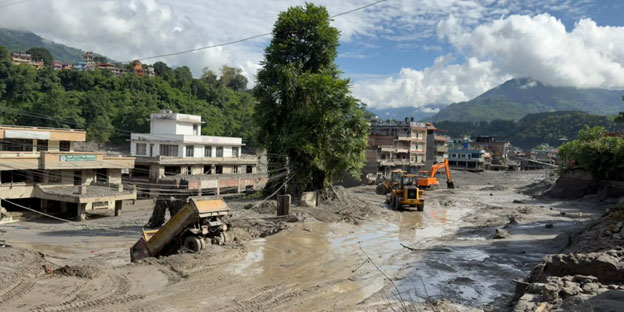 Homes and roads are covered in mud in Nuwakot District, Nepal, after devastating flash floods swept through central northern Nepal. Credit: UNICEF/Laxmi-Prasad-Ngakhusi
UNITED NATIONS, September 1 (IPS) - On the morning of August 26, an unprecedented series of flash floods struck Nepal and the Tibet Autonomous Region of China, causing immense destruction, killing hundreds of civilians and leaving thousands missing. Entire neighborhoods have been buried underwater and beneath mud as the Nepalese government and humanitarian organizations rush to provide emergency assistance.
“My family members were swept away by the flood in front of my eyes,” Kalpana Malla from Nepal’s Nuwakot district told reporters. “They could not escape the flood; there was no chance at all. This flood took everything, but my son and I climbed the rooftop of a house and survived, but couldn’t explain how.”
Although the direct cause of the floods is currently unknown, figures from the U.S. Geological Survey (USGS) indicate that the floods were caused by a significant glacial collapse, after previously reporting they were caused by a magnitude 4.4 earthquake. Marking a magnitude 5.2 seismic event, the subsequent debris flow and downstream collapse of seismic waves crashed over the Nepal-China border, destroying buildings and roads along the Trishuli River.
“Initial analysis of before-and-after satellite images now suggests that part of a glacier collapsed high in the mountains,” said Professor Liz Stephens, Professor in Climate Risks and Resilience at the Department of Meteorology at the University of Reading in the United Kingdom, noting that the stability of high-mountain environments is increasingly threatened by the global impacts of climate change. She adds that the Intergovernmental Panel on Climate Change (IPCC) has “high confidence” that similar “complex cascading events” could occur in the future if underlying climate factors are not addressed soon.
Entire regions in Nepal have been rendered inaccessible due to heavy flooding and mudslides, which destroyed at least 35 bridges, affected over 40 kilometers of roads, and disrupted telecommunications and electricity services in roughly 10 percent of the total affected areas. The hardest-hit regions are the Rasuwa district near Kathmandu in northern Nepal, the Nuwakot district in central-northern Nepal, and the towns of Timure, Rasuwagadhi, and Syabrubesi. According to figures from the Office for the Coordination of Humanitarian Affairs (OCHA), roughly 10,000 households are in dire need of emergency assistance, with many families stripped of basic services, such as shelter, food, water supply, and access to healthcare.
Last week on August 27, Lila Pieters Yahia, the United Nations (UN) Resident Coordinator in Nepal, informed reporters during a press briefing at the UN Headquarters that at least 359 people had been killed, while 73 additional civilians had been hospitalized, though some have since been released. Yahia also stated that approximately 910 civilians remain missing, though various media outlets report the figure exceeds 1,300. Since then, Nepal officials have confirmed 900 deaths and over 4247 missing.
These numbers are projected to fluctuate in the coming days as aid personnel increasingly access isolated areas. Of those unaccounted for, Yahia noted that roughly 517 are foreign nationals spanning over 30 countries—including hundreds from China and India, alongside approximately 90 from the United States.
“Everyone in a mountain valley faces the same hazards, but tourists are more vulnerable because they may not recognize the danger or understand local warnings,” said Dr. Fatima M. Pillosu, hydrometeorologist and flash floods researcher from the Department of Meteorology at the University of Reading. “Visitors from regions where such events are rare may not appreciate how fast a mountain river can rise, nor that these valleys also face avalanches, landslides and floods from melting glaciers, even in dry weather. Knowing in advance what can happen, and what to do if it does, is one of the most useful protections.”
Children in Nepal are among the hardest-hit populations, with the United Nations Children’s Fund (UNICEF) estimating that at least 17,000 children have been impacted. UNICEF has recorded the destruction of at least 18 schools and damage to 20. Roughly 10,000 school-age children are projected to require urgent support to continue their education, including new learning materials, access to temporary learning centers, and psychosocial support services for both children and teachers.
“Children across Rasuwa and Dhading saw their lives being literally washed away in front of their eyes in a very short span of time, with homes, classrooms, and medical facilities damaged,” said Alice Akunga, the UNICEF representative to Nepal. “Children who have survived the floods now face heightened risks of disease, malnutrition, violence and exploitation,” she said.
Yahia informed reporters that the UN and its partners are currently on the ground, providing direct support to vulnerable communities while simultaneously conducting assessments to determine the exact scale of needs. Currently, the World Food Programme (WFP) is positioned to provide equipment and emergency rations to communities on the frontlines of the crisis. Additionally, two staff members from the World Health Organization (WHO) are distributing tents, logistics support, and medical kits for about 10,000 people for roughly three months.
Although the UN has identified potential risk for additional flooding in areas of Nepal on August 27, it is working closely with the Nepalese government to scale up its life-saving operations across health, nutrition, water, sanitation, protection, and education.
In the wake of the disaster, both countries and UN entities have begun sending emergency supplies and funding for the relief efforts in Nepal. UN Under-Secretary-General for Humanitarian Affairs and Emergency Relief Coordinator Tom Fletcher announced that USD 2 million would be allocated from the UN Central Emergency Response Fund (CERF).
The U.S. State Department has pledged to send a disaster response advisor along with USD 500,000 in aid. Yahia also confirmed that Switzerland has sent more than USD 600,000 for aid, and other countries such as Japan, Australia and the United Kingdom have pledged to send aid funding and supplies in the days to come. Regional neighbors, such as India, Bangladesh and Sri Lanka, have begun sending emergency supplies.
IPS UN Bureau Report
© Inter Press Service (20260901070449) — All Rights Reserved. Original source: Inter Press Service























 English (US) ·
  French (CA) ·
  French (FR) ·