

 1 week ago
5
1 week ago
5
PROTECT YOURSELF with Orgo-Life® QUANTUM TECHNOLOGY
Orgo-Life the new way to the future Advertising by Adpathway
ECONOMY · CUBA
Key Facts
- —The country Cuba is a one-party communist state of about 10 million people, 90 miles from Florida. It is short of hard currency and has lived under a US embargo since the 1960s.
- —Why it matters Suitcases carried by travellers are one of the main ways phones, appliances and generators reach Cuban homes. Until now, goods above the limits could simply be confiscated.
- —Why now The rules appeared in the Gaceta Oficial on Monday 5 October 2026. They take effect seven days after publication.
- —What happened Decree-Law 132 and two resolutions, published 5 October, let travellers clear excess goods as a commercial import. Duty and customs fees must be paid in US dollars.
- —The numbers Travellers pay 15% on the first US$2,000, rising to 30% above US$6,000. Shipments pay a flat 30%, plus a service fee of US$2 to US$50 (Resolution 197/2026).
- —What it means for you Americans flying to family in Cuba with heavy bags may keep extra goods by paying duty in dollars. The US State Department says US cards do not work in Cuba.
- —Still open How airport desks will handle the separate clearance, and how strictly officers will judge what counts as commercial, have not been explained.
Cuba customs will let travellers keep goods above the personal limits if they pay duty of 15% to 30% in US dollars. The change matters most to Cuban Americans who fly to Havana with suitcases of goods for relatives.
Until now, the law let officers confiscate goods that exceeded the limits or looked commercial. The rules were published in Cuba’s Gaceta Oficial No. 83 on Monday 5 October 2026.
What the New Rules Say
Three texts appear together in the gazette. Decree-Law 132 rewrites the rules on non-commercial imports. It was signed on 19 August by Juan Esteban Lazo, president of the National Assembly and the Council of State.
Confiscation stays in the law for excess or commercial goods. But a traveller may now choose to formalise those goods as a commercial import before the customs authority instead.
Resolution 197/2026 from the Finance and Prices Ministry sets the price of that choice. It is dated 25 August and signed by minister Vladimir Regueiro Ale.
The third text, Resolution 340/2026, comes from customs chief Nelson Enrique Cordovés Reyes. It updates the quantities and reference values that officers use. All three enter into force seven days after publication.
Follow this story
Get an email when there’s news on Cuba markets
Free. One email a day at most, and only when there is news. This also signs you up to our weekday newsletter, The LatAm Brief. Nothing arrives until you click the confirmation link, and you can stop either with one click. Privacy policy.
How Much Travellers Will Pay
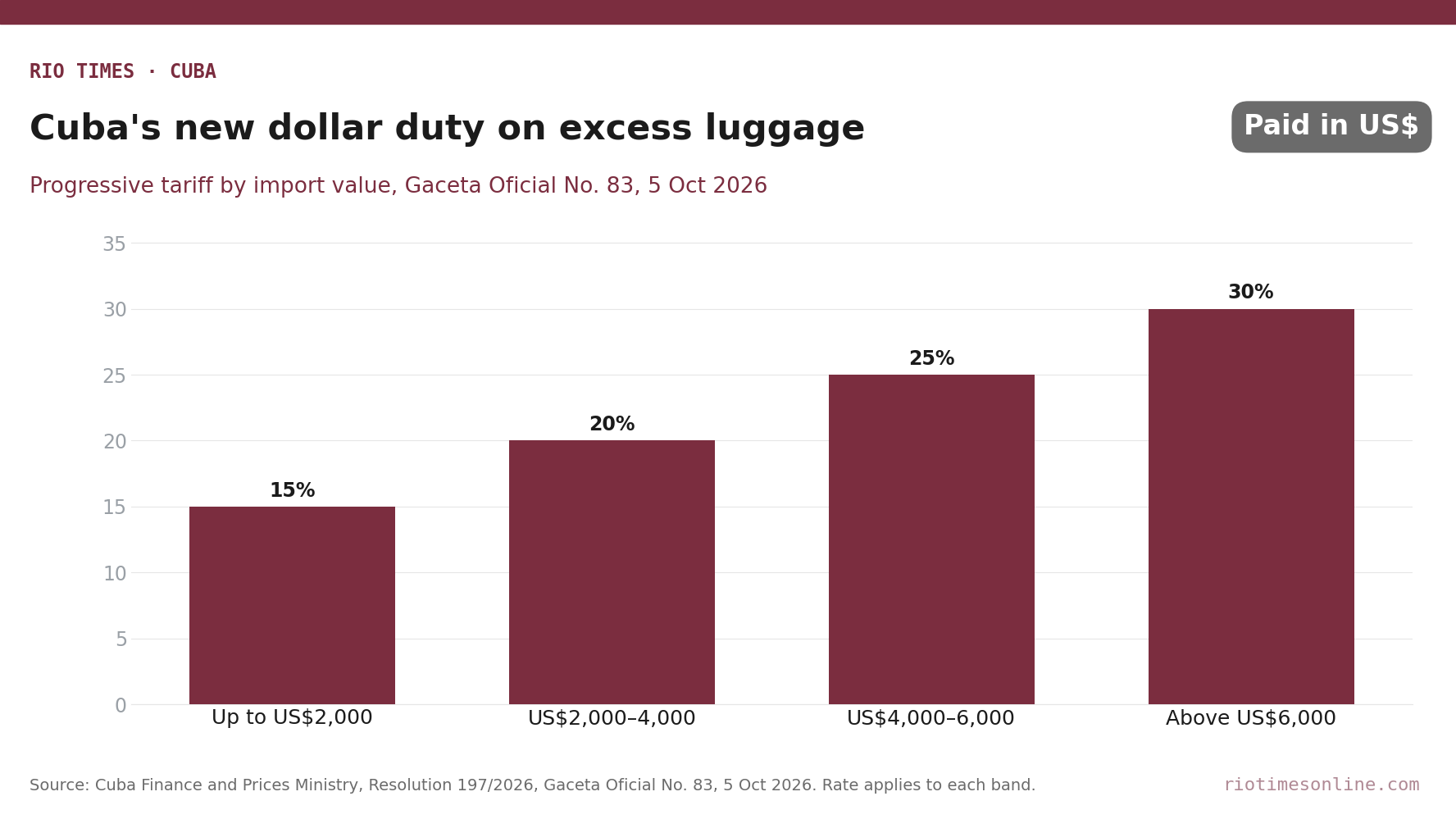
Travellers pay a progressive duty on the value of the goods they choose to clear. The rate is 15% up to US$2,000, then 20% up to US$4,000.
Value between US$4,000 and US$6,000 pays 25%, and anything above US$6,000 pays 30%. Goods sent as shipments rather than luggage pay a flat 30%.
On top of the duty comes a customs service fee, also in dollars. It runs from US$2 for goods worth up to US$200 to US$50 above US$6,000.
The paid clearance is a separate procedure, opened after the normal baggage check and only if the traveller agrees. Anyone who refuses to pay in dollars may ask to ship the goods back out.
If the traveller neither pays nor re-exports, customs applies the usual administrative measure. Goods held while payment is arranged stay in customs storage at the owner’s expense.
The resolution also states that this duty applies even to goods that enjoy tax breaks under other regimes. That matters because food, toiletries and medicine carried in luggage currently enter duty free.
The Limits on Phones and Appliances
Resolution 340 sets how many items Cuba customs treats as personal use. The gazette lets travellers bring up to five mobile phones, a figure Directorio Cubano also reported on Monday.
Computers, laptops and tablets are capped at three units in total. Household appliances are limited to two of the same type, and generators to two as well.
The resolution also lists reference values that customs uses to price goods. A mobile phone is valued at US$80, a laptop at US$250 and a household refrigerator at US$300.
Portable power stations, popular during Cuba’s long blackouts, are valued at US$300 to US$500 depending on capacity. Generators of up to 15 kVA run from US$200 to US$950.
Why Havana Is Doing This
The decree ties the change to the government’s programme of “economic and social transformations”. Its stated aim is to let individuals import goods commercially without this counting as foreign trade.
The stabilising side is clear enough. Travellers who overpack gain a legal, priced route in place of losing goods at the discretion of an officer.
The cost falls on those without dollars. Most Cubans are paid in pesos, so the channel mainly serves families with relatives abroad or access to hard currency.
For context on the economy, see Cuba Explained 2026: The Economy, the Exodus, the System and What to Watch. Travellers can also read Britain Revises Its Cuba Travel Advice: Bring Cash, Expect Blackouts.
What It Means for You
For Cuban Americans who carry goods to relatives, the rule turns a possible loss into a priced choice. Goods above the US$1,000 baggage limit can now be cleared by paying the dollar duty on the excess.
The US State Department says US credit and debit cards do not work in Cuba and advises bringing dollars or euros. Cuba requires travellers to declare cash above the equivalent of US$5,000.
US rules still apply on the American side. Americans may visit only under one of 12 travel categories set by the Treasury’s Office of Foreign Assets Control. Tourism remains banned under US law.
What Is Not Known
The texts take effect seven days after publication, but Cuba customs has not announced a start date for the airport desks. The procedure itself is left to the General Customs Office.
It is also unclear which payment methods the airport desks will accept. The gazette only says the duty and fees must be paid in US dollars.
Officers keep wide discretion to decide what looks commercial. How often they steer travellers into the paid channel, rather than waving goods through, will only show once the rules apply.
What changes for travellers arriving in Cuba?
Goods above the personal limits, or judged commercial, no longer have to be lost. Travellers can clear them as a commercial import by paying duty and fees in US dollars.
How much is the duty under the new Cuba customs rules?
For luggage, 15% on value up to US$2,000, 20% up to US$4,000, 25% up to US$6,000 and 30% above that. Shipments pay a flat 30%, plus a service fee of US$2 to US$50.
When do the new rules take effect?
The decree and both resolutions enter into force seven days after their publication in the Gaceta Oficial on 5 October 2026. Customs has not yet given details of the airport procedure.
Sources: Gaceta Oficial de la República de Cuba, Ordinary Edition No. 83, 5 October 2026 (Decree-Law 132/2026, Resolution 197/2026, Resolution 340/2026); Directorio Cubano, 5 October 2026; Directorio Cubano on duty-free food and medicine rules, July 2026; US Department of State, Cuba International Travel Information.
Editorial responsibility: Matthias Camenzind, Editor-in-Chief · Editorial standards · Report an error
LatAm Markets: Live Signals → — real-time movers, turnover leaders and FX across Latin America.





















 English (US) ·
  French (CA) ·
  French (FR) ·